Pescadero Basin Hydrothermal Vents: A Window into Extremophiles
Explore extremophiles in Pescadero Basin hydrothermal vents and their implications for astrobiology. Gain insights into unique ecosystems and potential extraterrestrial life forms.
Microbial Metabolism in Acidic Brines of Western Australia
Explore microbial metabolism in acidic brines of Western Australia, examining water activity limits, single-cell analysis, and implications for astrobiology and Mars analogs.
Examining Microbes and Biosignatures with Acidic Mars Analog Gypsum
Explore microbes and biosignatures in acidic Mars-like gypsum environments. Gain insights into astrobiology research and potential extraterrestrial life detection methods.
Mineralogy of Evaporites and Sediments in Phosphate-Rich Lakes - AbGradCon 2023
Explore mineralogy of evaporites and sediments in phosphate-rich lakes, focusing on hydrated minerals and their implications for astrobiology research.
Detecting Biosignature Molecules in Brines - Follow the Salt
Explore biosignature detection in brines through untargeted analysis, LIF, and microCHIP techniques. Gain insights into ATP concentration and classification methods for astrobiology research.
The Climates of G1514 b - AbGradCon 2023
Explore the climates of exoplanet G1514 b through cutting-edge astrobiology research presented by Héctor Delgado Díaz at AbGradCon 2023, fostering interdisciplinary collaboration in planetary science.
Differences in Climates and Transit Spectra of Habitable Planets
Explore differences in climates and transit spectra of habitable planets, focusing on key factors influencing planetary habitability and detection methods for exoplanets.
Machine Learning of Chemistry and Isotopologues of IRAS 16293-2422B
Explore machine learning applications in chemistry and isotopologue analysis of IRAS 16293-2422B, advancing astrobiology research and fostering interdisciplinary collaboration among early-career scientists.
A Model of Europa's Ice Shell and Its Effect on Ocean Circulation
Explore Europa's ice shell and its impact on ocean circulation through a cutting-edge model presented by Sara Miller at AbGradCon 2023, advancing our understanding of this intriguing Jovian moon.
Modeling a Subsurface Biosphere on Europa
Explore modeling techniques for Europa's potential subsurface biosphere, examining the possibilities of life in its ocean world environment.
Arabidopsis thaliana Response to the Spaceflight Environment
Explore Arabidopsis thaliana's response to spaceflight conditions in this astrobiology presentation, uncovering insights into plant adaptation and potential implications for space exploration.
Characterization and Automated Detection of Palimpsest Ripples
Explore automated detection of palimpsest ripples in astrobiology research, enhancing understanding of ancient sedimentary structures and their implications for early life on Earth and beyond.
Exploring the Molecular Limits of Life Using Assembly Theory - AbGradCon 2023
Explore molecular limits of life through Assembly Theory in this astrobiology talk. Gain insights into cutting-edge research on life's origins and potential extraterrestrial existence.
Earth Detecting Earth: Human Baselines for Technosignatures - AbGradCon 2023
Explore Earth's technosignatures and their potential for exoplanet detection. Gain insights into radio transmissions, laser leakage, and exoplanetary pollutants in astrobiology research.
Proton Irradiation Effects on Stable Chiral Amino Acid Radicals
Explore proton irradiation's impact on stable chiral amino acid radicals in astrobiology research. Gain insights into cutting-edge findings presented at AbGradCon 2023 by early-career scientist Máté Szarka.
Long Period Seismology on Titan - AbGradCon 2023
Explore long period seismology on Titan, focusing on NASA's Dragonfly mission, methane clathrates, and seismic wave propagation models to uncover the moon's interior structure.
Microscopy Methods for Life Detection on Icy Ocean Worlds
Explore microscopy techniques for detecting life on icy ocean worlds. Learn cutting-edge methods in astrobiology research and their applications in the search for extraterrestrial life.
AXE: A New Frontiers Enceladus Astrobiology Mission Concept Study - AbGradCon 2023
Explore Enceladus' potential for life through AXE mission concept study. Learn about plume formation, mission trajectory, and key objectives for this New Frontiers astrobiology mission.
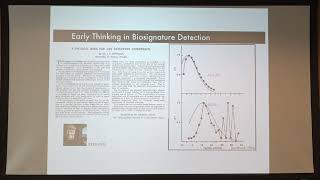
Geochemistry, Biosignature and Life Detection Techniques
Explore geochemistry, biosignatures, and life detection techniques with NASA expert Mary Beth Wilhelm in this insightful talk on ocean world microhabitats.
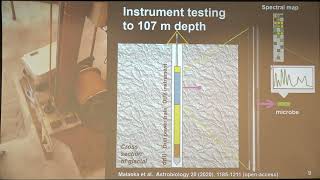
Ocean World Microhabitats 101 - Targeting and Life Detection Techniques
Explore microhabitats in ocean worlds, their potential for harboring life, and techniques for detecting and analyzing these environments in deep ice.
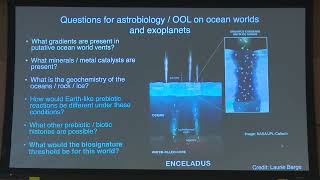
Searching for Life: General Motivation and Approaches
Explore the motivations and methods for searching extraterrestrial life through an expert's perspective from the Jet Propulsion Laboratory.