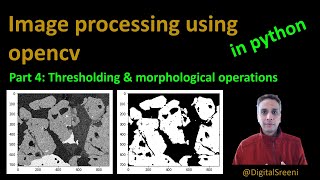
Thresholding and Morphological Operations Using OpenCV in Python
Learn to enhance image quality using OpenCV's thresholding and morphological operations for noise reduction and feature extraction in Python.

Denoising and Edge Detection Using OpenCV in Python
Learn OpenCV techniques for denoising microscope images and performing edge detection, with practical code examples for enhancing image quality without losing crucial information.
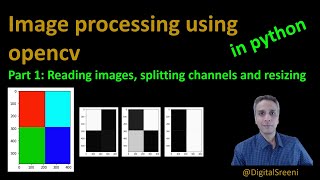
Reading Images, Splitting Channels, Resizing Using OpenCV in Python
Learn essential OpenCV operations for image processing: reading, resizing, and channel manipulation. Gain practical skills for computer vision and microscopy image analysis.
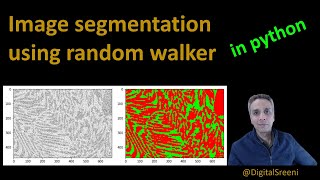
Random Walker Segmentation in Python
Explore Random Walker segmentation in Python for noisy BSE images, using markers and combining segments for effective alloy analysis.
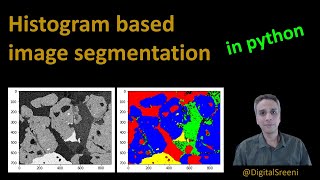
Histogram Based Image Segmentation in Python
Learn histogram-based image segmentation in Python for microscopy, covering thresholding techniques, feature extraction, and basic image processing operations to clean segmented regions.
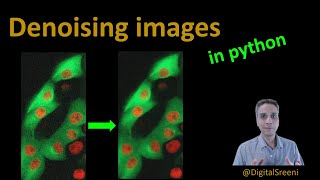
Denoising Microscope Images in Python
Learn techniques for denoising microscope images using Python, exploring algorithms from Scikit-image and NumPy libraries to extract relevant information and improve image quality.
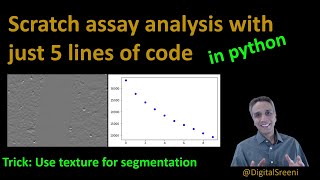
Scratch Assay Analysis With Just 5 Lines Code in Python
Learn to analyze scratch assays efficiently using Python, covering entropy filtering, Otsu thresholding, image processing, and result plotting in just 5 lines of code.
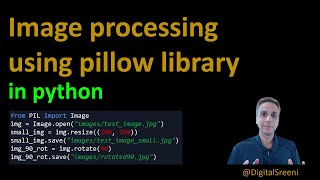
Image Processing Using Pillow in Python
Learn to manipulate images in Python using Pillow library. Covers resizing, cropping, rotating, flipping, and grayscale conversion with practical examples for multiple images.
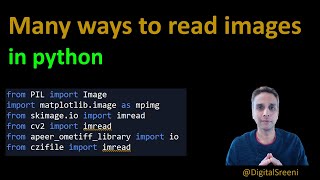
Reading Images in Python
Learn various methods to read images in Python, including standard formats and specialized scientific images like CZI and OME-TIFF, using popular libraries and techniques for efficient image processing.
Deep Generative Modeling
Explore deep generative modeling, including autoencoders, variational autoencoders, and GANs. Learn about latent variable models, reparameterization tricks, and recent advances in generative AI.
Convolutional Neural Networks
Explore convolutional neural networks for computer vision, covering feature extraction, network architecture, and real-world applications like self-driving cars in this comprehensive lecture.

MIT 6.S191 - Recurrent Neural Networks
Explore recurrent neural networks, LSTMs, and attention mechanisms for sequence modeling. Learn backpropagation through time, gradient issues, and practical applications in deep learning.

Introduction to Deep Learning
Comprehensive introduction to deep learning fundamentals, covering perceptrons, neural networks, loss functions, gradient descent, backpropagation, and regularization techniques.
MIT: Image Domain Transfer - NVIDIA Guest Lecture
Explore image domain transfer techniques, from artistic style transfer to multimodal translations, with applications in photo smoothing, seasonal transformations, and game engines.
Biologically Inspired Neural Networks
Explore biologically plausible learning algorithms for neural networks, inspired by brain function. Discover synaptic plasticity rules and their application in deep learning architectures.
MIT 6.S191 - Deep Learning Limitations and New Frontiers
Explore deep learning limitations, adversarial attacks, uncertainty quantification, and AutoML in this lecture. Gain insights into neural network challenges and emerging frontiers in AI research.
MIT: Deep Reinforcement Learning
Explore deep reinforcement learning concepts, algorithms, and applications, including Q-learning, policy gradients, and breakthroughs like AlphaGo and AlphaZero in game AI.
Deep Generative Modeling
Explore deep generative modeling, including autoencoders, VAEs, and GANs. Learn about latent variables, representation learning, and applications in image generation and domain transformation.

Convolutional Neural Networks
Explore convolutional neural networks for computer vision tasks, covering feature extraction, convolution operations, and applications in classification, segmentation, and image captioning.

MIT: Recurrent Neural Networks
Explore deep sequence modeling with recurrent neural networks, including LSTMs and attention mechanisms. Learn to tackle challenges like vanishing gradients and long-term dependencies in sequence tasks.

MIT: Introduction to Deep Learning
Foundations of deep learning: perceptrons, neural networks, loss functions, backpropagation, optimization techniques, and strategies to prevent overfitting in neural network training.