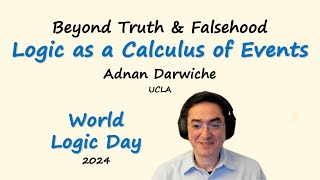
Beyond Truth and Falsehood - Logic as a Calculus of Events in AI
Explore logic's evolving role in AI, from truth calculus to event calculus, enabling advancements in probabilistic reasoning, machine learning, and explainable AI systems.
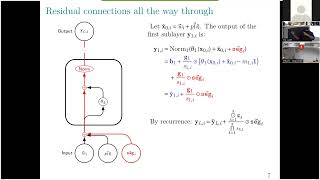
Linear Structures in Transformer Embedding Spaces
Explore linear structures in Transformer embedding spaces, examining anisotropy, BERT's next sentence prediction, layer behavior, and multi-head attention modules.
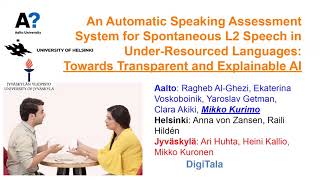
Automatic Speaking Assessment Systems for Second Language Learner's Spontaneous Speech in Under-Resourced Languages
Explore automatic speaking assessment for under-resourced languages, focusing on Finnish and Finland Swedish. Learn about system components, evaluation methods, and personalized feedback for language learners.
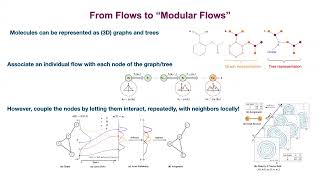
New Frontiers for AI-assisted Design and Discovery in Molecular Generation
Explore AI-assisted design for generating molecules with desired properties. Learn about overcoming challenges in combinatorial search, modeling interactions, and segregating representations for improved drug and material discovery.
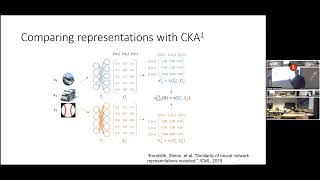
Comparing Representations Learned by Neural Networks - Deconfounded Similarity Measures
Explore improved methods for comparing neural network representations, addressing data structure confounding and enhancing functional similarity identification in transfer learning and out-of-distribution scenarios.
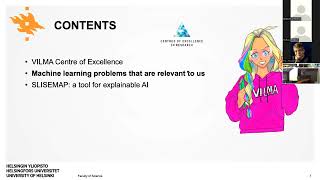
Explainable and Robust AI for VILMA Virtual Laboratory
Explore explainable AI and uncertainty quantification in atmospheric research. Learn about SLISEMAP, a supervised manifold visualization method for local explanations and dimensionality reduction.
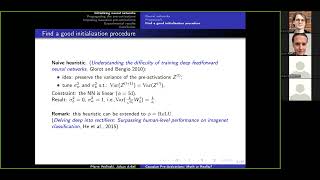
Gaussian Pre-Activations in Neural Networks: Myth or Reality?
Explore Gaussian pre-activations in neural networks, challenging common assumptions and proposing new initialization methods for improved information propagation in deep, narrow architectures.
Challenges in ML Engineering
Explore challenges in ML engineering, including cost-efficient inference, automation, accuracy monitoring, and anomaly detection for real-world AI applications.
New Frontiers for AI-assisted Design and Discovery in Molecular Generation
Explore AI-assisted design and discovery for generating molecules with desirable properties. Learn about overcoming challenges in combinatorial space, modeling interactions, and segregating representations for improved drug and material development.
Hierarchical Imitation Learning with Vector Quantized Models
Learn hierarchical imitation learning techniques using vector quantized models for complex decision-making tasks, exploring subgoal identification and planning strategies to outperform expert demonstrations.
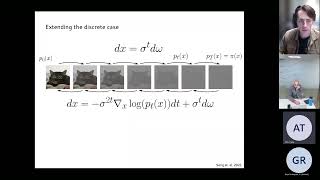
Elucidating the Design Space of Diffusion-Based Generative Models
Explore advancements in diffusion-based generative models, including improved sampling, training, and score network preconditioning. Learn about state-of-the-art results and modular design changes for enhanced efficiency and quality.
Total Variation Minimization Perspective on Trustworthy Federated Learning
Explore total variation minimization in federated learning, covering computational and statistical aspects for designing trustworthy systems across various FL flavors.
Scalable and Flexible Distributed Reinforcement Learning Systems
Explore scalable distributed reinforcement learning systems, focusing on flexible training loops, statement management, and GPU allocation. Gain insights into building efficient RLHF systems for large-scale applications.
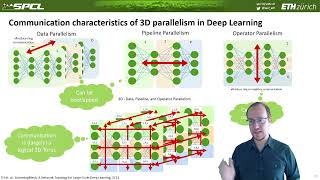
Post-Moore Spatial Computing: From Chips to Clusters
Explore spatial computing strategies for post-Moore's Law era, addressing challenges in scaling compute power from chips to clusters for AI and high-performance computing.
Efficient AI: From Supercomputers to Smartphones
Explore techniques for efficient AI training and inference, from data ingestion to model compression, enabling powerful models on supercomputers and smartphones.
HPC and AI/ML: A Synergistic Relationship
Explore synergies between HPC and AI/ML, focusing on scalable algorithms, efficient resource use, and data-driven models for performance optimization in large-scale computing environments.
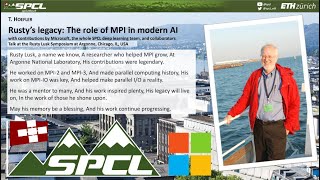
The Role of MPI in Modern AI - Rusty Lusk's Legacy
Explore MPI's crucial role in modern AI and its impact on parallel computing, honoring Rusty Lusk's contributions to the field.
AI-Driven Performance Metaprogramming - Embedding Spaces for Program Analysis and Optimization
Explore AI-driven performance metaprogramming using embedding spaces for programs. Learn to assess, analyze, and improve program performance through advanced AI methods.
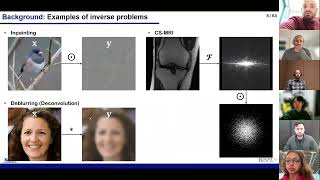
Diffusion Models for Inverse Problems
Explore advanced techniques for solving inverse problems using diffusion models, focusing on posterior sampling and manifold constraints.
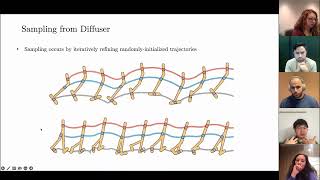
Planning with Diffusion for Flexible Behavior Synthesis
Learn flexible behavior synthesis using diffusion models for planning, exploring compositional trajectories, goal-directed planning, and offline reinforcement learning techniques.
Hierarchically Branched Diffusion Models for Efficient and Interpretable Multi-Class Conditional Generation
Explore efficient and interpretable multi-class conditional generation using hierarchically branched diffusion models. Gain insights into advanced generative techniques.