The Role of Conventions in Adaptive Human-AI Interaction
Explores partner modeling in multi-agent coordination, focusing on representation learning, conventions, and strategies for reducing non-stationarity in decentralized systems.
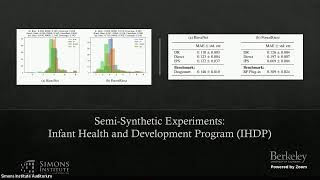
Orthogonal Statistical Learning
Explore statistical learning with nuisance parameters, focusing on excess risk guarantees and Neyman orthogonality. Discover applications in treatment effects, policy optimization, and more.
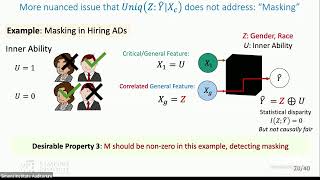
Algorithmic Fairness From The Lens Of Causality And Information Theory
Explore algorithmic fairness through causality and information theory, focusing on identifying and explaining sources of disparity in ML models and quantifying accuracy-fairness trade-offs.
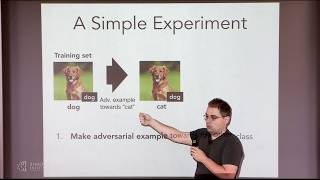
A New Perspective on Adversarial Perturbations
Explore adversarial perturbations in deep learning, their impact on ML models, and new perspectives on robustness, transferability, and data efficiency in AI systems.

Algorithmic Fairness and Quantum Computation
Experts discuss cutting-edge research in algorithmic fairness and quantum computation, exploring challenges, advancements, and potential impacts on technology and society.

AI Aspirations and Advances
Explore the latest AI developments and future aspirations with Microsoft's Eric Horvitz, delving into theoretical and practical implications for technology and society.

Towards Verification of General Neural Networks: A Dual Approach
Explore a dual approach for verifying general neural networks, focusing on mathematical and computational challenges in real-time decision making.

The Deep Learning Revolution: What Does It Tell Us About Our Understanding of Intelligence?
Explore the implications of deep learning on our understanding of intelligence, examining its revolutionary impact and potential insights into cognitive processes.
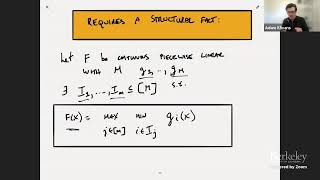
In Search of New Algorithms Part I - Neural Networks
Explore neural networks and their role in developing new algorithms, focusing on computational complexity and statistical inference challenges.

Answer Set Programming in a Nutshell
Explore Answer Set Programming's foundations, applications, and problem-solving capabilities in this comprehensive overview by expert Torsten Schaub from the University of Potsdam.
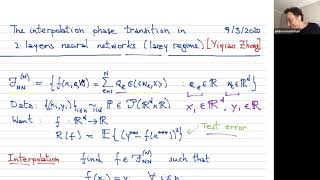
The Interpolation Phase Transition in Neural Networks - Memorization and Generalization Lazy Training
Explores overparametrization in neural networks, focusing on two-layer models in the neural tangent regime. Analyzes interpolation, optimization landscape, and generalization error under specific data assumptions.

Learning One-Hidden-Layer Neural Networks with Landscape Design
Explore optimization techniques for one-hidden-layer neural networks, focusing on landscape design and new objective functions to overcome traditional training challenges.

Solving Inverse Problems With Deep Neural Networks - Robustness Included?
Exploring robustness of deep learning in inverse problems, focusing on resilience against statistical noise and adversarial perturbations in image reconstruction tasks.
Build Your Own AI Chatbot with OpenAI API and Linode - A Step-by-Step Guide From Code With Harry
Step-by-step guide to building an AI chatbot using OpenAI API and Django, covering project setup, frontend development, API integration, and deployment on Linode.

Leaner and Greener AI with Quantization in PyTorch - Suraj Subramanian
Discover how quantization in PyTorch can make AI models lighter, faster, and more power-efficient without compromising accuracy. Learn techniques and workflows from an ML expert at Meta AI.

Deep Neural Networks for YouTube Recommendations
Explore deep neural networks for YouTube recommendations, analyzing the architecture and techniques used to enhance user experience and content discovery on the platform.
Fixing LLM Hallucinations with Retrieval Augmentation in LangChain
Learn to enhance LLM accuracy using retrieval augmentation in LangChain. Explore data preprocessing, embedding creation, vector database setup, and generative question-answering with citations for improved AI responses.
How EleutherAI Trains and Releases LLMs - Interview with Stella Biderman
Explore EleutherAI's approach to LLM development, covering model selection, training techniques, GPU choices, and interpretability challenges in this insightful interview with Stella Biderman.
Exotic Spheres and Singularities - Math Associates Seminar
Explore the fascinating journey from exotic spheres to Milnor's Fibration Theorem, a cornerstone in singularity theory, and its impact on complex hypersurface geometry and topology.
AI and Shared Prosperity
Exploring AI's role in promoting shared prosperity, addressing sociotechnical challenges, and fostering equality in technology benefits and risks across society.

F-Singularities - Applications of Characteristic P Methods to Singularity Theory
Explore applications of characteristic p methods in singularity theory, focusing on F-singularities and their implications in algebraic geometry and commutative algebra.