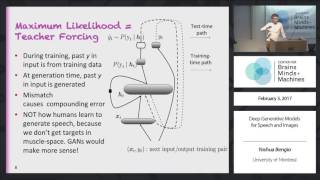
Deep Generative Models for Speech and Images
Explore deep learning's power in generating sounds and images, focusing on unsupervised learning and multiple levels of abstraction for advanced AI applications.

Unsupervised Learning of Spoken Language with Visual Context
Explores unsupervised learning of spoken language using visual context, aiming to develop ASR capabilities for more languages through audio-visual embedding and clustering techniques.

Connections Between Physics and Deep Learning
Explore the fascinating intersections of physics and deep learning, from neural networks to scale-invariant behavior, with insights from MIT's Max Tegmark.

Demis Hassabis: Towards General Artificial Intelligence
Explore cutting-edge AI research with DeepMind's CEO, covering breakthroughs like AlphaGo and potential impacts on science and healthcare. Gain insights into AI's future and its implications for understanding human cognition.

William Marshall – A Measure for Intrinsic Information
Explores a unique information measure reflecting intrinsic perspectives in communication, with implications for integrated information theory and consciousness.

OpenAI's CLIP for Zero Shot Image Classification
Explore OpenAI's CLIP model for flexible computer vision classification without retraining, enabling generalization to new classes and images beyond initial training data.

OpenAI CLIP Explained - Multi-modal ML
Explore OpenAI's CLIP model, bridging text and image understanding. Learn about multi-modal AI, CLIP's functionality, and its applications in encoding, classification, and object detection.

Bag of Visual Words for Image Classification and Retrieval
Learn to build image embeddings using the Bag of Visual Words technique for image retrieval, object detection, and classification in computer vision applications.
Vector-Based Methods for Similarity Search - TF-IDF, BM25, SBERT
Explore three vector-based approaches for language comparison and document similarity: TF-IDF, BM25, and Sentence-BERT. Learn key techniques for building effective search engines in AI and machine learning.

Sentiment Analysis on Any Length of Text With Transformers - Python
Learn to perform sentiment analysis on long texts using transformers in Python, overcoming token limitations through chunking and processing techniques for NLP tasks.
Build a Transformer for Language Classification in TensorFlow
Build a transformer-based sentiment classifier using HuggingFace's library in TensorFlow. Learn to download data, tokenize inputs, prepare datasets, define the model architecture, and train for multi-class sentiment analysis.

LangChain Agents Deep Dive with GPT 3.5 - LangChain
Explore LangChain agents to enhance LLMs with tools for logic, calculation, and search. Learn implementation, customization, and various agent types to superpower your AI applications.
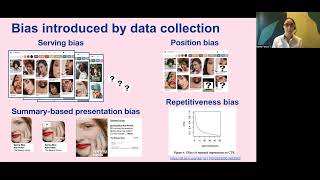
Inclusive Search and Recommendations
Explore inclusive AI in personalized discovery systems, focusing on fairness, diversity, and privacy. Learn strategies for reducing bias and implementing responsible AI in search and recommendation algorithms.
Face Recognition and Privacy: Balancing Technology and Personal Rights - 2019
Exploring face recognition technology, its applications, privacy implications, and global legislation. Dispels myths and discusses potential for privacy-preserving implementations of this identification method.
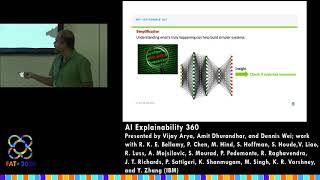
AI Explainability 360 - First Half of the Tutorial
Explore AI Explainability 360 toolkit: understand machine learning models, enhance transparency, and gain insights into AI decision-making processes for more responsible and ethical AI applications.

Self-Driving Car Simulation 2 - Collision Avoidance in Complex Environments
Explore collision avoidance techniques for self-driving cars through Unity simulations, focusing on raycast and centerline debugging methods for enhanced vehicle safety.
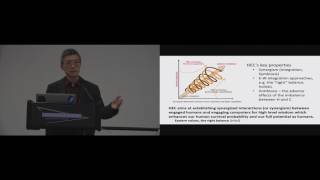
Human Computer Integration versus Powerful Tools
Experts debate the future of human-computer relationships, exploring symbiosis, integration, and powerful tools. Discusses implications for design, research, and society in this thought-provoking panel.

Building Realistic Machine Learning Systems for Security
Explore building robust machine learning systems for malware detection, addressing challenges like low false positive rates, polluted data, and realistic adversarial attacks in security applications.

Trustworthy Machine Learning: Challenges and Frameworks
Exploring the security challenges in machine learning, this talk discusses strategies for building trustworthy AI systems by analyzing data influence, addressing vulnerabilities, and enhancing interpretability.

Adversarial Examples in Machine Learning - Crafting and Defending Against Attacks
Explore machine learning vulnerabilities, adversarial examples, and their impact on system security. Learn crafting techniques and defenses through practical tutorials and real-world applications.

Kubernetes for AI Workloads - What Works and What Doesn't
Explore Kubernetes for AI workloads: benefits, challenges, and solutions. Learn to train deep learning models, use GPUs efficiently, and overcome K8s limitations in research environments.