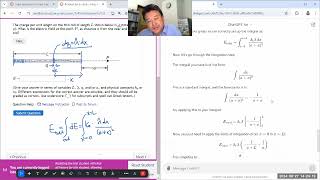
Physics 4B - Problem Solving with ChatGPT 4.0 - Set 5
Enhance problem-solving skills in physics using ChatGPT 4o, focusing on Set 5 exercises from PHYS 4B curriculum.
Alone in the Infinite? - Exploring Mankind's Place in the Universe
Explore compelling evidence suggesting we're not alone in the universe, backed by scientific research and projections of AI and technological advancements.
AI in Structural Biology: Roots of Success
Explore the history and impact of AI in protein structure prediction, focusing on AlphaFold 2's breakthrough and its implications for structural and cell biology research.
How Vision Succeeds in a Hidden World: Perception Beyond Physical Reality
Explore how vision succeeds despite hidden realities, challenging traditional views on perception and proposing an empirical approach to understanding visual processing.
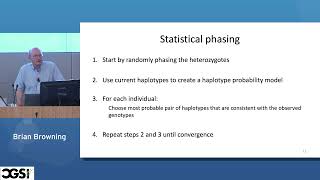
Haplotype Phasing: Methods and Accuracy
Explore haplotype phasing methods and accuracy with Professor Brian Browning. Learn about fast two-stage phasing, integrative estimation, and genotype error impacts on trio-based accuracy.
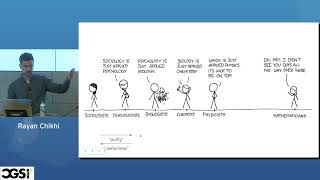
Living in the Future of Genomics
Explore cutting-edge genomics research and its future implications with insights from Rayan Chikhi at the Computational Genomics Summer Institute.
Generalized Biomolecular Modeling and Design with RoseTTAFold All-Atom
Explore advanced biomolecular modeling using RoseTTAFold All-Atom. Learn to predict and design complex biological assemblies, including proteins, nucleic acids, and small molecules, with applications in drug discovery and synthetic biology.
Harmonic Self-Conditioned Flow Matching for Multi-Ligand Docking and Binding Site Design
Explore advanced AI techniques for protein-ligand binding structure generation and binding site design, improving drug discovery and molecular interaction modeling.
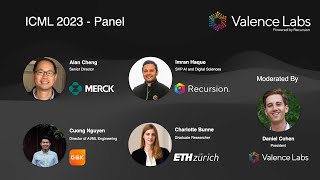
Fostering the Development of Impactful AI Models in Drug Discovery - ICML 2023 Panel
Explore challenges and solutions in bridging academic AI research with real-world drug discovery applications through expert panel insights on benchmarking, data sharing, and industry-academia collaboration.
Target Deconvolution Explanation - Lab 4
Explore target deconvolution techniques in drug discovery through hands-on lab exercises led by experts Ali Denton and Kristina Ulicna.
Accelerating Cryptic Pocket Discovery Using AlphaFold and Markov State Modeling
Explore cryptic pocket discovery using AlphaFold and Markov State Modelling. Learn about Plasmepsin II, transition states, and activation mechanisms in drug discovery.
Chemically Transferable Generative Backmapping of Coarse-Grained Proteins
Explore innovative machine learning techniques for generative backmapping of coarse-grained proteins, focusing on transferability, reliability, and efficiency in molecular simulations.

The Molecular Twin Platform: A Multi-Omic Approach for Predicting Accurate Clinical Outcomes
Explore a multi-omic AI platform combining tumor and host data to predict disease survival outcomes using advanced biomarker panels and machine learning techniques.
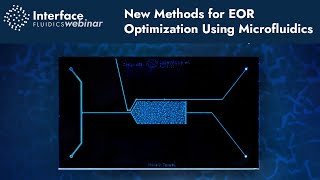
New Methods for EOR Optimization Using Microfluidics
Explore microfluidics-based optimization for heavy oil recovery, focusing on chemical spend efficiency and increased oil extraction in Alberta and Saskatchewan fields.
Towards Higher-level Abstractions for Molecular Programming
Explore higher-level abstractions for molecular programming using chemical reaction networks, inspired by functional reactive programming. Build modular CRN programs with a Haskell library.
Differentiable Simulations for Enhanced Sampling of Rare Events
Explore deep learning applications in molecular simulations, including surrogate functions, sampling complex distributions, and time-propagation of differential equations. Learn about active learning, generative models, and reaction path finding.
Molecule Representation Learning: A Perspective from Topology, Geometry, and Textual Description
Explore molecule representation learning through topology, geometry, and textual description. Gain insights into AI-driven drug discovery and molecular modeling techniques.

DiffDock: Diffusion Steps, Twists, and Turns for Molecular Docking
Explore DiffDock, a novel diffusion-based approach to molecular docking that outperforms traditional and deep learning methods in predicting ligand-protein binding structures for drug design.
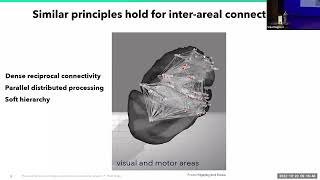
The Cerebral Cortex: A Delay Coupled Recurrent Oscillator Network - CCS22
Explore the cerebral cortex as a delay-coupled recurrent oscillator network in this insightful keynote by Wolf Singer at the Complex Systems Conference.
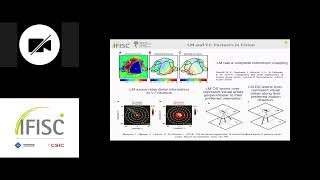
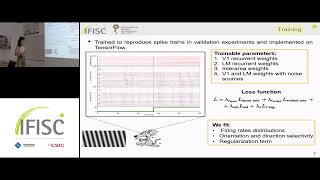
Integrating Biology and AI: Enhancing Recurrent Networks of Spiking Neurons for Visual Information
Explore the fusion of biology and AI, focusing on enhancing recurrent networks of spiking neurons for visual processing and information analysis.
Understanding the Role of Top-Down Input in Visual Information Processing
Explore how top-down input influences visual information processing, examining its impact on perception and cognitive functions.