Goemans-Williamson: Rounding the Max-Cut SDP - Lecture 20a of CS Theory Toolkit
Efficient algorithm for approximating maximum graph cuts using semidefinite programming and randomized rounding, with guaranteed performance ratio of 0.878.

Learning from Data: The Two Cultures
Explore statistical and task modeling approaches in AI, their strengths, limitations, and the importance of integrating principles from both cultures for more robust and responsible machine learning.
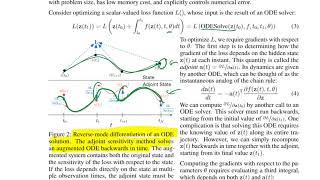
Neural Ordinary Differential Equations
Explore continuous-depth neural networks using differential equations, offering advantages in memory efficiency, adaptive evaluation, and numerical precision-speed tradeoffs for various machine learning tasks.
Sense-Making - Accounting for Intelligibility - IPAM at UCLA
Exploring mathematical accounting systems for collective intelligence, focusing on sense-making as a key component in understanding and articulating the phenomenon of intelligence.

Categories - The Mathematics of Connection - IPAM at UCLA
Explore the mathematics of connection through category theory, focusing on open systems, their interfaces, and composition. Learn how this approach applies to various fields and collective intelligence.
Collective Intelligence as Collective Computation - Future Directions
Explore collective intelligence as computation, examining principles of information processing, dimension reduction, and emergent phenomena in biological and social systems.
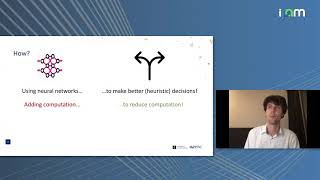
Deep Learning for Combinatorial Optimization - Count Your Flops & Make Your Flops Count
Explores deep learning for combinatorial optimization, focusing on reducing computation through learned models while balancing solution quality. Discusses practical examples, challenges, and future research directions.
Machine Learned Regularisation for Solving Inverse Problems
Machine learned regularization techniques for solving inverse problems, focusing on image reconstruction from tomographic and blurred measurements. Explores data-driven approaches and discusses open mathematical challenges.
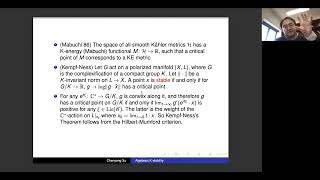
K-Stability of Fano Varieties
Explores K-stability of Fano varieties, connecting complex geometry and algebraic geometry. Discusses recent developments, including solved conjectures and the construction of a moduli space for Fano varieties.
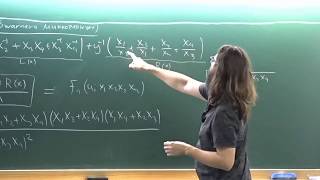
Mirror Symmetry for Character Varieties and Field Theory by Sergey Galkin
Explore mirror symmetry for character varieties, using threespace mirrors to construct SU(2) character variety mirrors on Riemann surfaces, with applications in topological field theory and random walks.
The Pitfalls of Using ML-Based Optimization - IPAM at UCLA
Explore pitfalls of ML-based optimization in graph problems, comparing traditional approaches for Force Path Cut and Hypergraph Discovery. Gain insights on limitations and potential improvements in AI applications.
Learning How to Break Symmetry With Symmetry-Preserving Neural Networks - IPAM at UCLA
Explore symmetry-preserving neural networks for data efficiency and generalization, learning symmetry-breaking information, and predicting structural distortions in crystalline materials.
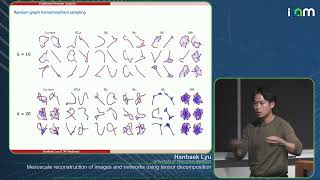
Mesoscale Reconstruction of Images and Networks Using Tensor Decomposition
Explore mesoscale reconstruction of images and networks using tensor decomposition, focusing on a unified framework, error bounds, and online CP-dictionary learning for multi-modal datasets.
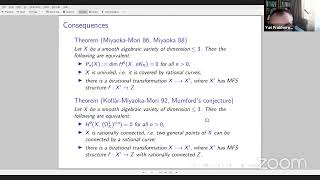
Yuri Prokhorov - Effective Results in the Three-Dimensional Minimal Model Program
Explore recent developments in 3D minimal model program, covering basic operations, terminal singularities, classification strategies, and effective boundedness of Q-Fano 3-folds.
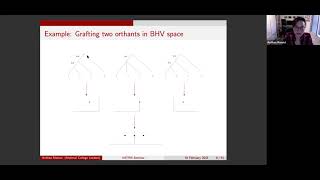
Tropical Geometry of Phylogenetic Tree Spaces
Explore tropical geometry's application to phylogenetic tree spaces, examining BHV space, tropical Grassmannians, and their implications for computational biology and statistics.
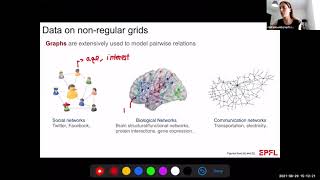
Simplicial Neural Networks
Explore simplicial neural networks, a generalization of graph neural networks for multi-dimensional data, and their applications in imputing missing data on coauthorship complexes.
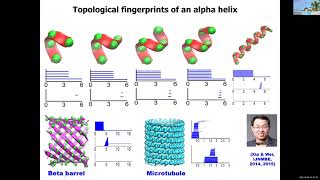
How Math and AI Are Revolutionizing Biosciences
Exploring how mathematics and AI revolutionize biosciences, focusing on tackling challenges in biological data complexity, dimensionality, and nonlinearity to enhance AI's capabilities in drug design and viral mutation prediction.
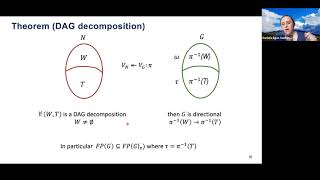
Nerve Theorems for Fixed Points of Neural Networks
Explore how network connectivity shapes neural activity using combinatorial threshold-linear networks. Learn about nerve theorems and their application in understanding fixed points of large neural networks.
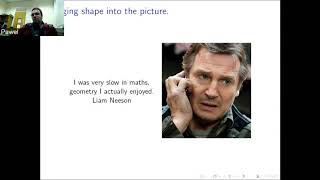
Pawel Dlotko - A Few Simple Stories on Topology in Action
Explore practical applications of computational topology in material science, dynamical systems, and brain research. Learn how theory and algorithms work together to solve real-world problems.
Chad Giusti - Topology, Convexity, and Neural Networks
Explore topology in neuroscience, focusing on receptive fields, neuron convexity, and geometric features. Discover connections between neural networks and mathematical concepts.
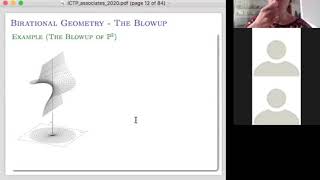
Symmetries in Algebraic Geometry and the Cremona Group
Explore symmetries in algebraic geometry, focusing on automorphisms and birational self-maps of projective varieties. Delve into the Cremona group and its subgroups, with insights from recent research.