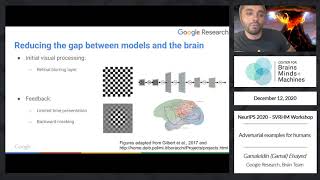
Adversarial Examples for Humans
Explore blackbox adversary attacks, system methodology, and class conditions in adversarial examples for AI systems.
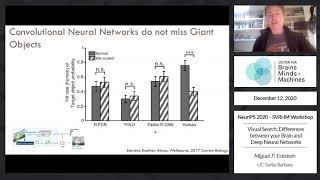
Visual Search - Differences Between Your Brain and Deep Neural Networks
Explore how human visual perception differs from deep neural networks, examining experiments, results, and implications for fields like medical imaging.
Is There Anything Special About Human Intelligence? - Vs. Non-Human Animals, Vs. Machines
Explore human intelligence compared to animals and machines in this panel discussion, examining unique cognitive abilities, language, abstract thinking, and self-awareness.
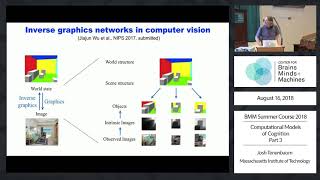
Computational Models of Cognition - Part 3
Explore cognitive models, inverse graphics, and Bayesian learning in this advanced lecture on computational approaches to understanding the mind and brain.
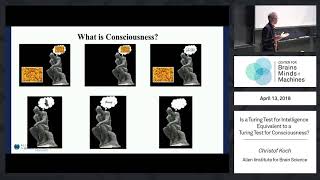
Is a Turing Test for Intelligence Equivalent to a Turing Test for Consciousness?
Explore the distinction between intelligence and consciousness in AI systems, examining neural correlates, theories of consciousness, and implications for future technology.
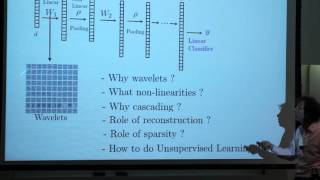
Scattering Bricks to Build Invariants for Perception - Part 1
Explore high-dimensional classification, wavelet transforms, and deep convolution networks for stable translation invariants in image processing and texture classification.
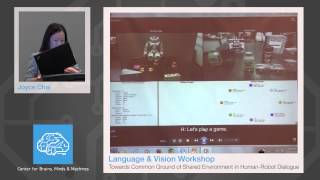
Human-Human Communication
Explore human-human communication principles and their application to human-robot dialogue, focusing on referential grounding, collaborative effort, and empirical studies using NAO robots.
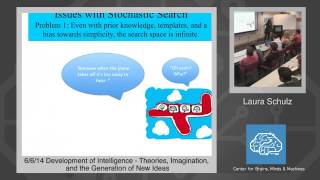
Development of Intelligence - Tomer Ullman vs. Laura Schulz Debate
Debate exploring theories of intelligence development, comparing stochastic search models with goal-oriented hypothesis generation and the role of imagination in cognitive processes.
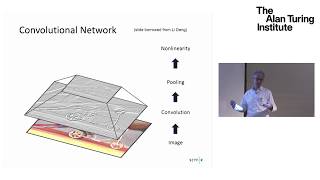
Artificial Intelligence per Kilowatt-Hour - Max Welling, University of Amsterdam
Explore cutting-edge AI efficiency: compressing neural nets, low-precision computing, and spiking networks to maximize intelligence per kilowatt-hour as AI moves to edge devices.
A Photoacoustic Airborne Sonar System
Innovative airborne sonar system using photoacoustic effect for high-throughput underwater imaging, bridging gap between aerial and underwater sensing technologies.
Robotics Seminar - Bradley Hayes - University of Colorado Boulder
Explainable AI techniques for human-robot collaboration, focusing on shared expectations, interpretable models, and safe task planning to create trustworthy autonomous teammates in various domains.
Fall 2019 Robotics Seminar - NVIDIA Robotics Lab Part II
Explore NVIDIA's AI-driven robotics research, focusing on robot manipulation, physics simulation, and perception. Discover breakthroughs in manufacturing, logistics, and healthcare industries.
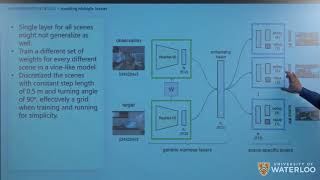
Target-Driven Visual Navigation
Explore target-driven visual navigation techniques, including architectures, experiments, and real-world robot applications for efficient and adaptable navigation systems.

When Biology Moves to Engineering
Exploring AI's role in transforming biology from empirical science to engineering, enabling better diagnostics and biological circuit design for improved healthcare and drug discovery.

Software Secures the World
Explore evolving security threats and strategies in the digital age, from medieval walls to AI-driven solutions. Learn how CEOs and CSOs can adapt to new challenges in cloud computing and complex systems.
Data for Disaster Management - Steven Reece
Explore machine learning approaches for data fusion in disaster management, combining diverse sources to enhance situation awareness and improve response effectiveness.
Data Debate - Cyber Attacks: Is Artificial Intelligence the New Defence?
Explore the evolving landscape of cyber threats and AI's potential role in defense. Expert panel discusses challenges, implications, and strategies for securing cyberspace in an era of rapid technological change.
The Primitives of Legal Protection Against Data Totalitarianisms - Professor Mireille Hildebrandt
Explore legal protections against data-driven totalitarianism, examining concepts like consent, purpose limitation, and contestability in the context of AI and data processing regulations.
Mel-Frequency Cepstral Coefficients Explained Easily
Explore Mel-Frequency Cepstral Coefficients (MFCCs) in audio processing, covering their history, computation, visualization, and applications in speech and music analysis.
How to Select a Research Topic for Your Paper
Learn effective strategies for selecting engaging AI audio research topics, from brainstorming concepts to developing research questions and approaches, ensuring your paper aligns with conference themes and personal interests.
Do Great Minds Think Alike? - Tackling Trafficking with Tech
Experts discuss AI's potential to combat modern slavery, exploring challenges in law enforcement, international collaboration, and ethical considerations for technology-driven solutions.