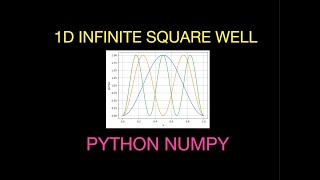
Solving Schrödinger's Equation as an Eigenvalue Problem with Numpy
Explore numerical solutions to the 1D infinite square well using Python's NumPy library and the finite difference method for Schrödinger's equation.
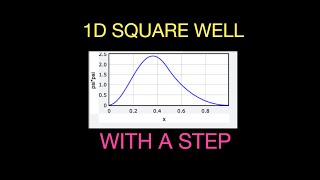
1D Square Well with Step Potential - Shooting Method
Solve 1D square well with step potential numerically using Python's shooting method. Explore infinite potential walls and half-step potential.
Using a Bunch of Balls to Model the Ideal Gas Law in Python
Model the ideal gas law with bouncing balls in Python and calculate pressure and temperature.
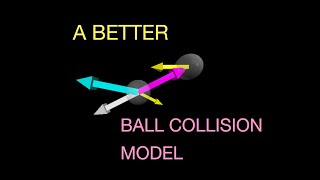
Building a Better Ball Collision Model for Solar System Simulation in Python
Improve ball collision modeling for a flat solar system simulation, focusing on conservation of momentum and angular momentum.

Which String Breaks First? Modeling a Physics Demo with Python
Model a physics demo of two strings supporting a mass using Python to determine which string breaks first when pulled.

Two Ways to Calculate the Change in Potential Near a Dipole
Explore two methods for calculating potential change near a dipole: using electric field expression and numerical computation with Python.
Finding the Value of Pi from a Random Walk Using Python
Explore Python coding to calculate pi using random walks, from 1D to 3D simulations. Enhance mathematical understanding through practical programming.
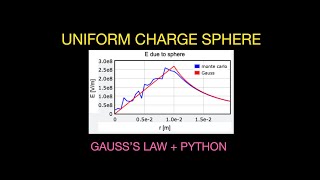
Electric Field due to Uniform Sphere - Gauss's Law and Python Simulation
Explore electric fields of uniformly charged spheres using Gauss's law and Python simulation with 10,000 random points for precise calculations.
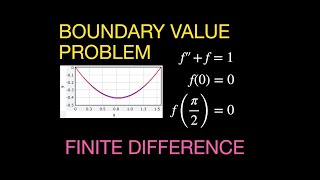
Solving a Boundary Value Problem with the Finite Difference Method - Python
Implement finite difference method in Python to solve boundary value problems for differential equations. Learn practical numerical techniques.
Modeling Projectile Motion: How Far Can a Football Be Thrown From a Building?
Explore projectile motion modeling, analyzing Peyton Manning's football throw from a building with and without air resistance using Python simulations.
The Eigenvalue Problem: An Example with Rigid Body Rotations and Python
Explore rigid body rotations using Python, solving the eigenvalue problem to find principal axes and animating results with Web VPython.
Python Physics: Modeling the Motion of a Coffee Filter with Air Drag
Model coffee filter motion with air drag using Python, breaking complex physics into manageable time intervals for accurate simulations.
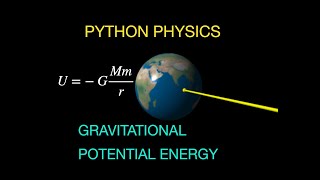
Python Physics: Object Falling to Earth and Gravitational Potential Energy
Model an object falling to Earth, exploring gravitational potential energy and the relationship between work done by changing gravitational force and kinetic energy change.
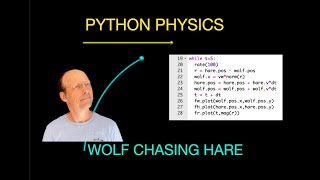
Python Physics: Modeling the Wolf and Hare Problem
Model wolf-hare chase dynamics using Python, exploring predator-prey motion patterns and computational problem-solving in physics simulations.

Introduction to Sensitivity Analysis - Week 12
Explore sensitivity analysis techniques to assess how changes in input variables affect model outcomes and decision-making processes.
Physics Informed Neural Networks - BC Incorporation
Explore Physics Informed Neural Networks and learn techniques for incorporating boundary conditions in these advanced machine learning models.

Offline Bayesian Estimation - MATLAB Demo
Explore offline Bayesian estimation techniques through hands-on MATLAB demonstrations and practical applications.
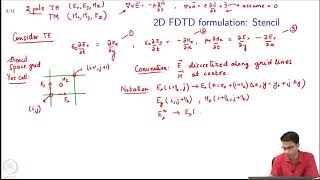
Finite Difference Time Domain Methods: 2D FDTD Formulation and Stencil
Explore 2D FDTD formulation and stencil techniques in finite difference time domain methods for electromagnetic wave simulation.
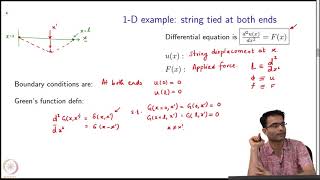
Introduction to Green's Function - A One-Dimensional Example
Explore Green's Function through a one-dimensional example, gaining insights into this mathematical concept and its applications in physics and engineering.
Code Walkthrough for PINNs in Burgers Equation
Explore Physics-Informed Neural Networks (PINNs) applied to the Burgers equation through a detailed code walkthrough.
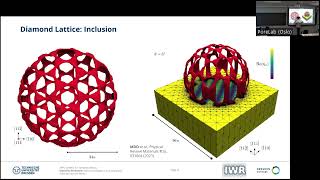
Amplitude Phase-Field Crystal Model for Complex Lattices
Explore complex lattice structures using the amplitude phase-field crystal model, focusing on advanced computational techniques and applications in materials science.