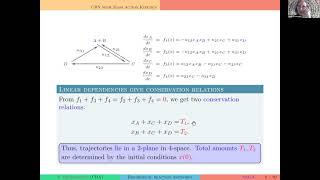
Families of Polynomials in Biochemical Reaction Networks
Exploring polynomial systems in biochemical reaction networks, focusing on computational techniques for analyzing families of polynomials with combinatorial structures derived from reaction digraphs.
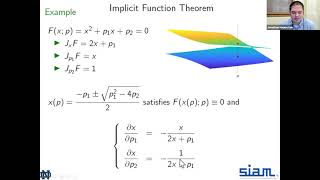
Applications of Homotopy Continuation in Science and Engineering
Explore homotopy continuation in numerical algebraic geometry and its applications in chemistry, mechanical engineering, and biological modeling. Learn about tracking solutions to parameterized nonlinear equations.
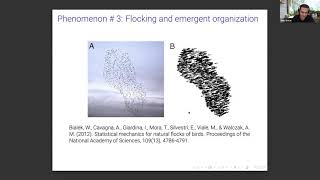
Comprehensive Fluids, Entropy Hierarchies, and Flocking - SIAM PDE Seminar
Exploring compressible fluid equations, entropy hierarchies, and flocking dynamics. Covers Navier-Stokes models, nonlocal collective dynamics, and mathematical proofs for fluid behavior and emergent organization.
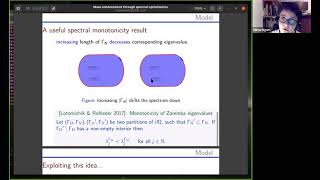
Wave Enhancement Through Spectral Optimization - 33rd IMAGINE Seminar
Explore efficient optimization of wave transmission in cavities through boundary condition adjustments, using spectral analysis and layer potential methods for accurate eigenvalue calculations.
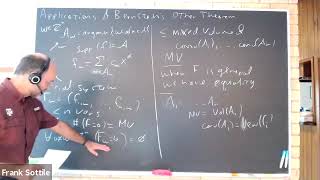
Applications of Bernstein's Other Theorem in Geometry and Algebra
Explore applications of Bernstein's Other Theorem in polynomial systems, focusing on non-general yet Bernstein-general cases from various fields, and their optimal solution methods.
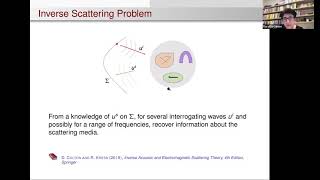
Spectral Problems in Inverse Scattering Theory - 21st IMAGINE OneWorld SIAM-IS Seminar
Explore scattering theory's spectral problems, focusing on poles, non-scattering frequencies, and transmission eigenvalues. Learn how these relate to scattering operators and material properties in inhomogeneous media.
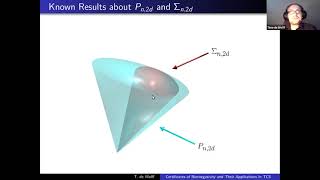
Certificates of Nonnegativity and Their Applications in Theoretical Computer Science
Explore nonnegativity certificates in real algebraic geometry, focusing on sums of squares and sums of nonnegative circuit polynomials, with applications to polynomial optimization and theoretical computer science.
Mathematics in Computer Animation - Pixar's Approach
Pixar engineer explores mathematical techniques behind computer-animated effects, including dynamic simulations for clothing, hair, and 3D interactive animation, showcasing real-world applications in film production.
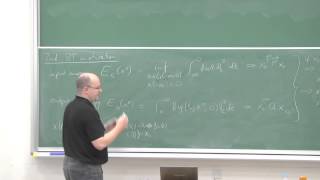
Matrix Equations and Model Reduction - Lecture 4
Explore matrix equations and model reduction techniques, focusing on SR method, high multiplicity, and theoretical background with renowned expert Peter Benner.
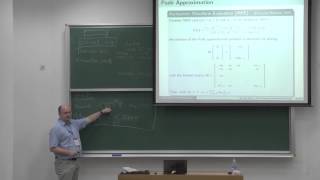
Matrix Equations and Model Reduction - Lecture 3
Explore matrix equations and model reduction techniques with Peter Benner, covering enrichment, polar residual form, transfer functions, and moment matching for efficient system analysis.
New Frontiers in Topology: Multilevel Systems and Out-of-Equilibrium Dynamics - Lecture 2
Explore advanced topology concepts in multilevel systems and out-of-equilibrium phenomena. Delve into complex theoretical physics and gain insights from cutting-edge research in this field.
Introduction to Theory and Numerics of Partial Differential Equations - Lecture 5
Explore numerical methods for solving partial differential equations, focusing on techniques essential for gravitational wave astronomy and computational relativity.

Introduction to Theory and Numerics of Partial Differential Equations - Lecture 2
Explore numerical methods for solving partial differential equations, focusing on techniques essential for gravitational wave astronomy and computational relativity.
Introduction to Theory and Numerics of Partial Differential Equations - Lecture 3
Explore numerical methods for solving partial differential equations, focusing on techniques essential for gravitational wave astronomy and computational relativity.
Introduction to Theory and Numerics of Partial Differential Equations - Lecture 1
Explore fundamental concepts and numerical techniques for solving partial differential equations, essential for modeling complex physical phenomena in gravitational-wave astronomy and astrophysics.
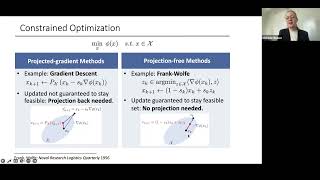
Exploiting Geometric Structure in Matrix-Valued Optimization
Exploring optimization on matrix manifolds, introducing Riemannian Frank-Wolfe methods for constrained problems, and discussing applications in machine learning and mathematics.
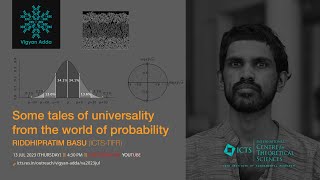
Some Tales of Universality from the World of Probability by Riddhipratim Basu
Explore universality in probability theory, from the central limit theorem to contemporary research, examining how complex systems share large-scale features despite microscopic differences.

Statistics for Data Analysis with Exercises - Lecture 3
Explore advanced statistical methods for data analysis in high-energy physics, focusing on practical applications and exercises to enhance understanding and skills in this specialized field.
An Age-Structured Model of COVID-19 Transmission with Optimal Vaccination
Explore an age-structured model for COVID-19 transmission and optimal vaccination strategies, presented by Polly Sy as part of the inaugural Asian-Oceanian Women in Mathematics meeting.
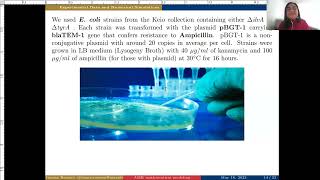
Mathematical Modeling of AMR in Complex Microbial Communities
Explore mathematical approaches to model antimicrobial resistance in complex microbial ecosystems, focusing on advanced techniques and their applications in public health.
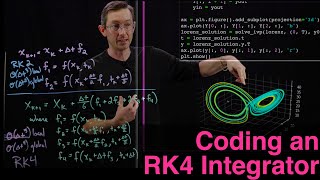
Coding a Fourth-Order Runge-Kutta Integrator in Python and Matlab
Learn to implement a 4th-order Runge-Kutta integrator in Python and Matlab, and apply it to simulate the chaotic Lorenz 1963 system. Gain practical coding skills for numerical integration.