Approximation Theory of Deep Learning from the Dynamical Viewpoint
Explore deep learning approximation theory from a dynamical perspective, covering supervised learning, universal approximation, sequence modeling, and insights on various neural network architectures.
Deep Learning for Nonlinear Stability Analysis in Dynamical Systems
Explore deep learning techniques for analyzing nonlinear stability in dynamical systems, presented by Bogdan Epureanu from the University of Michigan.
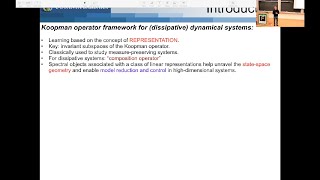
Koopman Operator Theory Based Machine Learning of Dynamical Systems
Explore advanced machine learning techniques for dynamical systems using Koopman operator theory, presented by Igor Mezic from UC Santa Barbara.
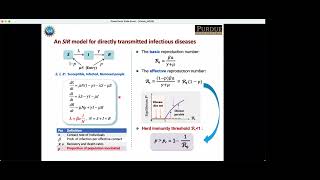
Mathematical Models of Infectious Diseases - Consequences of Underlying Assumption
Explore the impact of underlying assumptions in mathematical models of infectious diseases, examining their consequences for disease dynamics and control strategies.
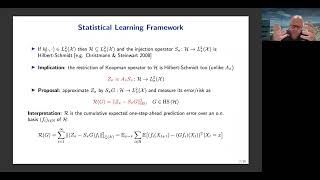
Learning Dynamical Systems via Koopman Operator Regression in Reproducing Kernel Hilbert Spaces
Explore Koopman operator regression in reproducing kernel Hilbert spaces for dynamical systems, enhancing understanding of machine learning applications in complex systems analysis.
Some Mathematical Insights About Traveling Waves
Explore mathematical insights on traveling waves, focusing on their applications in range expansion and evolutionary processes.
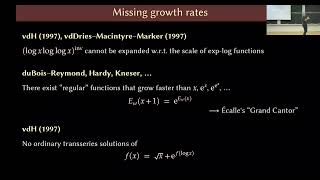
Toward a Unification of Infinities
Explore the concept of unifying different types of infinities in mathematics, delving into advanced theoretical frameworks and their implications for transseries and dynamical systems.
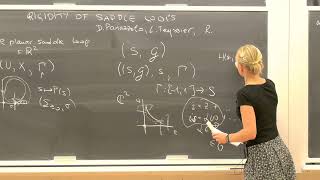
Rigidity of Saddle Loops
Explore the mathematical concept of rigidity in saddle loops, focusing on their properties and applications in dynamical systems theory.
Holomorphic Continuation of R_an,exp - Germs: The Missing Lecture
Explore holomorphic continuation of R_an,exp-germs in this advanced mathematics lecture, delving into complex analysis and dynamical systems.

The Absolute Model Companionship Spectrum of a Mathematical Theory and the Continuum Problem
Explore the Continuum problem and mathematical theory's Model Companionship Spectrum with Matteo Viale, delving into existentially closed models and absolute model companionship concepts.
Smooth Dynamic vs Symbolic Dynamic
Explore the interplay between smooth and symbolic dynamics in this advanced mathematics lecture by Olivier Mathieu, delving into complex theoretical concepts and their applications.
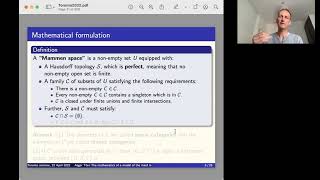
The Mathematics of a Model of the Mind in Psychology
Explore the mathematical foundations underlying psychological models of the mind, delving into set theory and its applications in cognitive science.
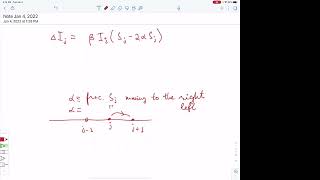
Modelling of Disease Spread Through Heterogeneous Population
Explore spatial variability in disease spread using PDEs with state-dependent diffusion. Examine density-dependent infection rates and super-diffusive propagation, with a case study on coronavirus in Nova Scotia.

Investigating Transmission-Blocking Anti-malarial Drugs: A Mathematical Modelling Approach
Explore mathematical models assessing transmission-blocking antimalarial drugs' impact on disease control, focusing on treatment coverage, drug efficacy, and protective effects in malaria hotspots.
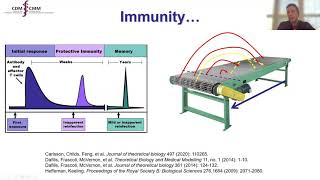
Modelling Immunity
Explore mathematical models of immunity generation and waning, fitted to data for estimating seroprevalence in Canadian jurisdictions, with applications to COVID-19 vaccination programs.
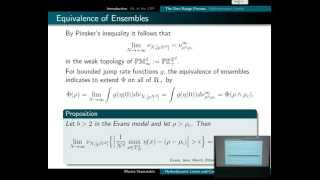
Hydrodynamic Limits and Condensing Zero Range Processes
Explore hydrodynamic limits and condensing zero range processes in interacting particle systems. Learn about phase separation, relative entropy method, and non-closed hydrodynamic descriptions.
Non Linear Programming
Explore advanced optimization techniques including convex, quadratic, separable, geometric, and dynamic programming, as well as search methods and numerical integration.
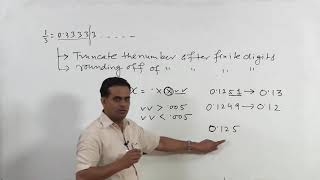
Numerical Methods
Comprehensive exploration of numerical methods covering error analysis, linear systems, interpolation, differentiation, integration, and solving algebraic equations using various techniques.

Best Practice From Julia - Impact Through Efficient Research Code
Explore Julia's impact on efficient research code, from self-driving cars to astronomy. Learn about cutting-edge tools for mathematical modeling and machine learning in various fields.

Promoting Global Stability in Models of Quadratic Nonlinear Dynamic
Explore innovative algorithm for identifying globally stable fluid and plasma flow models, featuring presentation and Q&A on recent research in nonlinear dynamics and vortex shedding.
Pendulum Simulation: In Search of Chaos - Part 6
Explore chaos in double pendulum systems through simulation, analyzing different initial conditions and observing complex behavior patterns.