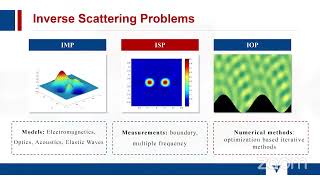
Mathematical Analysis and Numerical Methods for Inverse Scattering Problems
Explore mathematical analysis and numerical methods for inverse scattering problems, covering applications, challenges, algorithms, and recent progress in stability analysis and deep learning approaches.
Kathryn Mann- Groups Acting at Infinity
Explore rigidity in group actions, lattices, and infinity, with applications to surface groups, boundaries, and Anosov flows. Gain insights into mathematical concepts and their interconnections.
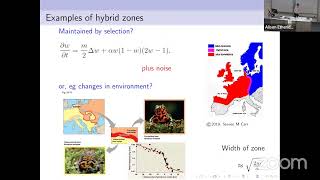
The Motion of Hybrid Zones - And How to Stop Them
Explore mathematical models of hybrid zones in population genetics, including deterministic approximations, curvature flow, and probabilistic proofs, with applications to invasions and blocking.
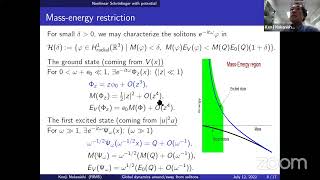
Kenji Nakanishi - Global Dynamics Around and Away From Solitons
Explore global dynamics of nonlinear dispersive PDEs, focusing on solitons in Klein-Gordon and Schrödinger equations. Analyze stability, multi-soliton interactions, and open questions in soliton behavior.
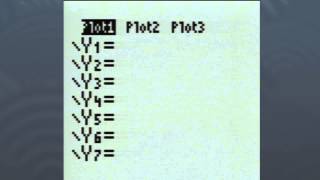
The Box Problem: Optimizing Volume in Rectangular Cardboard Boxes - Grades 8-9
Explore volume optimization through 'The Box Problem'. Investigate using models, tables, and graphs. Learn to define variables, write functions, and use graphing calculators for advanced analysis.
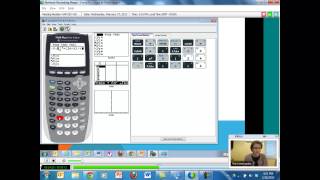
Using Functions to Build Models - Math Teacher Professional Development
Hands-on exploration of mathematical modeling using real-world problems, connecting concepts across Math I to Calculus. Focuses on function creation, domain analysis, and student engagement techniques.
Distinguishing Between Linear and Exponential Growth in Mathematics - Real-World Applications
Explore real-world applications of linear and exponential growth through population and food production data, using calculators for analysis and modeling in mathematics.
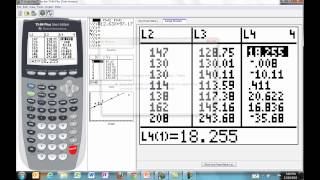
Linear Data Analysis for Math Common Core Standards - Part 3
Explore linear functions for real-world data modeling, focusing on slope and intercept interpretation, linear regression, and residual analysis using interactive tools and practical examples.

Convex Sunflower Theorems and Neural Codes
Explore convex sunflower theorems and neural codes, connecting neuroscience with discrete geometry to understand place cell encoding and cognitive mapping in rat hippocampus.
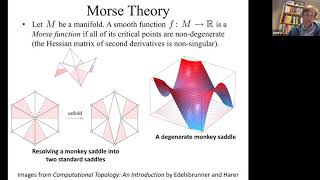
Henry Adams and Enrique Alvarado - An Introduction to Morse Theory
Explore Morse theory's applications in topology, including CW complexes, key theorems, and simplification techniques, with real-world examples in material science.
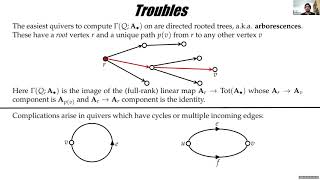
Vidit Nanda - Principal Components Along Quiver Representations
Principal components analysis for quiver representations: dimensionality reduction, comparison, and optimization techniques for vector-space valued representations across pure and applied mathematics.
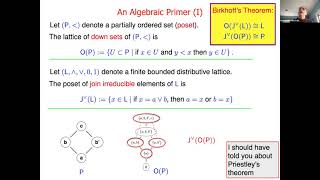
Nonlinear Dynamics in an Age of Heuristic Science
Explore nonlinear dynamics through combinatorial topology, offering efficient computational methods and new perspectives for multiscale systems and data-driven science in biology and engineering.
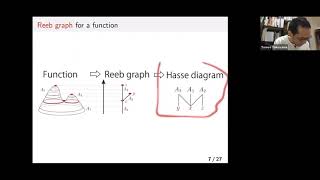
Tomoo Yokoyama - Generalizations of Morse Graph of Flows and Reeb Graph of Hamiltonian Flows
Generalizations of Morse and Reeb graphs for flows, exploring connections between dynamical systems, topological structures, and abstract orbit spaces. Insights into Conley theory and topological invariants.
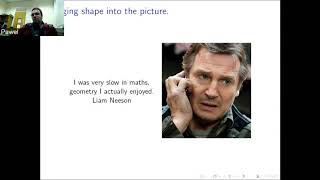
Pawel Dlotko - A Few Simple Stories on Topology in Action
Explore practical applications of computational topology in material science, dynamical systems, and brain research. Learn how theory and algorithms work together to solve real-world problems.
Convergent Semi-Lagrangian Methods for the Monge-Ampère Equation on Unstructured Grids
Explores semi-Lagrangian discretisation of Monge-Ampère operator on P1 finite element spaces, discussing challenges and solutions for numerical methods in solving Monge-Ampère equations, with applications in inverse reflector problems.
Axel Målqvist - Localization of Multiscale Problems
Explore multiscale problem-solving techniques, focusing on Local Orthogonal Decomposition for PDEs. Learn about convergence, high-contrast data, and applications to time-dependent problems.

SRB Measures and Young Towers - Lecture 3 of 4
Explore SRB measures and Young towers in dynamical systems, focusing on nonuniformly hyperbolic systems and their statistical properties. Learn about recent advances in this field of mathematics.
Symbolic Dynamics for Nonuniformly Hyperbolic Systems - Lecture 4
Explore advanced techniques in nonuniformly hyperbolic dynamics, focusing on symbolic coding and statistical properties of complex systems using Markov Partitions and Young Towers.
Symbolic Dynamics for Nonuniformly Hyperbolic Systems - Lecture 3 of 5
Explores advanced techniques in nonuniformly hyperbolic systems, focusing on symbolic dynamics and Markov partitions. Covers key concepts, challenges, and recent developments in the field of dynamical systems.
Symbolic Dynamics for Nonuniformly Hyperbolic Systems - Lecture 2 of 5
Explores advanced techniques in symbolic dynamics for nonuniformly hyperbolic systems, focusing on graph transforms, recurrence properties, and Markov partitions to analyze complex dynamical behaviors.

Fractal Dimensions in Nature and Mathematics - 2019
Explore fractal dimensions in nature and math, from intuitive integer dimensions to non-integer fractals. Learn alternative definitions, simple examples, and applications in dynamical systems.