Distributed Systems and the End of the API - Emerging Technologies for the Enterprise Conference
Explore distributed systems' impact on APIs, discussing real-world implications, functional programming parallels, and data-oriented approaches for modern system design.
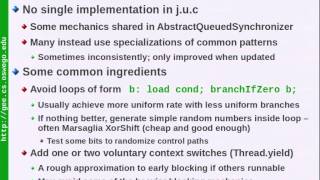
Engineering Concurrent Library Components
Explore concurrent algorithms, hardware trends, and Java Memory Model intricacies for engineering robust library components in multi-threaded environments.

Running at Scale on Parse - Tips for High-Traffic Apps
Learn strategies for scaling high-traffic apps on Parse, including optimizing API requests, database principles, and data modeling techniques to enhance performance and reliability.

Essential Patterns for Designing and Implementing Kubernetes Operators
Learn essential patterns for designing and implementing Kubernetes operators, covering API design, infrastructure management, client cache optimization, multi-cluster interactions, and API server load minimization.
Gateway API Project Update - Current State and Future Plans
Explore Gateway API's progress, implementations, conformance testing, and future plans for Kubernetes inbound traffic management. Learn about GAMMA initiative and policy attachments.

API Evolution with CRDs: Best Practices for Authoring and Fuzz Testing APIs
Best practices for authoring and fuzz testing CustomResourceDefinitions APIs in Kubernetes, covering strategies for design, validation, and evolution of scalable and stable APIs.
SIG Architecture Introduction and Deep Dive - Kubernetes Design Principles and Consistency
Explore Kubernetes architecture principles, API conventions, and cross-cutting concerns. Learn about SIG Architecture's role, subprojects, and community efforts in maintaining Kubernetes design consistency.

Gateway API - The New Way to Manage North-South Traffic in Kubernetes
Explore the Gateway API, a new approach for managing north-south traffic in Kubernetes clusters. Learn its benefits, comparison to Ingress, and migration strategies.
Save Your Pipelines with Tekton Results - Improving CI/CD Infrastructure Stability
Explore Tekton Results for archiving and querying pipeline data, improving CI/CD infrastructure stability, performance, and usability in Kubernetes environments.
What Can I Get You? An Introduction to Dynamic Resource Allocation
Explore dynamic resource allocation in Kubernetes, its advantages over traditional methods, and how to implement it for flexible and efficient management of specialized hardware resources.
Memory Sharing Mechanisms in Linux - Implementation and Security
Explore the Hamster Mechanism, implementation details, security considerations, and API for efficient memory sharing in Linux systems.
Stateless HEVC Decoding in Mainline Linux - The Rocky Road to Becoming a Stable API
Explore the journey of implementing stateless HEVC decoding in Linux, covering API design challenges, hardware requirements, and the path to stability in the mainline kernel.
New USB Device Class API Introduction for Zephyr RTOS
Introduction to Zephyr RTOS's new USB device stack, focusing on the common API for class implementations and management functions. Covers implementation of multi-instance functions and key features.
Generic BPF Multi-Attach API and Implementation for TCX and XDP Meta Netdevices
Explore the new BPF multi-attach API and its implementation for tcx and XDP meta netdevices, enhancing network programming flexibility and performance.

What Exactly is Headless? - Understanding Headless Architecture
Explore the concept of headless software architecture, its benefits, and applications in modern development, with a focus on improving performance and flexibility.
Introducing a New Zephyr Sensing Subsystem
Explore the new Zephyr sensing subsystem's architecture, design, and applications in client computing platforms, building upon the existing sensor driver API to enhance functionality.
ThingSet and Zephyr: Transport-Agnostic Device Connectivity in 10 Minutes
Explore ThingSet's zero-overhead remote API for embedded devices, its integration with Zephyr, and learn to create connected sensor firmware in minutes using various communication interfaces.
CPU Feature Management: Lessons from Trenches
Explore CPU feature management challenges in heterogeneous hardware clustering, including migration issues, feature deprecations, and contrasting interpretations between Intel and AMD.

Extending containerd: Architecture, APIs and Custom Integrations
Explore containerd's architecture, APIs, and extensibility. Learn to build custom snapshotters, integrate with specialized runtimes, and leverage plugins for enhanced container deployments and Kubernetes integrations.

IoT TLS - Challenges and Solutions for Embedded Devices
Exploring TLS challenges in IoT: memory constraints, networking stacks, and security implications. Insights on improving TLS support for embedded systems and the Zephyr project.

OpenTracing: Beyond Distributed Tracing - Video 2
Explore OpenTracing's role in microservices monitoring, its connection to logging and metrics, and its practical applications through a demo involving distributed traces and Prometheus monitoring.