
Splunk: Cloud-Native Infrastructure Monitoring at Scale
Gain end-to-end visibility into infrastructure and application performance with Splunk's cloud-native monitoring platform. Deploy easily, detect issues proactively, and leverage ML for insights.
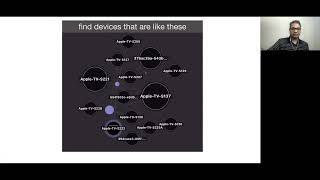
Weak Supervision and Next-Gen AI-Based Threat Detection
Explore weak supervision for efficient AI-based threat detection in network security, leveraging analyst heuristics to build predictable models and overcome traditional machine learning challenges.

Innovate with Business-First AI - Bridging Experimental Innovation and Real Business Value
Explore enterprise AI solutions for automating operations, detecting fraud, and understanding customers. Learn about language processing, speech services, and advanced analytics for business impact.

Towards Fair Deep Anomaly Detection
Explore fair deep anomaly detection techniques, addressing bias in machine learning algorithms through adversarial learning and minimizing adversarial loss, with experimental results and practical applications.
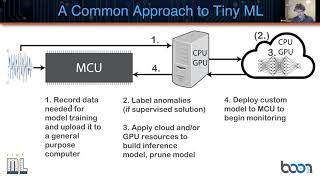
Amber - A Complete, ML-Based, Anomaly Detection Pipeline for Microcontrollers
Discover a complete ML-based anomaly detection pipeline for microcontrollers, featuring real-time sensor value processing, automatic hyperparameter tuning, and high-speed inference capabilities.

Wio Terminal TinyML Course - Anomaly Detection for Predictive Maintenance with Blynk IoT Platform
Learn to implement anomaly detection for predictive maintenance using Wio Terminal, TinyML, and Blynk IoT platform. Covers data collection, model training, testing, and integration with IoT systems.
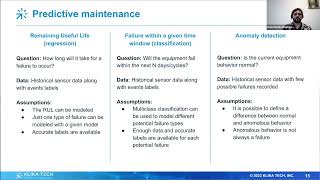
TinyML Talks - On-Device Model Fine-Tuning for Industrial Anomaly Detection Applications
Explore on-device model fine-tuning for industrial anomaly detection, improving flexibility and adaptability of ML models while reducing infrastructure costs and operational efforts.
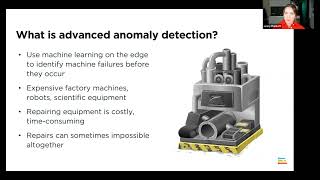
Advanced Anomaly Detection Made Easy
Advanced anomaly detection techniques for embedded ML, focusing on custom DSP blocks, feature importance, and threshold optimization. Learn to implement these methods for various IoT applications using Edge Impulse.
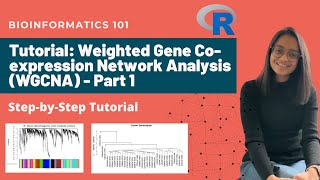
Weighted Gene Co-expression Network Analysis - Step-by-Step Tutorial - Part 1
Learn step-by-step Weighted Gene Co-expression Network Analysis (WGCNA) for RNA-Seq data, covering data manipulation, outlier detection, normalization, module identification, and visualization techniques.
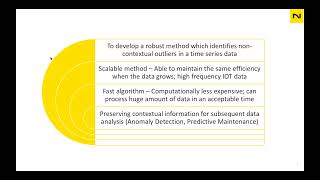
A Spurious Outlier Detection System for High Frequency Time Series Data
Discover an integrated approach for detecting spurious outliers in high-frequency time series data from IoT sensors, applicable across various domains like manufacturing, retail, and healthcare.
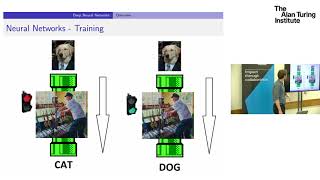
A Review of Machine Learning Techniques for Anomaly Detection - Dr. David Green
Explore machine learning techniques for anomaly detection, covering traditional methods, deep neural networks, and practical applications in various domains.

MOSIP Research Platform - Integrating Anomaly Detection Prototypes into Centralized ID Systems
Explore novel anomaly detection methods for digital identity systems using autoencoders, with a focus on fraud prevention during registration in MOSIP architecture.
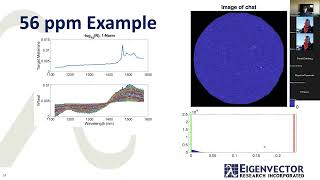
Anomaly Detection in Hyperspectral Imaging - Neal Gallagher
Explore advanced anomaly detection techniques in hyperspectral imaging, focusing on GLS, ELS, and WPCA methods for improved sensitivity and selectivity in detecting minor signals within complex mixtures.

Prepare Your Data for Machine Learning Like a Rockstar Data Engineer With DataRobot AI Platform
Learn to prepare data for machine learning using DataRobot AI Platform. Covers AI catalog creation, EDA, feature engineering, outlier detection, data joining, and more. Ideal for data engineers and analysts.
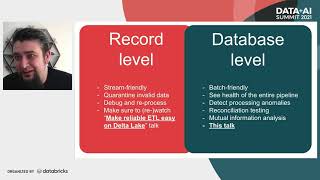
Data Quality Tools Comparison for Continuous Data Imports
Comparison of open-source data quality tools for continuous imports, covering maturity, documentation, extensibility, and features like data profiling and anomaly detection.
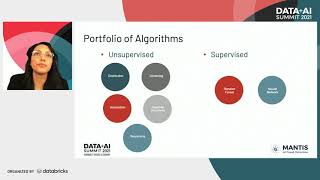
Wizard Driven AI Anomaly Detection with Databricks in Azure
Explore wizard-driven AI anomaly detection for fraud prevention using Databricks. Learn unsupervised and supervised methods, aggregation frameworks, and human-in-the-loop feedback to improve models over time.

PLSE Seminar Series - Alessandra Gorla - Mining Android Apps for Anomalous Behavior
Techniques for detecting suspicious behavior in Android apps by clustering based on advertised functionality and identifying outliers in API usage, with applications in malware detection.
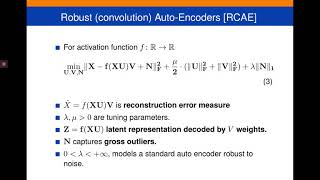
KDD 2020: Robust Deep Learning Methods for Anomaly Detection
Explore robust deep learning techniques for anomaly detection, focusing on auto-encoders and their applications in video surveillance and image analysis.

Using Apache Spark for Predicting Degrading and Failing Parts in Aviation
Leveraging Apache Spark for predictive maintenance in aviation, enabling efficient data processing, anomaly detection, and component health scoring to improve fleet readiness and prevent failures.

Exploratory Data Analysis Tutorial - Basics of EDA with Python
Learn Python-based exploratory data analysis techniques to uncover insights, detect patterns, and visualize relationships in datasets for informed decision-making and hypothesis testing.

The CAMELS Project - Paco Villaescusa Navarro
Exploring the CAMELS project: a large-scale simulation suite for galaxy formation and cosmology, combining hydrodynamics and machine learning to advance our understanding of the Universe.