
Approximation Algorithms
Explore approximation algorithms for network design, including connectivity augmentation, Steiner trees, and spectral rounding techniques. Learn about linear programming and future research directions.

On the Nisan-Ronen Conjecture for Submodular Valuations
Explore the Nisan-Ronen conjecture for submodular valuations, covering scheduling mechanisms, player valuations, and related proofs in algorithmic game theory.

Weighted Min-Cut - Sequential, Cut-Query and Streaming Algorithms
Explore advanced algorithms for solving the weighted min-cut problem across sequential, cut-query, and streaming models, with a focus on a unified schematic approach and open challenges.
Data Structures Meet Cryptography - 3SUM with Preprocessing
Explore the intersection of data structures and cryptography, focusing on the 3SUM problem with preprocessing and its implications for algorithmic efficiency and security.
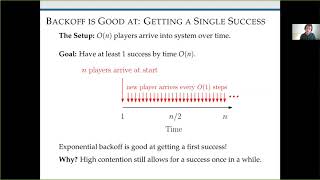
Contention Resolution without Collision Detection
Explore contention resolution algorithms without collision detection for shared channels, focusing on backoff strategies, channel simulation, and handling player arrivals and stragglers.

Approximately Stable Committee Selection
Explore committee selection methods, focusing on fairness, stability, and approximation algorithms. Learn about preference models, participatory budgeting, and innovative approaches to achieve balanced representation.
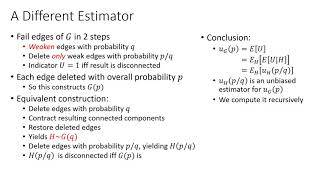
A Phase Transition and Quadratic Time Estimator for Network Reliability
Explore network reliability estimation, including a novel quadratic-time approach, phase transitions, and unbiased estimators for efficient analysis of complex networks.

On the Need for Large Quantum Depth
Explore quantum computing depth, its implications for quantum supremacy claims, and the challenges in designing oracle problems for quantum circuits.

Machine Learning for Algorithm Design
Explore data-driven algorithm design using machine learning, combining theoretical foundations with practical applications to improve performance for various combinatorial problems.
Machine Learning for Beginners - Data Scientists and Analysts
Comprehensive introduction to machine learning for data professionals, covering key concepts, techniques, and practical applications in business contexts, with hands-on coding examples.
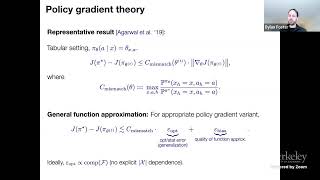
Reinforcement Learning - Part I
Explore reinforcement learning fundamentals, including credit assignment, dynamic programming, and exploration algorithms. Gain insights into algorithm design and sample complexity in this comprehensive introduction.

Optimal Gradient-Based Algorithms for Non-Concave Bandit Optimization
Explore optimal gradient-based algorithms for non-concave bandit optimization, covering stochastic problems, low-rank linear rewards, and high-order polynomials with applications to reinforcement learning.
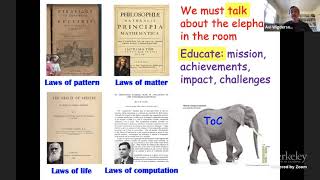
Are We Aging Well?
Explore the evolution and impact of Satisfiability (SAT) in computing theory over 50 years, including recent breakthroughs, algorithms, and its central role in computational complexity.

Hybrid Classical-Quantum Algorithms
Explore hybrid algorithms combining quantum and classical computing for optimization and inference, leveraging strengths of both platforms to solve complex problems efficiently.

Federated Heavy Hitters Discovery with Differential Privacy
Explore federated learning, differential privacy, and heavy hitters discovery in this talk by Peter Kairouz. Learn about multiparty computation, open research, and practical applications in data analysis.
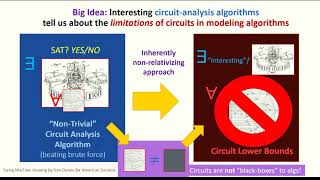
Circuit Lower Bounds from Algorithm Design - An Overview I
Explore circuit lower bounds in computational complexity, focusing on algorithm design techniques and their implications for NP problems and Boolean functions.
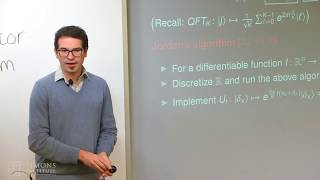
Quantum Algorithms - An Overview of Techniques
Explore quantum algorithms, from Fourier transforms to Hamiltonian simulations, covering key techniques and applications in quantum computing advancements.
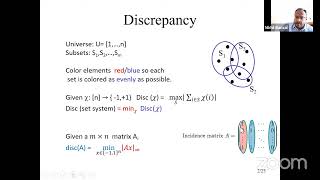
Algorithmic Aspects of Discrepancy Theory
Explore algorithmic aspects of discrepancy theory, including vector balancing, Spencer's Problem, and Banaszczyk's Theorem, with insights on geometric perspectives and partial coloring techniques.
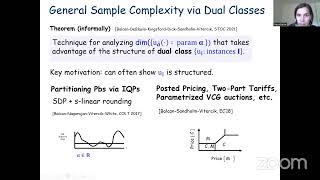
Learning Theoretic Foundations of Data-Driven Algorithm Design
Explore machine learning techniques for data-driven algorithm design, focusing on combinatorial problems and online optimization. Learn to adapt algorithms to specific domains for improved performance.
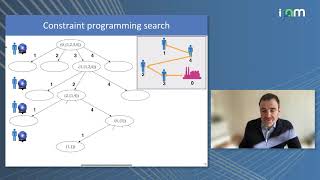
Combining Reinforcement Learning and Constraint Programming for Combinatorial Optimization
Explore a hybrid approach combining reinforcement learning and constraint programming for solving complex combinatorial optimization problems, with applications in various fields.
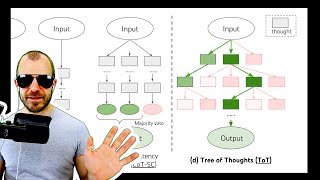
Tree of Thoughts - Deliberate Problem Solving with Large Language Models
Explores Tree-of-Thoughts prompting, enhancing language models' problem-solving abilities through strategic exploration, evaluation, and backtracking across multiple reasoning paths.