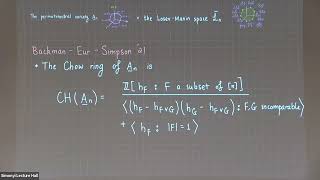
Multimatroids and Rational Curves with Cyclic Action
Explore the intersection of multimatroids and rational curves, discovering how these mathematical structures connect through combinatorial formulas and independence polytopal complexes in topological graph theory.
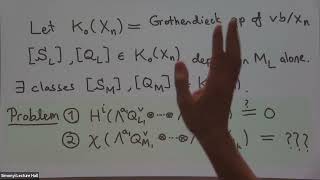
The External Activity Complex of a Pair of Matroids
Delve into advanced matroid theory, exploring external activity complexes and their relationship to Schubert varieties, with applications to tautological classes and Speyer's matroid invariant.
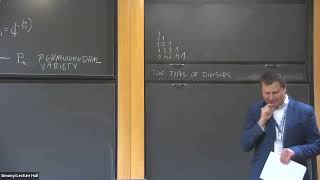
Towards Generalized Schubert Varieties and Anabelian Matroids
Delve into advanced geometric theories connecting Huh's matroid discoveries with Schubert varieties, exploring applications in statistics and combinatorics through mixed Eulerian numbers.
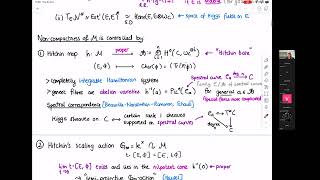
Moduli Spaces of Bundles on Curves with Abelian Motives
Explore the mathematical theory behind abelian motives in bundle moduli spaces, examining motivic formulas and their relationship to cohomological phenomena on curves.
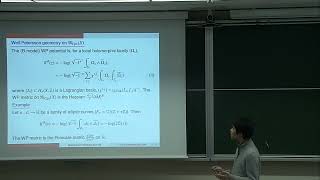
Moduli of Calabi-Yau Manifolds and Mirror Symmetry
Delve into advanced mathematical concepts exploring Calabi-Yau manifolds and mirror symmetry theory through expert insights from Kyoto University's mathematics department.
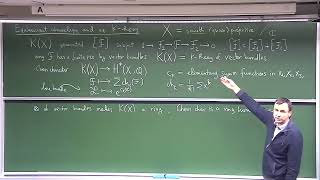
Curve Counting, Geometric Representation Theory, and Quantum Integrable Systems - Lecture 2
Delve into advanced mathematical concepts exploring curve counting, geometric representation theory, and quantum integrable systems with Professor Andrei Okounkov's expert analysis and insights.
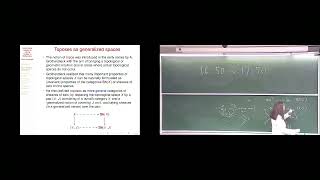
Grothendieck Toposes as Unifying Bridges in Mathematics - Lecture 2
Delve into Grothendieck toposes and their role as mathematical bridges, exploring how these structures enable the transfer of ideas between theories and lead to new discoveries in classical domains.
The Minimal Model Program for Varieties of Log General Type - Lecture 3
Delve into advanced birational geometry and minimal model program concepts with Distinguished Professor Christopher Hacon, exploring complex projective varieties and canonical ring theory.
Geometry with Linear Algebra - Wild Linear Algebra A - NJ Wildberger
Explore the connection between linear algebra and geometry, focusing on Pythagoras' theorem and perpendicularity. Learn how linear algebra provides a solid framework for understanding Euclidean and other geometries.
Affine and Projective Geometry, and the Problem of Lines
Explore affine and projective geometry, focusing on points, vector spaces, and lines in 2D. Learn to solve geometric problems using projective coordinates and understand curve representation.
Seminar - Some Fundamental Formulas from Metrical Algebraic Geometry
Explore fundamental formulas in metrical algebraic geometry, connecting classical theorems to modern discoveries. Gain insights into affine and projective variants applicable across various fields.
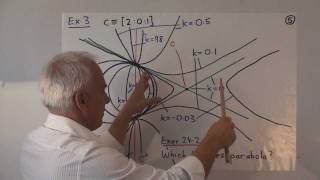
Visualizing Quadrance with Circles - Universal Hyperbolic Geometry - NJ Wildberger
Explore quadrance in universal hyperbolic geometry through circles, examining their appearance as ellipses, parabolas, or hyperbolas with different centers, enhancing understanding of this fundamental concept.
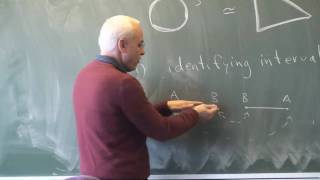
One-Dimensional Objects - Algebraic Topology
Explore one-dimensional objects in algebraic topology, focusing on lines and circles. Learn about their diverse representations and fundamental properties in this introductory lecture.
Residual Intersections in Geometry and Algebra by David Eisenbud
Explore geometric questions from the 19th century, including tangent conics and space curves, leading to the theory of residual intersections in geometry and algebra. Open problems discussed.
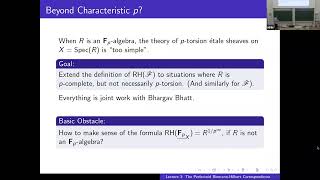
Jacob Lurie: A Riemann-Hilbert Correspondence in P-Adic Geometry
Explore p-adic geometry through Riemann-Hilbert correspondence, covering perfectoid rings, prismatic cohomology, and sheaf theory in characteristic p and beyond.
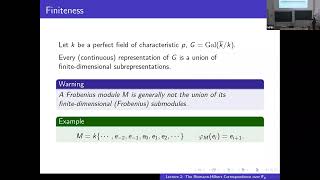
Jacob Lurie: A Riemann-Hilbert Correspondence in P-adic Geometry Part 2
Explore p-adic geometry through a Riemann-Hilbert correspondence, examining algebraic differential equations, perverse sheaves, and prismatic cohomology in nonarchimedean fields.
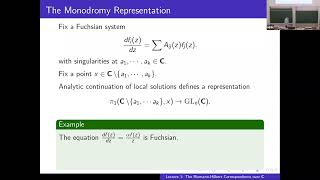
Jacob Lurie: A Riemann-Hilbert Correspondence in P-adic Geometry Part 1
Explores the Riemann-Hilbert correspondence in complex and p-adic geometry, discussing its historical context, mathematical foundations, and recent developments in prismatic cohomology.
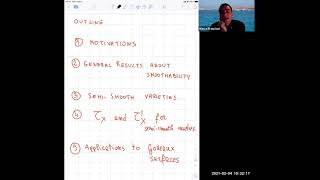
Deformations of Semi-Smooth Varieties
Explore deformation theory of semi-smooth varieties, focusing on tangent sheaf and T^1 sheaf. Discusses smoothability of semi-smooth Godeaux surfaces as an application.
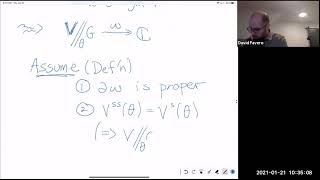
CoFTs for GLSMs
Explore enumerative invariants for GLSMs, generalizing Gromov-Witten and FJRW theories. Learn about virtual fundamental classes, Atiyah classes, and matrix factorizations in this context.
Homological Mirror Symmetry for Log Calabi-Yau Surfaces
Explore homological mirror symmetry for log Calabi-Yau surfaces, including construction of mirror Landau-Ginzburg models and connections to SYZ fibrations and previous research.
Unitary Representations of Reductive Lie Groups
Explore unitary representations of reductive Lie groups using Hodge theory, including progress on a conjecture. Joint work with Kari Vilonen presented by Harvard's Wilfried Schmid.