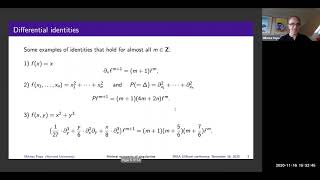
Minimal Exponents of Singularities
Explore advanced mathematical concepts like minimal exponents, Bernstein-Sato polynomials, and their connections to D-modules, Hodge theory, and birational geometry in this in-depth lecture.
Fixed Points in Toroidal Compactifications and Essential Dimension of Covers
Explores essential dimension in algebraic objects, focusing on congruence covers of Shimura varieties. Presents new geometric approaches and fixed point theorems, extending incompressibility results to exceptional types.
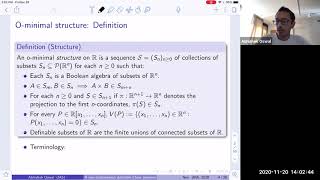
A Non-Archimedean Definable Chow Theorem
Explore non-archimedean algebraization theorems and their applications in Diophantine geometry, focusing on a p-adic analogue of the definable Chow theorem.
Log Symplectic Pairs and Mixed Hodge Structures
Explores log symplectic pairs, their connection to hyperkaehler variety degenerations, and classification of pure weight pairs. Discusses analogies with log Calabi-Yau surfaces and implications for mixed Hodge structures.
Model Theory - From Logic to Geometric Stability Theory and O-Minimality I
Explore model theory principles, focusing on o-minimality and stability theory, with applications to complex geometry and arithmetic aspects.
O-Minimality and Hodge Theory - Definable GAGA + Griffiths Conjecture
Explore o-minimal geometry, definable GAGA, and Griffiths Conjecture in algebraic geometry. Learn about definable analytic spaces, Oka coherence, and their applications to period maps and variations of mixed Hodge structures.
Mixed Period Maps: Definability and Algebraicity
Explore definable analytic spaces and their applications in algebraic geometry, focusing on period maps and mixed Hodge structures. Learn about o-minimal geometry and its role in proving key conjectures.
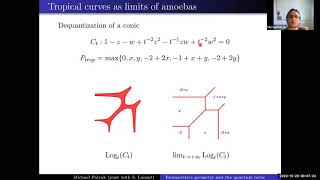
Enumerative Geometry and the Quantum Torus
Explore enumerative geometry through tropical curves, pseudotropical curves, and their connection to Lie algebras and quantum torus. Discover innovative approaches to classical counting problems in algebraic geometry.
Nonrational Toric Geometry III - Quasifolds, Foliations, Combinatorics and One-parameter Families
Explores nonrational toric geometry through quasifolds, foliations, and combinatorics, extending classical toric geometry to new contexts and examining one-parameter families of toric quasifolds.
Nonrational Toric Geometry I - Symplectic Toric Quasifolds Minicourse
Explore symplectic toric quasifolds, generalizing toric varieties to non-rational polytopes. Learn about quasilattices, quasirationality, and quasitori through examples like quasispheres and Penrose tilings.
Nonrational Toric Geometry II - Quasifolds, Foliations, Combinatorics and One-parameter Families
Explore complex toric quasifolds, their structure, and relation to rational toric varieties. Learn about extending constructions to nonsimple convex polytopes in symplectic and complex settings.
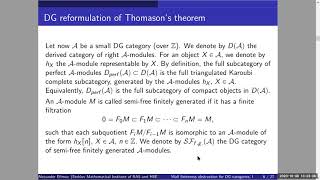
Wall Finiteness Obstruction for DG Categories I
Explore Wall finiteness obstruction theorem for DG categories, its applications to phantom DG categories, and implications for algebraic geometry, including results on Barlow surface and stratified varieties.
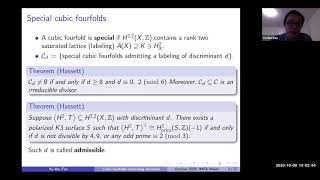
On Rational Cubic Fourfolds Containing Veronese Surfaces
Explore birational automorphisms and rationality of cubic fourfolds containing Veronese surfaces, with insights on K3 categories and Cremona transformations in algebraic geometry.
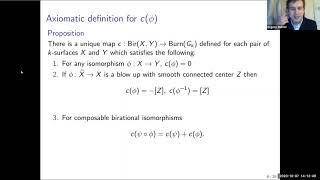
Factorization Centers in Dimension Two and the Grothendieck Ring of Varieties
Explores factorization centers in birational isomorphisms for smooth projective surfaces, discussing their independence and relation to rationality problems and the Grothendieck ring of varieties.
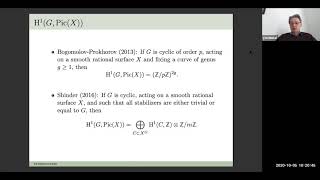
Equivariant Birational Types
Explore obstructions in equivariant birational geometry, covering rationality, basic facts, refined invariants, and applications to abelian and non-abelian actions on surfaces.
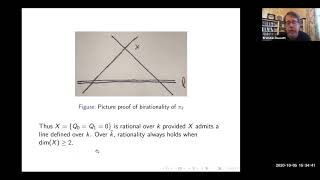
Rationality for Threefolds Over Non-Closed Fields
Explore recent developments in rationality of geometrically rational threefolds over non-closed fields, including symbol invariants and new approaches to longstanding questions in algebraic geometry.
A Categorical Interpretation of the GKZ D-Module
Explore the categorical interpretation of GKZ D-modules in toric homological mirror symmetry, focusing on B-side categories and characteristic cycle strata.
A Tropical Approach to Homological Mirror Symmetry of Quadrics
Tropical geometry approach to homological mirror symmetry of quadrics, exploring new anti-canonical divisor and potential construction. Compares with previous work and discusses exceptional collections.
Period Mapping at Infinity
Explore Hodge theory's global study of period mapping at infinity, including new invariants, moduli space implications, and geometric insights for singular varieties.
Is There Geometric Recursion for the Moduli Space of Toric Varieties?
Explore moduli space of quantum toric varieties, drawing parallels with geometric recursion. Delve into quantum lattices, tori, and CP1, examining group actions, calibration, and quantum geometric invariant theory.
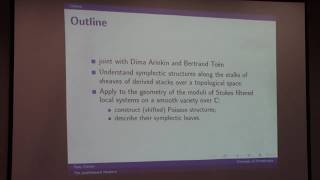
The Pushforward Theorem and Applications
Explore relative shifted symplectic structures, their pushforward theorem, and applications to Poisson structures on derived moduli of Stokes data, with insights on symplectic leaves and irregular types.