Number Systems Ancient to Modern - The Babylonians - Sociology and Pure Maths
Explore ancient Babylonian mathematics, including their base-60 system, arithmetic tables, and problem-solving techniques. Gain insights into historical mathematical practices and their relevance today.
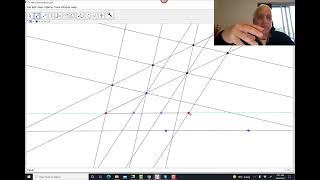
Calculus and Affine Geometry of the Magical Parabola - Algebraic Calc and DCB Curves 3 - Wild Egg
Explore affine geometry and the parabola's unique properties in algebraic calculus, focusing on parallelism and linear algebra concepts without relying on traditional Euclidean definitions.
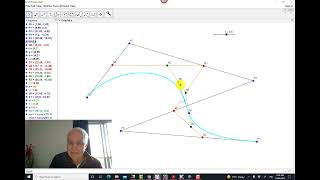
Polynumbers and De Casteljau Bezier Curves - Algebraic Calculus and DCB Curves - N J Wildberger
Explore polynumbers and de Casteljau Bezier curves in algebraic calculus. Learn new formulas for planar integration and use GeoGebra to visualize these remarkable curves, with applications in design and animation.
Relativistic Dot Products and Complex Numbers - Wild Linear Algebra B
Explore relativistic dot products, complex numbers, and chromogeometry in planar geometry. Discover the symmetry between Euclidean and relativistic geometries using 2x2 matrices, unit circles, and isometries.
Energy, Momentum and Linear Algebra - Wild Linear Algebra B
Explore conservation of momentum and energy in mechanics using linear algebra, featuring a geometric interpretation of elastic collisions and a butterfly collision diagram for particle interactions.
The Language of Algebra - Math Terminology
Essential algebra terminology and concepts for first-year university students, covering polynomials, sequences, series, and rational functions. Includes the Binomial theorem and an introduction to calculus with polynomials.
The Relativistic Dot Product - Wild Linear Algebra B
Explore the relativistic dot product in Einstein's Special Relativity, comparing it to the Euclidean dot product and examining its applications in geometry and physics.
Circles and Spheres via Dot Products II - Wild Linear Algebra A
Explore 3D Euclidean dot products, quadrance, linear functionals, and spheres. Learn about projections, Pythagoras' theorem, and perpendicularity in three-dimensional space.
Dot Products, Pythagoras' Theorem, and Generalizations - Wild Linear Algebra A - NJ Wildberger
Algebraic approach to metrical geometry using dot products and quadrance. Introduces symmetric bilinear forms for understanding relativistic geometry, with applications to linear algebra and physics.
Geometry with Linear Algebra - Wild Linear Algebra A - NJ Wildberger
Explore the connection between linear algebra and geometry, focusing on Pythagoras' theorem and perpendicularity. Learn how linear algebra provides a solid framework for understanding Euclidean and other geometries.
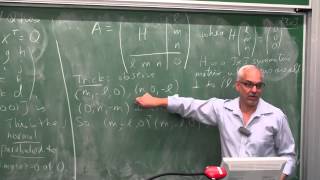
Curvature for the General Paraboloid - Differential Geometry - NJ Wildberger
Novel approach to surface curvature using projective geometry and linear algebra. Explores paraboloid curvature through characteristic polynomials, offering insights for higher-dimensional generalizations.
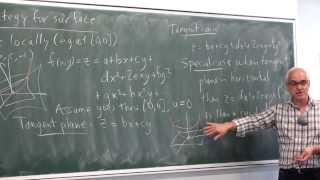
Paraboloids and Associated Quadratic Forms - Differential Geometry
Explore paraboloids and quadratic forms in differential geometry, covering diagonalization, eigenvalues, and Dupin's indicatrix. Learn key concepts for understanding surface curvature.
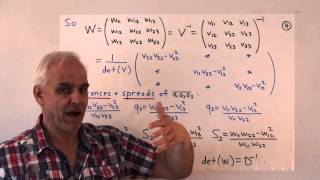
Trigonometry in Elliptic Geometry II - Universal Hyperbolic Geometry - NJ Wildberger
Explore elliptic trigonometry laws, including Spread, Cross, and Dual cross, using linear algebra. Learn proofs for Thales', Pythagoras', and Triple Quad formulas in elliptic geometry.
Metrical Structure and Curvature of a Parabola - Differential Geometry
Explore metrical structures and curvature in differential geometry, focusing on parabolas. Learn about symmetric bilinear forms, relativistic geometries, and their applications in physics.
Differential Geometry With Finite Fields - Differential Geometry
Exploring differential geometry in finite fields, introducing arithmetic in prime fields, polynomial operations, and tangent conics to cubics. Highlights unique patterns and combinatorial structures in finite calculus.
Infinitesimal Calculus with Finite Fields - Famous Math Problems
Explore infinitesimal calculus in finite fields through the semi-cubical parabola over F_7, challenging traditional real number analysis and emphasizing polynumbers and de Casteljau Bezier curves.
Dual Complex Numbers and Leibniz's Differentiation Rules - Famous Math Problems
Explore algebraic infinitesimals, dual complex numbers, and Leibniz's differentiation rules in this advanced mathematics lecture, extending calculus to general and finite fields.
The Geometry of the Dihedrons and Quaternions - Famous Math Problems
Explore the geometry of Dihedrons and Quaternions, comparing their properties and connections to relativity, linear algebra, and complex numbers. Gain insights into fundamental mathematical structures.
The Remarkable Dihedron Algebra - Famous Math Problems
Explore the Dihedron algebra, a key to constructing complex numbers. Learn its basis, properties, and connections to group theory in this comprehensive mathematical exploration.
How to Construct the True Complex Numbers I - Famous Math Problems
Exploring the construction of true complex numbers using field theory and linear algebra, challenging traditional approaches and introducing novel concepts for a modern understanding.
Computing Cyclotomic Polynumbers - Famous Math Problems
Explore cyclotomic polynomials, their factorization, and applications in algebra and number theory. Learn about Mersenne primes and the Schoenemann-Eisenstein criterion for irreducibility.