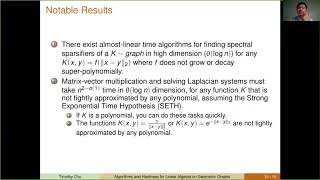
Algorithms and Hardness for Linear Algebra on Geometric Graphs
Explore algorithms and hardness for linear algebra on geometric graphs, focusing on K and K-graphs, sparsifiers, matrix-vector multiplication, and Hamming nearest neighbor problems.
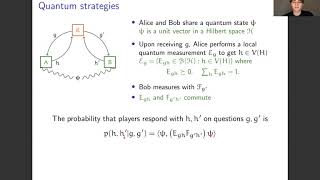
Quantum Isomorphism Is Equivalent to Equality of Homomorphism Counts from Planar Graphs
Explore quantum isomorphism and its equivalence to homomorphism counts from planar graphs, delving into quantum strategies, permutation matrices, and bilabel graphs.
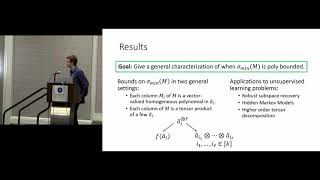
Smoothed Analysis in Unsupervised Learning via Decoupling
Explore smoothed analysis in unsupervised learning, focusing on tensor decomposition, high-dimensional data, and robust subspace recovery. Gain insights into condition number bounds and perturbation techniques.
I Am or AI Am?
Explore AI's potential and limitations through a mathematician's lens, examining reality representation, mathematical theorems, and quantum mechanics to address the fundamental question of identity.
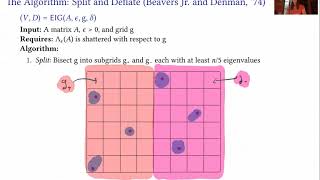
Pseudospectral Shattering the Sign Function and Diagonalization in Nearly Matrix Multiplication Time
Explore advanced matrix algorithms, including pseudospectral shattering and diagonalization techniques, for efficient computation in nearly matrix multiplication time.
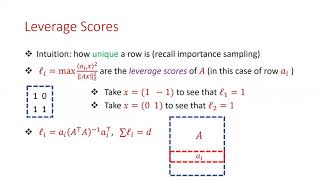
Near Optimal Linear Algebra in the Online and Sliding Window Models
Explore near-optimal linear algebra techniques for streaming and sliding window models, focusing on randomized algorithms and their applications in data analysis.
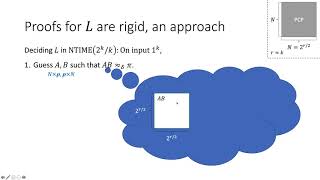
Rigid Matrices from Rectangular PCPs
Explore rigid matrices, low rank matrices, and rectangular PCPs in this technical talk on advanced mathematical concepts and their applications.
Introduction to Unity.Mathematics
Explore Unity.Mathematics for game development: efficient matrix operations, rotations, and DOTS integration. Learn to solve common math problems and optimize performance.
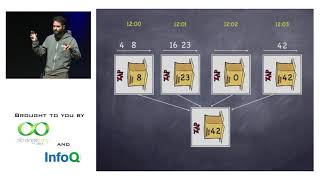
Add ALL the Things - Abstract Algebra Meets Analytics
Explore how abstract algebra principles apply to analytics systems, enhancing distributed and real-time aggregation efficiency through group theory laws and practical coding examples.
A Box of Chaos - The Generative Artist's Toolkit
Explore generative art techniques, from algorithms and color theory to creating natural-looking code-generated artwork. Learn practical tools for producing unique digital art pieces.
Time-Optimal Interactive Proofs for Circuit Evaluation
Explore time-optimal interactive proofs for circuit evaluation, covering regular and irregular circuits, parallel computation, and matrix multiplication, with insights on practical applications and future directions.
Large-Scale Architecture - The Unreasonable Effectiveness of Simplicity
Explore principles of simplicity, orthogonality, asynchrony, and feedback in large-scale architecture. Learn from real-world examples at Google and eBay to build scalable, efficient systems.
Deep Learning - An Introduction
Explore neural networks, their algorithms, and practical applications in image recognition. Learn to implement and train deep learning models using DL4J, a Java library for Spark-based deep learning.
It's All About Morphisms
Gentle introduction to Category Theory for OOP programmers exploring Functional Programming. Explains key concepts with diagrams, metaphors, and code examples in Java and Kotlin, comparing to classical OOP approach.
It's All About Morphisms
Gentle introduction to Category Theory for OOP programmers exploring Functional Programming. Explains key concepts with diagrams, metaphors, and code examples, comparing to OOP and showing real-world applications.
Inside Every Calculus Is A Little Algebra Waiting To Get Out
Explore algebraic approaches to automatic differentiation and integration in calculus, with Kotlin code examples. Learn how synthetic differential geometry simplifies complex mathematical concepts.

Functional Programming from First Principles
Explore functional programming fundamentals, side effects, and the contrast with imperative programming. Delve into concepts like monoids, category theory, and monads in this insightful talk by Erik Meijer.
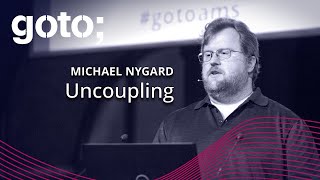
Uncoupling
Explore coupling in software systems, its impact on development, and strategies for effective uncoupling to improve system flexibility and maintainability.

Achieving Functional Programming in Java
Explore functional programming in Java using the Lambda library, covering functors, monads, lazy evaluation, and more. Learn to leverage FP concepts in Java development.
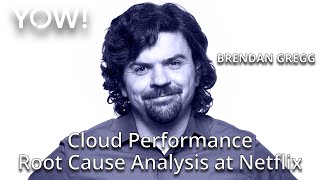
Cloud Performance Root Cause Analysis at Netflix
Explore Netflix's cloud performance analysis techniques, tools, and procedures for root cause identification across 150k instances, featuring open-source solutions for cloud-wide and instance-level optimization.
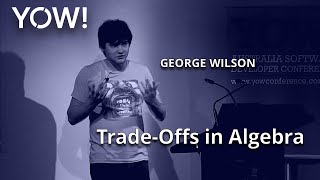
When Less is More and More is Less - Trade-Offs in Algebra
Explore algebraic structures in functional programming, focusing on semigroups and semilattices. Learn their applications, trade-offs, and how to choose the right structure for your programming needs.