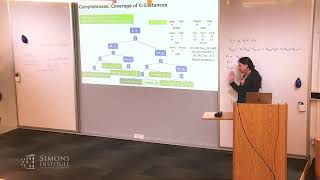
Understanding Queries by Conditional Instances
Explores methods for generating representative database instances to illustrate query satisfaction, aiding in query debugging and comprehension through abstraction and characterization.
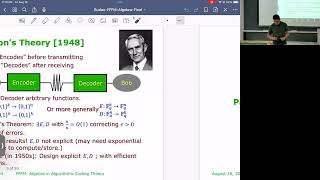
Algebra in Algorithmic Coding Theory
Explore algebraic techniques in algorithmic coding theory, focusing on error-correcting codes and their applications in computer science and information theory.
Thermalization of Quantum Memories - A Tensor Networks Approach
Explore thermalization of quantum memories using tensor networks, focusing on 2D Kitaev's quantum double models and their Gibbs state representation as PEPS.
Classical and Quantum Subjectivity in Uncertainty and Belief Systems
Explore uncertainty in subjective logic, from Markov networks to quantum quasiprobabilities, gaining insights on computational irreducibility and belief spaces.
Exploring Random Quantum Circuits: A New Implementation Method
Discover a novel method for constructing random quantum circuits, comparing its properties to traditional approaches and exploring its potential for quantum hardware implementation.
Linear Structure of High-Level Concepts in Text-Controlled Generative Models
Explore the linear structure of high-level concepts in text-controlled generative models, focusing on embedding, representation, and semantic encoding for precise model control.
Type-Checking CRDT Convergence
Explore Propel, a language with a type system for verifying algebraic properties in CRDT implementations. Learn about its case analysis and induction approach for ensuring correctness.
Accelerating Sparse Matrix Computations with Code Specialization
Explore techniques for optimizing sparse matrix computations through code specialization, enhancing performance in numerical algorithms and scientific computing applications.
Automated Detection of Under-Constrained Circuits in Zero-Knowledge Proofs
Discover a novel technique for detecting vulnerabilities in zero-knowledge proof circuits, combining SMT solving with uniqueness inference to enhance security in blockchain applications.
An Algebraic Language for Specifying Quantum Networks
Explore BellKAT, a novel specification language for quantum networks based on Kleene algebra, designed to address resource competition and enable formal reasoning about quantum network protocols.
De/Re-Composition of Data-Parallel Computations via Multi-Dimensional Homomorphism - PLDI 2024
Explore a systematic approach for efficient (de/re)-composition of data-parallel computations using Multi-Dimensional Homomorphisms, applicable to various architectures and outperforming state-of-the-art solutions.
Guaranteed Training of Neural Networks Using Tensor Methods - 2015
Explore guaranteed neural network training using tensor methods. Learn about overcoming non-convexity, risk bounds, and combining unsupervised learning with supervised tasks.
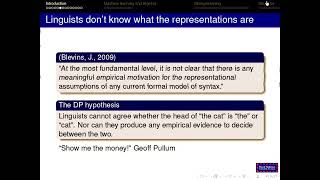
Weak and Strong Learning of Context-Free Grammars - 2012
Explore recent advancements in unsupervised learning of context-free grammars and the transition from weak to strong learning algorithms for accurate syntactic structure prediction.
Higher Algebra and Koszul Duality - Talk 28
Delve into advanced mathematical concepts exploring higher algebra, operads, and Koszul duality, understanding the relationship between Lie algebras and commutative algebras in group theory.
Hecke Eigensheaves via Chiral Homology - Talk 26
Delve into advanced mathematical concepts exploring Hecke eigensheaves through chiral homology, examining the quantized global Hitchin fibration and Kac-Moody localization applications.
Localizing Motives, Algebraic KK-Theory and Refined Negative Cyclic Homology
Delve into advanced algebraic geometry concepts exploring localizing motives, their rigidity properties, and applications in refined negative cyclic homology and topological cyclic homology.
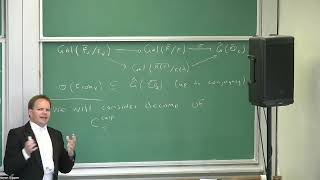
Shtukas and Global Langlands for Function Fields - Talk 37
Delve into V. Lafforgue's groundbreaking proof of global Langlands correspondence, exploring shtukas, geometric Satake, and excursion operators in function fields through expert analysis.
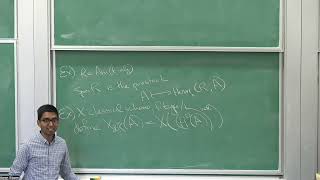
Basics of Derived Algebraic Geometry - Talk 38
Dive into fundamental concepts of derived algebraic geometry, exploring prestacks, tangent complexes, quasi-smooth derived schemes, and ind-coherent sheaf singular support analysis.
The Stacks of n-Truncated Barsotti-Tate Groups - Part 3
Delve into advanced algebraic geometry concepts focusing on n-smooth group schemes over F_p-schemes and their relationship with BT_n groups, exploring commutative structures and theoretical foundations.
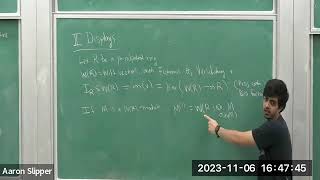
The Moduli Stack of Displays - Introduction to Zink's Display Theory
Delve into advanced algebraic geometry concepts through Zink's display theory, exploring Dieudonne theory extensions and connections to Barsotti-Tate groups in characteristic p settings.
Keynote - Historical Lessons for Improving Cyber Security
Historical lessons for improving cybersecurity: outsiders' role in cryptography advances, attention to seemingly foolish ideas, and applying risk analysis from nuclear deterrence to cryptography.