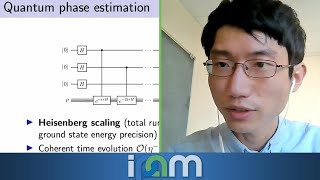
Heisenberg-Limited Ground State Energy Estimation for Early Fault-Tolerant Quantum Computers
Explore Heisenberg-limited ground state energy estimation for early fault-tolerant quantum computers, featuring a simplified circuit and classical post-processing for improved efficiency.
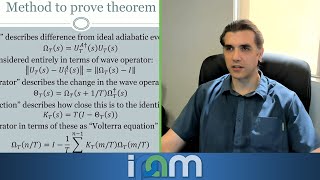
Optimal Scaling Quantum Linear Systems Solver via Discrete Adiabatic Theorem
Explore optimal quantum linear systems solver using discrete adiabatic theorem, achieving linear complexity in condition number and precision, with simplified implementation and constant factor analysis.
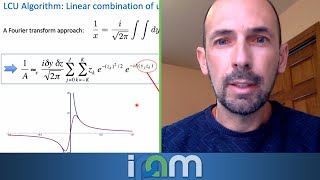
The Quantum Linear Systems Problem - IPAM at UCLA
Explore quantum algorithms for solving linear systems, including improved methods and complexity analysis, with a focus on potential exponential speedups and verification challenges.
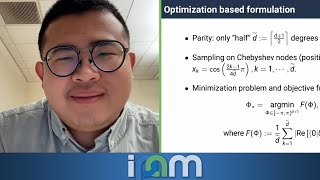
Fast Algorithms for Quantum Signal Processing - IPAM at UCLA
Explore fast algorithms for quantum signal processing, focusing on optimization techniques, energy landscapes, and phase factor structures in quantum singular value transformation.
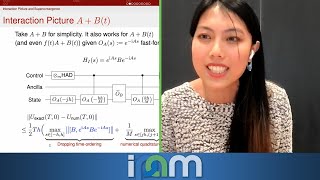
Time-Dependent Hamiltonian Simulation of Highly Oscillatory Dynamics - IPAM at UCLA
Explore highly oscillatory dynamics in quantum systems, focusing on efficient simulation algorithms for time-dependent Hamiltonians with applications in various scientific fields.
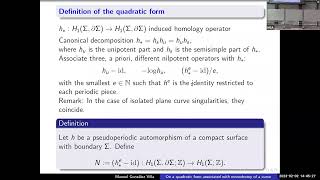
Quadratic Forms in Surface Automorphisms and Singularity Theory
Explore pseudo-periodic surface automorphisms, quadratic forms, and their applications in singularity theory. Gain insights into Milnor fibers and monodromy automorphisms.
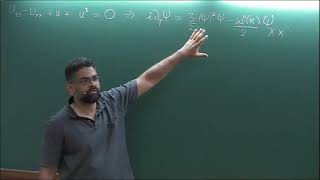
Perturbation Methods for Nonlinear PDEs - Lecture 3
Explore advanced perturbation techniques for nonlinear PDEs, focusing on multiple scales, asymptotic analysis, and the interplay between linear waves and nonlinearity in various scientific contexts.
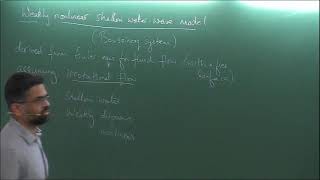
Perturbation Methods for Nonlinear PDEs - Lecture 4
Explore perturbation methods for nonlinear PDEs, focusing on shallow water waves and damped KDV models. Learn unified approaches to adapt linear equation techniques to nonlinear contexts.
Perturbation Methods for Nonlinear PDEs - Lecture 2
Explore perturbation methods for nonlinear PDEs, focusing on nonlinear oscillators and periodic solutions. Learn techniques like inner products, perturbation series, and 2Pi periodicity to tackle complex equations.
Perturbation Methods for Nonlinear PDEs - Lecture 1
Explore perturbation methods for nonlinear PDEs, focusing on adapting linear equation techniques. Learn unified approaches through examples from cold atoms, water waves, and atmospheric science.
Introduction to Optimal Transportation and Monge Ampère Type Equations - Lecture 2
Explore optimal transportation and Monge Ampère equations, covering key concepts like super differentials, isoperimetric problems, and probability measures in this advanced mathematics lecture.
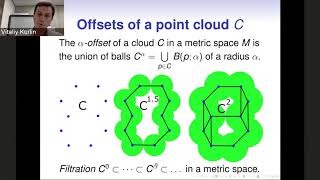
Skeletonization Algorithms With Theoretical Guarantees for Point Clouds
Explore skeletonization algorithms for point clouds, including Mapper, alpha-Reeb graphs, and Homologically Persistent Skeleton. Compare their performance on synthetic and real data sets.
Secure Distributed Matrix Multiplication
Explore information-theoretic methods for secure distributed matrix multiplication, focusing on trustworthy machine learning applications and techniques.
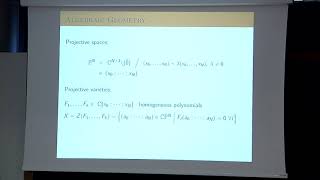
The Geometry of Tensors - Carolina Araujo
Explore tensor decomposition, its applications, and geometric interpretation. Learn about recent developments in determining tensor ranks and their significance in various fields.
AlphaTensor - Discover Faster Matrix Multiplication Algorithms with RL - IPAM at UCLA
Discover how DeepMind's AlphaTensor uses reinforcement learning to find efficient matrix multiplication algorithms, outperforming human-designed methods and improving on Strassen's algorithm after 50 years.
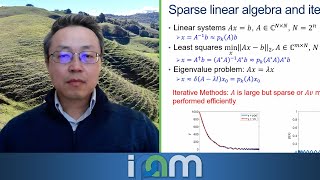
Practical Quantum Circuits for Block Encodings of Sparse Matrices
Explore efficient quantum circuits for block encodings of sparse matrices, focusing on strategies for well-structured matrices and quantum walks on graphs. Gain insights into quantum linear algebra algorithms.
Theory Seminar - On Linear Data Structures and Matrix Rigidity, Sivaramakrishnan Ramamoorthy
Explores systematic linear data structures, rectangular rigidity, and their equivalence. Discusses rigidity lower bounds and Cayley graphs, presenting recent research findings and open problems.
Theory Seminar - Algorithms and Hardness for Linear Algebra on Geometric Graphs, Aaron Schild
Explore algorithms and hardness for linear algebra on geometric graphs, focusing on efficient spectral graph theory and its limitations in high-dimensional spaces.
Arduino with Python - Simple Introduction to Matplotlib
Learn to create basic plots and graphs using Matplotlib in Python, including data visualization, customization, and array generation techniques.
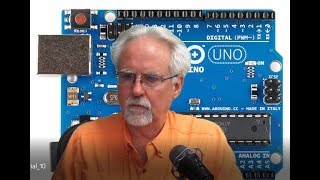
Using Servo in a Simple Project with Arduino
Learn to build a visual light brightness indicator using Arduino and servo, applying algebra for precise control and real-world sensor integration.
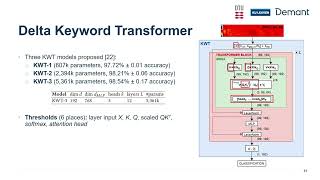
Delta Keyword Transformer: Bringing Transformers to the Edge Through Dynamically Pruned Multi-Head Self-Attention
Explore cutting-edge techniques for optimizing Transformers in edge computing, focusing on the Delta Keyword Transformer and its dynamic pruning approach for efficient multi-head self-attention.