The Algebra of Natural Number Multisets - Data Structures in Mathematics
Explore multiset algebra in natural numbers, introducing notation and operations. Discover potential extensions to negative and rational multiplicities, with implications for modern algebra.
Alan Turing and the Other Theory of Computing and Can a Machine Be Conscious?
Explore Turing's lesser-known 1948 paper on numerical computation and its impact on complexity theory. Discover how it unifies two major traditions in computational theory.

Neural Nets - Rotation and Squashing
Explore neural network fundamentals, including affine transformations, non-linearities, and PyTorch implementation. Learn about ReLU, tanh, and deep network architectures through intuitive explanations and coding examples.

C++ STL
Comprehensive overview of C++ STL, covering data structures and algorithms. Learn efficient coding techniques and boost your programming skills with practical examples.
Learning Mixtures of Linear Regressions in Subexponential Time via Fourier Moments
Explore efficient algorithms for learning mixtures of linear regressions using Fourier moments, overcoming previous barriers and achieving subexponential time complexity.
Optimization Crash Course
Explore geometric methods in optimization and sampling, covering key topics like convexity, optimality, and gradient descent with expert insights from MIT's Ashia Wilson.
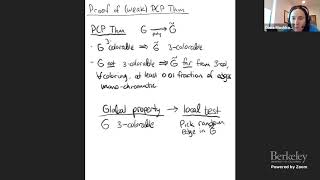
Crash Course on Probabilistically Checkable Proofs - PCP
Explore probabilistically checkable proofs, their formulation, global vs local tests, and computational implications in this comprehensive lecture on advanced theoretical computer science concepts.
Practical Applications of Homomorphic Encryption
Explore practical applications of homomorphic encryption, including ORAM optimization and MNIST inference, with insights on performance and implementation using Microsoft SEAL.
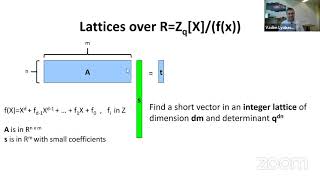
Signatures, Commitments, Zero-Knowledge, and Applications
Explore lattice-based cryptography, focusing on polynomial rings, homomorphic encryption, and zero-knowledge proofs. Learn about theoretical foundations and practical applications in modern cryptographic systems.
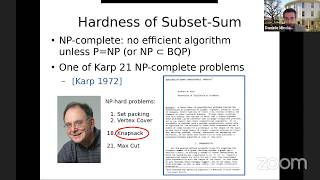
Lattices, Post-Quantum Security and Homomorphic Encryption
Explore lattice-based cryptography's foundations, quantum resistance, and encrypted data computation capabilities in this lecture on modern cryptographic techniques and applications.
An LLL Algorithm for Module Lattices
Explore an LLL algorithm for module lattices, covering key concepts, previous works, and algorithm details. Gain insights into lattice geometry and computational challenges.
Algebraic Lattices and Ring Learning With Errors
Explore algebraic lattices and Ring Learning with Errors, covering key concepts, operations, and hardness theorems in cryptography and lattice-based algorithms.
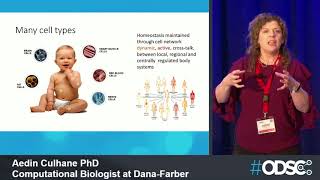
Unsupervised Feature Learning with Matrix Decomposition - Aedin Culhane, PhD | ODSC East 2018
Explore unsupervised learning techniques for high-dimensional data analysis, focusing on matrix factorization methods and their applications in oncology and precision medicine.
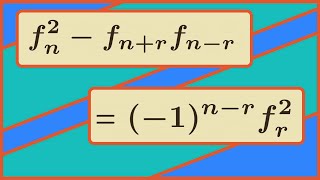
Catalan's Identity for Fibonacci Numbers
Explore Catalan's identity for Fibonacci numbers through matrix properties, building on previous proofs of Cassini's and d'Ocagne's identities in this mathematical deep dive.
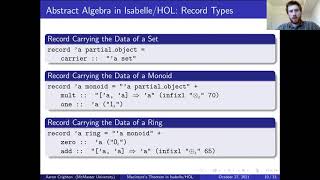
Formalizing Macintyre's Theorem in Isabelle-HOL
Exploration of formalizing Macintyre's Theorem in Isabelle/HOL, covering proof strategies, challenges, and foundational elements needed for a verified proof in the context of p-adic numbers.
The Sensitivity Conjecture: A Proof from the Book and Connections to Physics
Explore the elegant proof of the Sensitivity Conjecture, its implications for theoretical computer science, and connections to physics concepts like Majorana fermions.
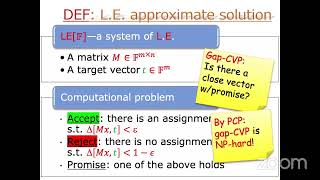
Mathematics of Computation Through the Lens of Linear Equations and Lattices
Explore mathematical foundations of computation through linear equations and lattices, covering error correction, vector problems, and lattice theory with implications for future computing.
David Gross: Stabilizer Formalism & Quantum Error Correction Through the Lens of Tensors
Explore advanced quantum error correction techniques, focusing on the stabilizer formalism and its applications in quantum fault tolerance, using tensor-based approaches and group theory.
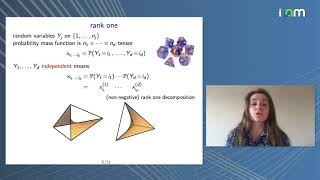
Tensors in Statistics and Data Analysis
Explore tensors in statistics and data analysis, covering probability tensors, biological measurements, and signature tensors for time-series data. Learn about decompositions and algebraic properties in this comprehensive overview.
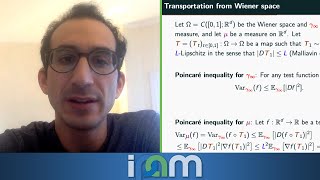
The Brownian Transport Map - IPAM at UCLA
Explore Lipschitz transport maps between probability measures, focusing on the Brownian transport map's construction, properties, and applications to Euclidean functional inequalities.
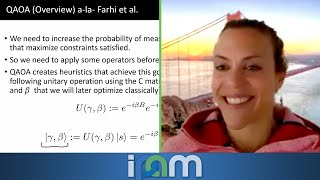
Quantum Approximate Optimization Algorithm and Local Max-Cut - IPAM at UCLA
Explore quantum optimization algorithms, focusing on QAOA's application to LocalMaxCut. Discover insights on quantum supremacy and the performance comparison between local algorithms and QAOA on various graph instances.