
Applied C++20 Coroutines
Practical guide to implementing C++20 coroutines in real-world applications, focusing on web server development, performance evaluation, and future C++ updates.
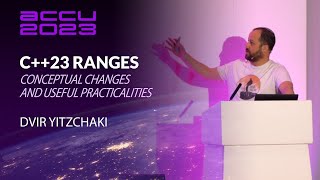
C++23 Ranges - Functional Programming With New View Adaptors and Other Utilities
Explore C++23 Ranges' conceptual changes and practical utilities, including owning views, new algorithms, and adaptors like std::generator for implementing range adaptors and printing ranges.

Programming in Modern C with a Sneak Peek into C23
Explore modern C programming features, including compound literals, flexible array members, and upcoming C23 additions. Enhance code readability, safety, and performance in low-level programming.
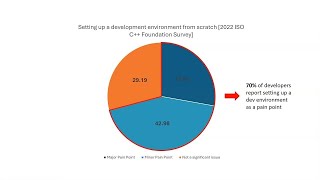
Cracking Collaboration - Problems and Solutions for C++ Modern Development
Explore tools and solutions for effective collaboration in distributed C++ development teams, including Live Share, CMake Presets, and cloud-based IDEs to enhance productivity and problem-solving.

Linux Debuginfo Formats - DWARF, ELF, dwo, dwp - What are They All?
Explore Linux debugging tools, debug info formats, and compiler options for effective troubleshooting. Learn about ELF, DWARF, split dwarf, and debuginfod to enhance your debugging experience.

Using Both Cores of Raspberry Pi Pico with C++OS - Coroutines and std - execution in Embedded Systems
Explore C++20 coroutines and std::execution for multi-core programming on Raspberry Pi Pico. Learn to implement portable embedded applications using C++OS, a proof-of-concept system for bare-metal multitasking.

Low-Latency Trading Systems in C++ - Templated Meta-State Machines in HFT
Explore advanced C++ techniques for optimizing low-latency trading systems using templated meta-state machines in high-frequency trading environments.

Psychology of Software Development - We’re Only Human After All
Explore the human aspects of software development, understanding how psychology impacts team dynamics, problem-solving, and coding practices for improved collaboration and productivity.

C++ And Beyond - Discussion
Expert panel discusses C++'s future, evolution, and challenges in the face of new programming languages, exploring topics like backward compatibility, standardization, and community-driven progress.

CMake - A Case Study
Explore advanced CMake techniques for integrating unsupported libraries and tools, focusing on embedded SQL in C++ applications with Oracle databases. Learn expert-level build setup strategies.

Spooky Action at a Distance - Revisiting C++ Observers
Explore C++ Observer pattern implementations, trade-offs, and practical applications in various scenarios. Learn from real-world examples to improve code structure and design.

C++ Coroutines From Scratch
Explore C++ coroutines through a practical example, comparing traditional approaches with coroutine-based solutions. Learn how coroutines simplify asynchronous programming and improve code clarity.

Monads in Modern C++
Demystifying monads in C++23: Learn functional programming techniques to simplify code, reduce boilerplate, and create pure pipelines. Explore practical examples and recent developments in std::vector and std::optional.

Concurrency Approaches - Past, Present, and Future
Explore the evolution of concurrency approaches, analyzing their pros and cons, and discover a new model that promises safety, efficiency, structure, and ease of use in concurrent programming.
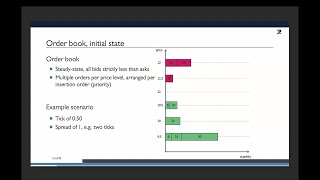
C++ Electronic Trading for Cpp Programmers
Explore electronic trading for C++ developers, covering market dynamics, low-latency strategies, and optimized programming techniques for high-frequency trading systems.
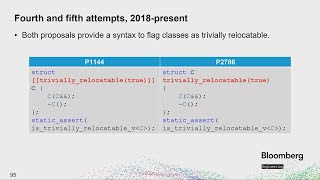
C++ Trivial Relocation Through Time
Explore the concept of trivial relocatability in C++, its performance benefits, and various proposals to incorporate it into the standard, enhancing container efficiency for non-trivial types.

Introduction to Epoch-Based Memory Reclamation - What to Do When No Thread is Watching
Explore epoch-based memory reclamation in concurrent programming, comparing it to hazard pointers and discussing its characteristics, benefits, and potential drawbacks for efficient memory management.

Comparing 'Classic C++' and 'Modern C++' Ways to Solve Programming Tasks
Explore the evolution of C++ programming techniques, comparing classic and modern approaches to solve common tasks, with insights on readability, efficiency, and best practices.
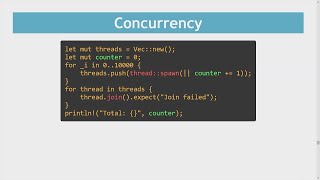
Rust for the Recalcitrant C++ Programmer - ACCU 2023
Comparative exploration of Rust features for C++ programmers, highlighting ownership, type system, immutability, pattern matching, and concurrency, with practical examples and discussions.

Binary File Format Engineering and Reverse Engineering
Explore binary file formats, from basics to advanced techniques. Learn engineering principles, reverse engineering methods, and practical applications in software development.
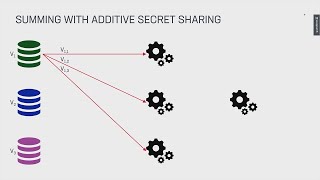
Introduction to Secure Multi-Party Computation
Explore secure multi-party computation techniques for joint calculations on private data without revealing inputs. Learn about homomorphic encryption, garbled circuits, and secret sharing.