jGuard - Programming Misuse-Resilient APIs
Explore jGuard, a Java extension enabling API designers to encode specifications directly, preventing misuse without additional tooling for users. Enhance API resilience effortlessly.
Contextualized Programming Language Documentation - Enhancing Learning with Adaptive Explanations
Generate contextualized programming language documentation tailored to specific code, improving learning efficiency and understanding for developers working with new languages.

GHC Plugin for Setting Breakpoints in Concurrent Programs
Explore a GHC plugin for improved breakpoint functionality in concurrent programs, addressing limitations in GHCi's built-in debugger.

Combinator-Based Fixpoint Algorithms for Big-Step Abstract Interpreters
Explore combinator-based fixpoint algorithms for big-step abstract interpreters. Learn to develop and ensure soundness of sophisticated fixpoint algorithms using reusable combinators for static analysis.
A Haskell Auto-Parallelizer for Distributed Computing
Explore a Haskell auto-parallelizer for distributed computing, leveraging function purity to create scalable and performant applications on large clusters.
Wasocaml: A Compiler from OCaml to WebAssembly - Lecture
Explore OCaml to WebAssembly compilation, addressing challenges and strategies for garbage-collected languages. Learn about Wasocaml compiler, value representation, and future plans for FFIs and effects handlers.

Realizing Persistent Signals in JavaScript
Explore persistent signals implementation in JavaScript, enabling time-travel functionality and broader application in web development through relay-server architecture and DSL library approach.
Conflict-Driven Synthesis for Layout Engines
Explore Medea, a framework for automatically generating efficient and correct incremental layout engines, addressing challenges in web browser development and improving performance.
Approaching Cloud-native RabbitMQ
Explore RabbitMQ as a centerpiece of serverless/cloud technologies, focusing on Knative integration, Cloudevents ecosystem, Observability frameworks, and OpenTelemetry Messaging Semantic Conventions.
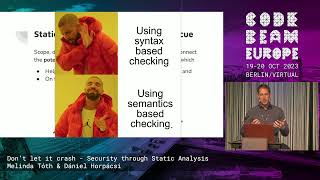
Security Through Static Analysis - Don't Let It Crash
Explore static analysis techniques for detecting and mitigating security vulnerabilities in Erlang/Elixir projects, focusing on data-flow analysis and real-world examples from open-source codebases.

QUICER: Next Generation Transport Protocol Library for BEAM
Explore QUIC protocol and QUICER library for BEAM, covering key features, benefits, and implementation. Learn about next-generation transport protocols and their impact on internet communication.

Lambdapad - Static Websites with Elixir or Erlang - Code BEAM Europe 2022
Explore Lambdapad, a static site generator for BEAM languages. Learn its features, setup process, and see a live demo for creating websites easily with Elixir or Erlang.

Everything About DNS You Never Dared to Ask
Explore DNS fundamentals, from authoritative servers to ICANN. Learn domain transfer techniques and DNS utilization for app scaling and distribution. Gain insights into this crucial internet pillar.

Bringing OpenCV to the Elixir World
Explore OpenCV integration in Elixir with Evision, learn its creation process, see practical demos, and discover its potential for computer vision and machine learning pipelines.

Deep Dive in Nx Backends - Lecture 1
Explore Nx Backends in Elixir, understanding their impact on performance and automatic differentiation. Learn about backend structure, runtime dispatching, and integration with Axon for deep learning.

How Elixir Helped Me to Love the Back End
Discover how Elixir transforms backend development, making it intuitive and approachable for JavaScript developers. Gain confidence to explore new coding territories and understand Elixir's advantages.
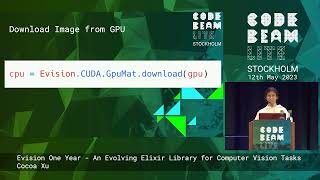
Evision: An Evolving Elixir Library for Computer Vision Tasks
Explore Evision, an evolving Elixir library for computer vision. Learn about Kino widgets, Nx integration, and performance comparisons across CPU, OpenCL, and CUDA for image processing tasks.

Wired Up - Using Ecto Without Schemas
Explore advanced Ecto features for dynamic data handling without schemas. Learn to create custom query languages and work with unknown database tables at compile time.
Building a Framework - Membrane's Journey to 1.0
Explore the challenges and lessons learned in developing Membrane, an open-source framework, as it approaches its 1.0 release. Gain insights into framework design, API creation, and open-source development.

Distributed and Parallel Image Processing on Livebook - ElixirConf EU 2023
Explore distributed and parallel image processing in Elixir using Livebook. Learn to implement face-hiding techniques with Nx and Evision, leveraging Flow for faster and more robust processing.
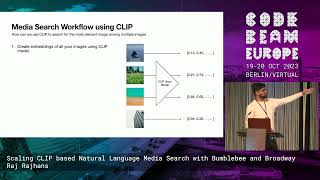
Scaling CLIP-Based Natural Language Media Search with Bumblebee and Broadway
Harness Elixir's power for machine learning with Bumblebee and Broadway. Learn to implement scalable natural language media search using CLIP, showcasing Elixir's capabilities in ML applications.