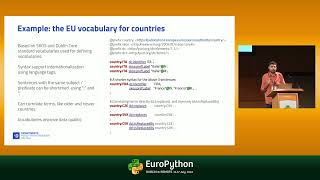
Self-Explaining APIs
Strategies and tools for creating semantically interoperable REST APIs, including contract-first development, RDF processing, and centralized catalogs. Ideal for those with API design experience.
Async Django
Explore asynchronous programming in Django, covering key concepts, tools, efficient practices, and Django's async request handling from NGINX to database operations.
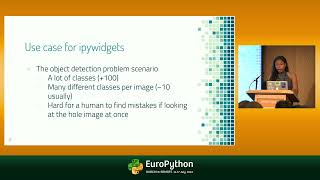
Creating Great User Interfaces on Jupyter Notebooks with Ipywidgets
Learn to create user-friendly interfaces in Jupyter Notebooks using ipywidgets, enabling data scientists to build interactive tools without extensive front-end skills or deployment concerns.
Real-Time Browser-Ready Computer Vision Apps with Streamlit
Learn to build real-time computer vision applications for browsers using Streamlit and streamlit-webrtc, with demos of object detection, speech-to-text, and style transfer.
Walk-through of Django Internals
Explore Django's inner workings, from request handling to ORM and server startup. Gain deep insights into the framework's structure and processes for better development and troubleshooting.
Maps with Django
Learn to create interactive web maps using Django's GeoDjango module, from simple Spatialite-based maps to complex PostGIS-powered solutions, without relying on external services.
Robyn - An Async Python Web Framework with a Rust Runtime
Explore Robyn, a high-performance async Python web framework with a Rust runtime. Learn its creation, technical decisions, performance benefits, and future plans for web app development.

Jupyter - Under the Hood
Explore Jupyter's architecture: from notebook server to IPython kernel. Dive into REST APIs, ZMQ sockets, and internal workings of Jupyter Notebook, JupyterLab, and JupyterHub.
Saving Lives with Predictive Geo - AI
Explore geospatial Python libraries for Multi-Criteria Decision making, including imagery dataset processing, overlay analysis, and zonal statistics. Learn to create intuitive geo-visualization portals using vector tiles.
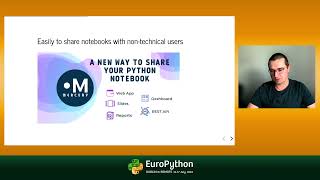
Mercury - Build & Share Data Apps from Jupyter Notebook
Learn to transform Jupyter Notebooks into interactive web apps using Mercury framework. Explore features, architecture, and deployment options for sharing data applications effortlessly.
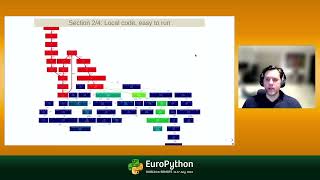
Why is it Slow? Strategies for Solving Performance Problems
Explore strategies for detecting, diagnosing, and solving performance issues in Python applications, covering tracing, profiling, isolation, reasoning, and prevention techniques.
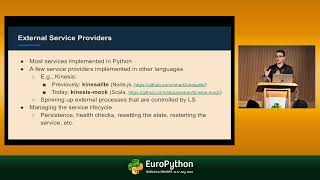
LocalStack - Turbocharging Dev Loops and Team Collaboration for Cloud Applications
Optimize cloud development with LocalStack: a local AWS cloud stack for faster testing, debugging, and collaboration. Explore hands-on scenarios, integrations, and Python internals.
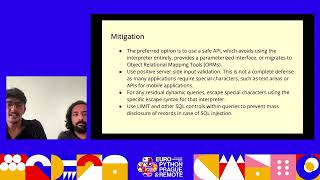
Pygoat - Learn Django Security the Hard Way
Explore OWASP top 10 vulnerabilities in Django apps using Pygoat, an intentionally vulnerable application. Learn to identify, exploit, and mitigate security risks for robust web development.
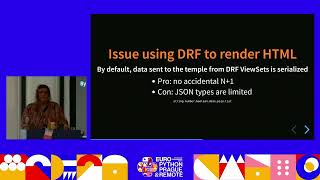
Leveraging the Power of Django REST Framework's Renderers with HTMX
Explore the powerful combination of HTMX with Django REST Framework's flexible renderer system, unlocking new possibilities for dynamic web applications.
Upgrading Django - From Legacy to Latest
Practical tips and tricks for upgrading legacy Django projects to the latest version, ensuring smooth transitions and improved functionality for long-standing web applications.
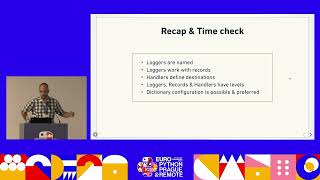
A Quick Guide to Logging for Django Developers
Explore Python's logging module, its integration with Django, and techniques to enhance logging for efficient troubleshooting and debugging in web projects.
GraphQL Subscriptions - Real-time Data with WebSockets and Strawberry
Explore real-time data delivery using GraphQL Subscriptions and WebSockets with Strawberry. Learn to design subscription schemas, handle server-side events, and enhance client-side experiences with seamless updates.
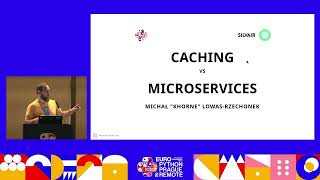
Caching in Microservices
Explore cache invalidation strategies in microservice architectures through live coding, focusing on implementing efficient caching to reduce database queries without altering API clients.
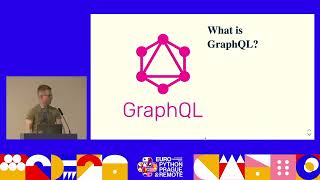
GraphQL as an Umbrella for Microservices
Explore how GraphQL can simplify complex microservices architectures, serving as an effective API gateway for modern single-page applications and distributed systems.
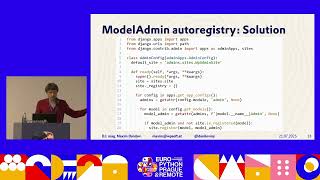
Ultimative Session About Hidden Gems of Django Admin
Descubre funcionalidades ocultas del panel de administración de Django para acelerar el desarrollo. Aprende sobre sitios múltiples, ModelAdmins, versionado de objetos y configuraciones de aplicaciones.
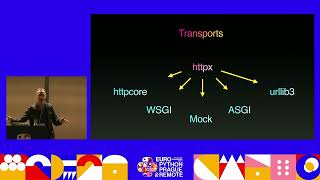
Designing an HTTP Client
Explore HTTPX architecture, HTTP client design decisions, and gain deeper HTTP understanding with insights from Tom Christie's EuroPython talk on building robust Python HTTP clients.