How to Develop a Robust Operator for Day-2 Operations - Lessons from KubeVirt and HCO
Discover strategies for developing robust Kubernetes operators, focusing on day-2 operations, upgrades, and reliability. Learn from KubeVirt project experiences to enhance your operator development skills.
Experience with Hard Multi-Tenancy in Kubernetes Using Kata Containers
Explore Databricks' implementation of hard multi-tenancy in Kubernetes using Kata Containers, addressing challenges, trade-offs, and cloud provider heterogeneity for secure serverless platforms.
Calling OPA from eBPF Through WASM in the Kernel - Exploring Unconventional Technology Integration
Explore the integration of eBPF, WASM, and OPA in kernel space, showcasing innovative approaches to cloud-native technologies and their potential impact on system performance and security.
Balancing Yin and Yang in Open Source Software - Community and Company Perspectives
Strategies for companies to practice "Business Aligned Open Source" in Kubernetes, addressing sustainability challenges and fostering community-company balance in open-source development.
Supercharge Your Kubernetes AI Deployments with WebAssembly
Optimize AI deployments on Kubernetes using WebAssembly for improved performance, security, and portability. Learn to leverage WASI and Krustlet for efficient machine learning model deployment.
Building a Sustainable CNCF Project Contributor Base
Strategies for building a sustainable open source project community, including contributor growth, governance, onboarding, mentoring, and leadership development to reduce maintainer burnout.
Making VMs a First-Class Citizen in Kubernetes with KubeVirt
Explore KubeVirt for running VMs in Kubernetes, covering setup, networking, live migration, snapshots, scaling, and integrations. Learn to manage virtual machines efficiently in cloud-native environments.
Challenges in Analysing Virtualisation Stacks - Dr Michael Tautschnig
Explore challenges in analyzing virtualization stacks, including shared responsibility, open-source software analysis, and coping with large codebases. Learn about workflows, bug reporting, and formal methods.
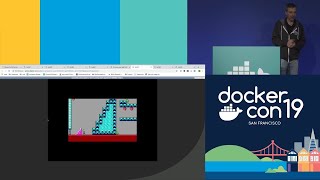
Retro Gaming with Docker - Building Cloud-Hosted DOS Games and BBS Platforms
Explore containerizing and hosting classic DOS games and BBS door games in the cloud using Docker, enabling online retro gaming experiences and innovative uses of container technology.
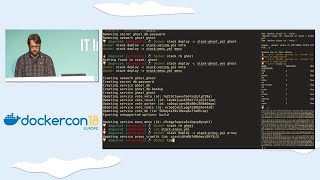
Building Your Swarm Tech Stack for Docker Container Platform
Practical guide to building a container cluster stack using Docker, covering OS selection, architecture, and tool integration for various scenarios including open-source and enterprise options.
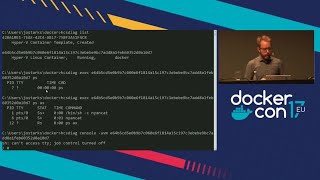
Linux Containers on Windows - The Inside Story
Explore the architecture and implementation of Linux Containers on Windows (LCOW) with insider insights from the project's lead architect, covering key components and technical details.
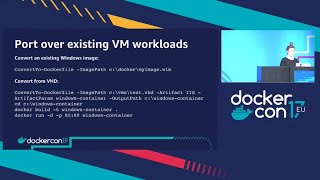
Creating Effective Docker Images
Learn to create efficient Docker images, optimizing disk space, enhancing security, and implementing best practices for production environments. Covers layers, base images, caching, and language-specific tips.
Docker Multi-arch: Extending to Windows, ARM, and IBM Platforms
Explore Docker's extension to Windows, ARM, and IBM platforms, covering multi-architecture images, heterogeneous swarms, and cross-platform deployment strategies.
Docker 101 - Introduction to Docker and Containers
Learn container basics, compare with VMs, and explore Docker's enterprise benefits for cost reduction and innovation. Understand images, layers, and the secure software supply chain.
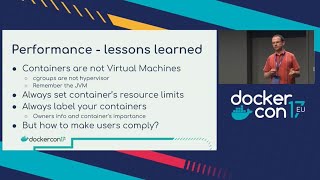
Dockerizing Aurea - Migrating Legacy Applications to Containers
Learn how Aurea migrated 2,000+ instances to 1,700 Cloud containers, achieving cost savings and improved resource usage. Discover key learnings, ROI metrics, and tips for dockerizing legacy applications.
Peeling Back the Layers of Storage - From Physical Disks to Advanced File Systems
Comprehensive overview of Linux storage options, from basic physical disks to advanced layered systems, covering partitioning, encryption, caching, and file management techniques.
IOMMUFD Integration in QEMU
Explore IOMMUFD integration in QEMU, covering new user API for IOMMU control, redesign challenges, backward compatibility, and impact on management layers like libvirt.
Hypervisor.Framework - Virtualization on macOS
Explore macOS's Hypervisor.Framework, its design principles, and implementation on Intel and Apple Silicon CPUs. Learn how QEMU utilizes this technology for virtual machine provisioning.
Optimizing KVM Performance for Electronic Health Record Systems
Optimizing KVM for Electronic Health Record systems: Reducing speculation overheads, accelerating IPI delivery, and enhancing ecosystem components for improved performance and reliability.
How Fast Can We Go? Booting a Linux VM to Userspace in 100ms and Beyond
Explore techniques to optimize Linux VM boot times, aiming for sub-100ms userspace access. Learn about performance analysis, mitigation strategies, and trade-offs in virtualization technology.
NVMe Emulation Performance Optimization Techniques in QEMU
Explore NVMe emulation optimization techniques to boost performance from 30 KIOPS to 330 KIOPS, including shadow doorbell buffers, ioeventfd, iothread, and polling strategies.