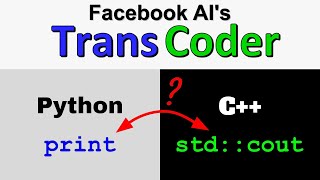
TransCoder - Unsupervised Translation of Programming Languages
Explore unsupervised neural machine translation for code migration between Python, C++, and Java. Learn about shared embeddings, objectives, evaluation, and results of this innovative approach.

Deep Generative Modeling
Explore deep generative modeling, including autoencoders, VAEs, and GANs. Learn about latent variables, representation learning, and applications in debiasing and image synthesis.
Machine Learning - The Bare Math Behind Libraries
Explore the mathematical foundations of machine learning, from basic algorithms to neural networks. Gain insights to confidently select and optimize ML models for practical applications.
Today Unsupervised Sentence Transformers, Tomorrow Skynet - How TSDAE Works
Explore unsupervised fine-tuning for sentence transformers using TSDAE. Learn to train models without labeled data, ideal for domains and languages with limited resources.
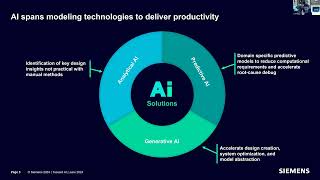
Big Strides in Electronics Test and Production - From Algorithmic Methods to Unsupervised Machine Learning
Discover how algorithmic methods and unsupervised machine learning are revolutionizing electronics testing and production processes for enhanced efficiency and automation.
Introduction to Machine Learning - Lecture 1
Discover the foundational concepts of machine learning, exploring its core principles, learning protocols, and real-world applications in this introductory lecture.
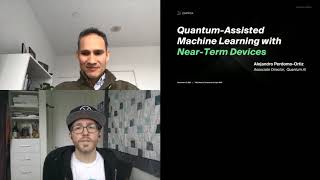
Quantum-Assisted Machine Learning with Near-Term Quantum Devices
Explore quantum-assisted machine learning applications for near-term devices, focusing on generative models in unsupervised and semi-supervised learning. Discover recent experimental implementations.
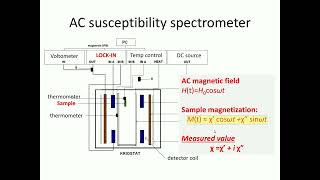
Application of Unsupervised Learning to AC Susceptibility Measurements of High-Temperature Superconductors
Explore unsupervised learning applications in analyzing AC susceptibility measurements of high-temperature superconductors, focusing on clustering techniques and data representation methods.

Exploring Clustering Algorithms in Machine Learning
Dive into clustering algorithms, exploring principles and real-world applications. Learn various types, including K-means, and understand how to implement and evaluate them effectively.
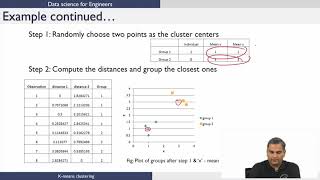
K-Means Clustering
Explore K-means clustering algorithm, its applications, and implementation techniques for effective data analysis and pattern recognition.
Climbing the Ladder of Causation Toward Mid-Level Vision
Explore mid-level visual concepts and their origins through Counterfactual World Models, examining how unsupervised algorithms can enhance machine and biological vision understanding.
Natural Artificial Intelligence - Keynote JuliaCon 2024
Exploring brain-inspired AI: Free Energy Principle, unsupervised learning, and real-time skill acquisition. Insights into brain computations and their application to AI engineering tools using Julia.
Exploring Anomalies in Authentication Logs with Autoencoders
Discover how autoencoders can enhance cybersecurity by detecting anomalies in authentication logs, overcoming limitations of traditional rule-based models and improving threat detection capabilities.

Domain Adaptation on Wheels: Closing the Gap to the Open-world
Explore domain adaptation techniques for autonomous driving, from standard unsupervised setups to practical approaches addressing open-world challenges in semantic segmentation and scene understanding.
Introduction to Machine Learning - Clustering - Part 3
Explore clustering in machine learning, focusing on k-means and hierarchical algorithms. Learn to uncover data relationships and apply techniques with practical considerations.
Machine Learning - Finding Patterns in the World
Explore patterns in data using machine learning techniques. Gain insights into real-world applications and methodologies presented by a Johns Hopkins expert.

Annotation-Efficient Object Detection: Unsupervised Discovery to Active Learning
Explore annotation-efficient object detection techniques, from unsupervised discovery to active learning strategies, enhancing intelligent systems with less manual input.
Введение в машинное обучение - Часть I
Изучите основы машинного обучения, включая ключевые концепции, алгоритмы и методы анализа данных для решения практических задач.
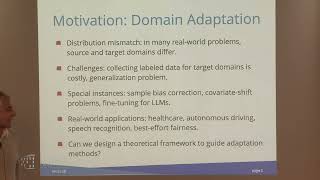
A Discrepancy-Based Theory of Domain Adaptation
Delve into domain adaptation theory through discrepancy concepts, exploring sample reweighting techniques and algorithmic applications for robust machine learning solutions.