Mestrado: Computação, Lógica e Teoria dos Conjuntos - Aula 12
Explore formal languages, register machines, decidability, algorithmic complexity, first-order logic, and set theory in this advanced mathematics lecture.
Mestrado: Computação, Lógica e Teoria dos Conjuntos - Aula 02
Explore formal languages, register machines, decidability, algorithmic complexity, first-order logic, and set theory in this advanced mathematics lecture.

Mestrado: Computação, Lógica e Teoria dos Conjuntos - Aula 01
Explore fundamentos de computação, lógica e teoria dos conjuntos em aula de mestrado. Aborde linguagens formais, máquinas de registro, decidibilidade, complexidade algorítmica e lógica de primeira ordem.
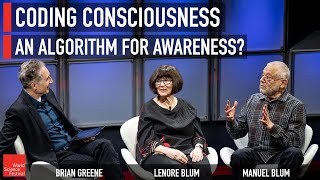
Coding Consciousness - An Algorithm for Awareness?
Explore theories of consciousness with computer scientists Lenore and Manuel Blum as they discuss the potential for coding self-awareness into algorithms, moderated by Brian Greene.
No Substitute for Functionalism
Explores types of variations in consciousness models, proving broad functionalist theories immune to substitution arguments. Discusses implications for consciousness science and functionalism.
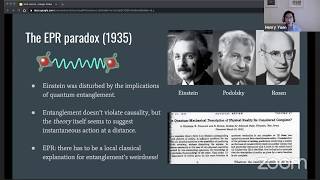
A Tale of Turing Machines, Quantum-Entangled Particles, and Operator Algebras
Explore the convergence of computational complexity, quantum information, and operator algebras in solving long-standing problems, including Connes' Embedding Problem, in this accessible lecture for a general scientific audience.
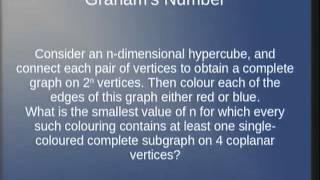
Numbers - From Merely Big to Unimaginable - Lecture 9
Explore the fascinating world of enormous numbers, from prime distribution to complex functions, and delve into advanced mathematical concepts like Ackerman operators and Ramsey Theory.
Computability and Problems with Set Theory - Math History
Explores historical controversies in set theory, Gödel's incompleteness theorems, Zermelo-Fraenkel axioms, and Turing's computability concepts, challenging traditional views on infinite sets in mathematics.
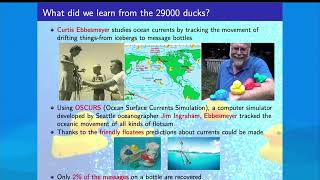
From Alan Turing to Contact Geometry: Towards a Fluid Computer
Explore the intersection of hydrodynamics, computation, and contact geometry. Discover how fluid dynamics can simulate universal Turing machines and its implications for undecidable fluid paths and celestial mechanics.
Distributed Random Access Merkledags - Exploring Registry Capabilities
Explore innovative uses of OCI registries, drawing parallels with computer architecture concepts to redefine distributed systems and introduce Distributed Random Access Merkledags.
MIP Equals RE - Putting Everything Together
Explore quantum protocols, testing, and quantum PCPs with a focus on distance measures, entanglement, compression, and the integration of key concepts in quantum computing.

Making a Computer Turing Complete
Explore Turing completeness, Turing machines, and Lambda calculus, and learn how to make an 8-bit breadboard computer capable of solving any computable problem.
Undergrad Complexity at CMU - Turing Machines
Explore Turing Machines in computational complexity theory, covering formalization, the Turing Thesis, examples, and mathematical definitions for a comprehensive understanding.
Computational Models - Turing Machines - CMU - CS Theory Toolkit
Explore Turing Machines as a computational model, covering historical advantages, multitape variations, and key concepts like memory, time, and space bounds in theoretical computer science.
Hierarchy Theorems - Time, Space, and Nondeterministic: Graduate Complexity Lecture at CMU
Explore hierarchy theorems in computational complexity, covering time, space, and nondeterministic aspects. Gain insights into encoding schemes, Turing machines, and nondeterministic certificates.
Great Ideas in Theoretical Computer Science - Turing's Legacy
Explore Turing Machines, their definition, and programming techniques in this theoretical computer science lecture, covering interpreters, formal definitions, and practical TM subroutines.
Great Ideas in Theoretical Computer Science: Computability
Explore computability theory, Turing machines, and undecidable problems in this theoretical computer science lecture, focusing on fundamental concepts and their implications.

Machine Learning News: Devin AI Exposed and NeurIPS High School Track
Explore AI news: Devin AI debunked, NeurIPS high school track, Opus as Turing machine, AI propaganda, outsourced AI labor, and ChatGPT's impact on academic writing.
Mathematical Games - Turing Machines and Turmites - Episode 19
Explore mathematical games and puzzles involving Turing machines and turmites with Ed Pegg Jr. Discover fascinating concepts in computational theory and cellular automata.
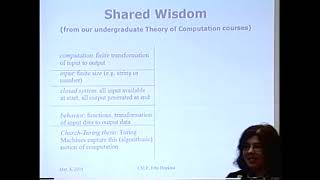
Conjectures, Results, and Myths in Interactive Computation - 2005 Lecture
Explore interactive computation paradigms, challenging traditional algorithmic models. Gain insights into Persistent Turing Machines and their implications for computational expressiveness and software engineering.
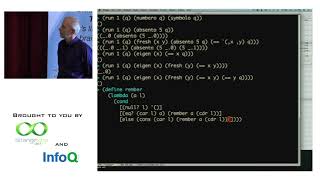
A Relational Exploration of the Chomsky Hierarchy
Explore encoding automata and Turing Machines in miniKanren for relational programming. Learn to generate strings and associated data structures, gaining insights into the Chomsky Hierarchy and automata workings.