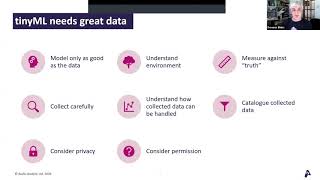
TinyML Talks - Dr. Dominic Binks- TinyML Doesn’t Need Big Data, It Needs Great Data
Explore challenges and solutions in obtaining quality audio data for tinyML sound recognition, focusing on data sources, collection methods, labeling strategies, and performance evaluation.
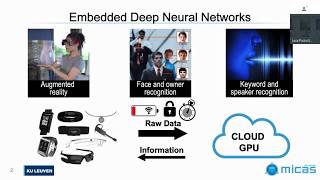
From Small to Tiny: Co-designing ML Models, Computational Precision, and Circuits - Energy-Accuracy Trade-offs
Explore co-designing ML models, computational precision, and circuits for energy-efficient tinyML systems. Learn about cross-layer optimization and cascaded networks for embedded applications.

Ultra-Low-Power Command Recognition for Ubiquitous Devices
Explore ultra-low-power command recognition for ubiquitous devices, covering noise challenges, system goals, core functions, training, and implementation on tiny hardware.

tinyMLPerf: Benchmarking Ultra-low Power Machine Learning Systems
Explore benchmarking for ultra-low power ML systems, focusing on tinyMLPerf's methodology, tasks, and ecosystem impact. Learn about quantization and community-driven efforts in this emerging field.

Resource Efficient Machine Learning in a Few KBs of RAM - tinyML Summit 2020
Explore resource-efficient machine learning techniques for IoT devices with limited RAM, focusing on Microsoft's EdgeML library and algorithms like ProtoNN and FastRNN for edge computing.
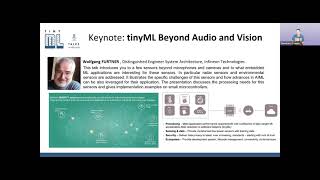
TinyML Talks - Review of the TinyML EMEA Forum - The Seeds Have Been Planted, Time for the EMEA
Comprehensive review of the inaugural tinyML EMEA Forum, highlighting key events, discussions, and future directions for the tinyML movement in Europe, Middle East, and Africa.
The "Top" Ten tinyML Commandments
Explore ten essential principles for tinyML success, covering data engineering, codesign, metrics, reproducibility, and industry collaboration, to drive innovation in embedded machine learning.
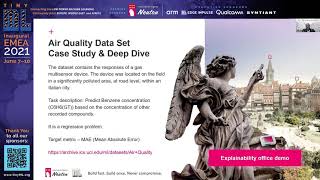
Avoiding Loss of Quality in Tiny Models - Neuton.ai Partner Session
Explore compact AI models without sacrificing quality. Learn to assess model quality, understand decision-making logic, evaluate training data, and interpret model outputs for tinyML applications.
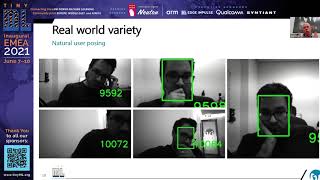
TinyML Journey - From Face Detection Demo to Real-Life Commercial Deployment
Explore the journey of TinyML from face detection demos to large-scale commercial deployment in notebooks, addressing real-world challenges and bridging the gap between technology and business.
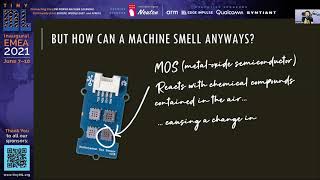
Lessons Learned from Building a TinyML-Powered Artificial Nose
Explore building a TinyML-powered artificial nose, from concept to implementation. Learn about hardware, sensors, models, and integrating TinyML applications into IoT ecosystems.
TinyML Talks - Building TinyML Applications Using Rune
Explore containerization for TinyML apps using Rune and Hammer. Learn to build efficient, portable solutions for healthcare, field ops, and telecom, with a focus on cough detection in public spaces.
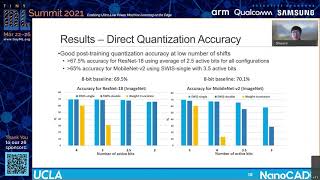
SWIS: Shared Weight Bit Sparsity for Efficient Neural Network Acceleration
Explore SWIS, a quantization framework for efficient neural network inference acceleration, offering improved performance and storage compression through weight decomposition and scheduling algorithms.
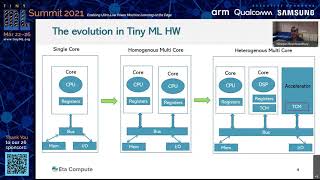
TinyML Summit 2021 Tiny Talks - TinyML Software Runtime for Hybrid Multicore Architecture
Explore software runtime for hybrid multicore architecture in TinyML, focusing on efficient resource allocation, minimized processing overhead, and optimized memory transfers for edge AI hardware.
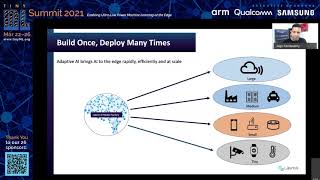
How Adaptive AI Solves Big Challenges for tinyML
Explore how Adaptive AI addresses challenges in tinyML, enabling efficient deployment of Edge AI models for smart devices and enterprise solutions.
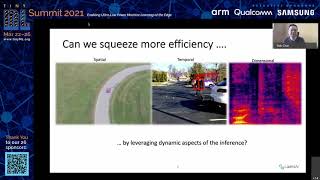
Adaptive Neural Networks for Agile TinyML - Keynote
Explore adaptive neural networks for efficient tinyML, enabling dynamic footprint minimization and runtime flexibility. Learn about throttleable networks, controller training, and hardware acceleration.
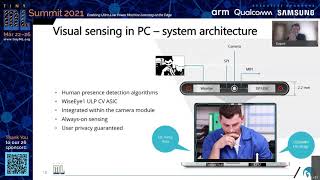
TinyML Journey: From Face Detection Demo to Real-Life Commercial Deployment
Exploring the journey from tinyML face detection demos to large-scale commercial deployment, addressing real-world challenges and bridging the gap between prototypes and practical applications.
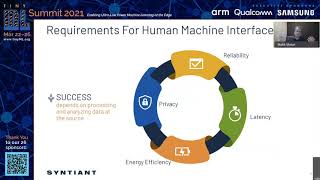
tinyML: Impact and Growth of Always-On Devices
Explore the growing impact of tinyML devices in everyday life, from always-on voice in phones to environmental sensing in machines, and learn about the market's rapid expansion and technological requirements.
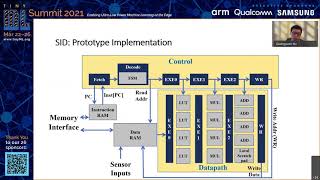
Smartphone Impostor Detection with Behavioral Data Privacy and Minimalist Hardware Support
Innovative smartphone security: Deep Learning for quick impostor detection, preserving user privacy with on-device processing and minimal hardware support.
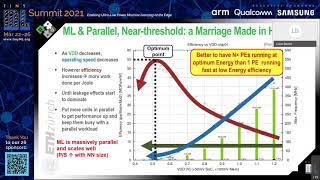
Many Shades of Acceleration - An Open TinyML Platform Perspective
Explore extreme edge AI, energy efficiency, and acceleration techniques for TinyML applications with insights from the PULP platform and RISC-V processors.
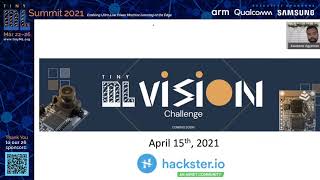
TinyML Vision Challenge - Summit 2021
Discover the tinyML Vision Challenge: Create innovative computer vision applications using tinyML, compete for $6k in prizes, and gain recognition from the tinyML Foundation.
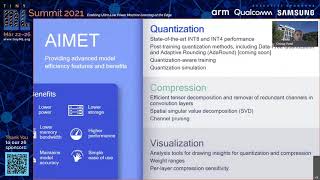
Advanced Network Quantization and Compression Using AIMET - tinyML Summit 2021
Explore advanced network quantization and compression techniques using AIMET to optimize AI models for efficient deployment on end devices, addressing memory, compute, and energy constraints.