Recursive State Machine Guided Graph Folding for Context-Free Language Reachability
Explore an innovative approach to improve CFL-reachability scalability through graph folding, reducing input size and enhancing performance in program analysis applications like alias and value-flow analysis.
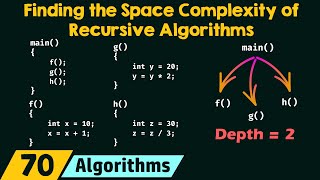
Finding the Space Complexity of Recursive Algorithms
Learn to analyze space complexity of recursive algorithms, focusing on function calls, activation records, and practical applications in algorithm design.
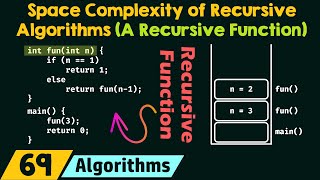
Space Complexity of Recursive Algorithms - A Recursive Function
Explore space complexity in recursive algorithms, focusing on direct and indirect recursion, and the role of call stacks in recursive functions.
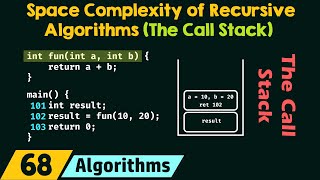
Space Complexity of Recursive Algorithms - The Call Stack
Explore the space complexity of recursive algorithms by understanding the call stack's operation and its impact on memory usage.
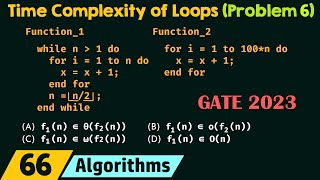
Time Complexity of Loops - Solved Problem 6
Analyze time complexity of loops through a GATE 2023 problem, enhancing algorithm understanding and problem-solving skills for computer science students.
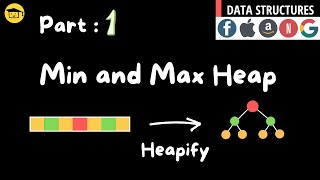
Min Heap, Max Heap, and Heapify Introduction - Lecture 1
Learn about min heap, max heap, and heapify algorithms. Explore implementation, code examples, and time complexity analysis for efficient data structure operations.
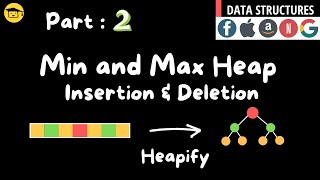
Min Heap and Max Heap Insertion and Deletion - Data Structures Tutorial
Learn to insert and delete nodes in min and max heap trees efficiently, with a focus on time complexity and maintaining heap properties. Includes code explanation for practical implementation.
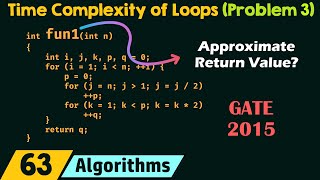
Time Complexity of Loops - Solved Problem 3
Solve a GATE 2015 problem on time complexity of loops, enhancing your algorithm analysis skills for competitive programming and software engineering interviews.
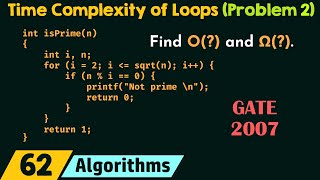
Time Complexity of Loops - Solved Problem 2
Solves a GATE 2007 problem on time complexity of loops, analyzing algorithmic efficiency and providing step-by-step explanations for better understanding.
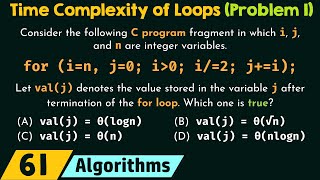
Time Complexity of Loops - Solved Problem 1
Detailed analysis of loop time complexity using a GATE 2006 problem, focusing on algorithmic efficiency and problem-solving techniques for computer science students.
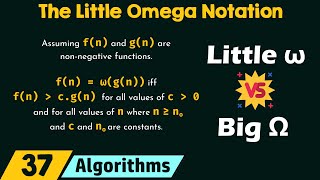
The Little Omega Notation in Algorithms
Explore Little Omega Notation in algorithms, its definition, and relationship with Big Omega Notation. Gain insights into asymptotic analysis for algorithm performance evaluation.
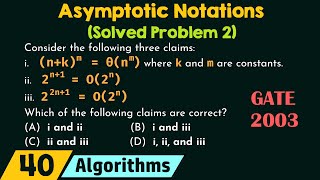
Asymptotic Notations - Solved Problem from GATE 2003
Detailed walkthrough of a GATE 2003 problem on asymptotic notations, enhancing understanding of algorithmic complexity analysis through practical application.
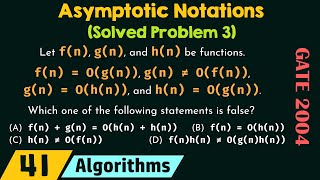
Asymptotic Notations - Solved Problem from GATE 2004
Solve a GATE 2004 problem on asymptotic notations, enhancing understanding of algorithmic complexity analysis through practical application.
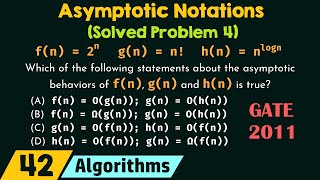
Asymptotic Notations - Solved Problem 4
Solve a GATE 2011 problem on asymptotic notations, enhancing understanding of algorithm complexity analysis through practical application.
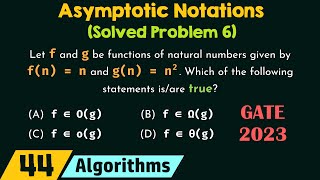
Asymptotic Notations - Solved Problem 6
Solve a GATE 2023 problem on asymptotic notations, enhancing understanding of algorithmic complexity analysis and time efficiency comparisons.
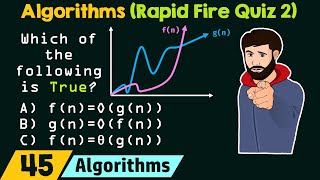
Algorithms - Rapid Fire Quiz on Asymptotic Notations
Rapid-fire quiz on asymptotic notations with 15 questions to test and reinforce understanding of algorithmic complexity analysis.
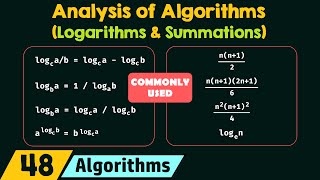
Analysis of Algorithms - Logarithms and Summations
Explore logarithms and summations in algorithm analysis, focusing on common applications and understanding their role in evaluating algorithmic efficiency.
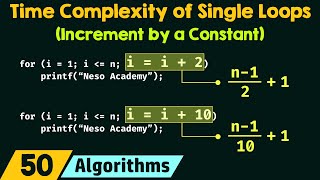
Time Complexity of Single Loops - Increment by a Constant
Explore time complexity of single loops with constant increments, enhancing algorithm analysis skills for efficient programming and problem-solving.
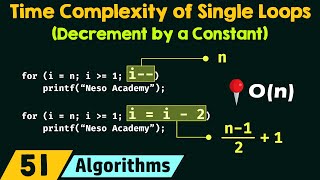
Time Complexity of Single Loops - Decrement by a Constant
Explore time complexity analysis for single loops with constant decrements, enhancing algorithm efficiency understanding and problem-solving skills.
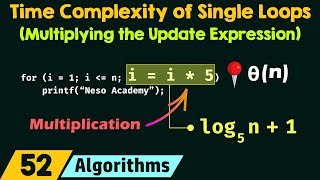
Time Complexity of Single Loops - Multiplying the Update Expression
Explore time complexity analysis for single loops with multiplicative update expressions, enhancing algorithm efficiency understanding and problem-solving skills.
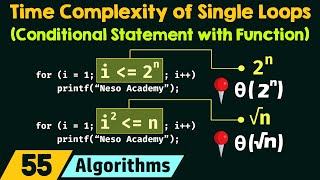
Time Complexity of Single Loops - Conditional Statement with a Function
Explore time complexity analysis for single loops with conditional statements and functions, enhancing your understanding of algorithm efficiency and performance evaluation.