Black Holes from Supercharge Cohomology
Explore supercharge cohomology in holographic CFTs, classifying into monotone and fortuitous types, and examine their connections to smooth geometries and black holes in N=4 super-Yang-Mills theory.
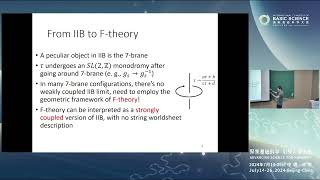
Updates on 4D F-Theory Landscape - ICBS2024
Explore recent developments in 4d F-theory geometric landscape, including massive spectrum and new base ensemble measures.
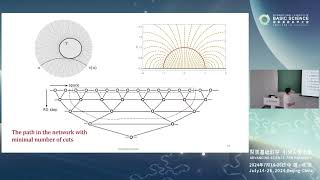
Partial Entanglement Network and Geometry Reconstruction in AdS/CFT
Explore partial entanglement entropy geometrization in AdS/CFT, examining PEE threads, network formation, and bulk geometry reconstruction using novel approaches.
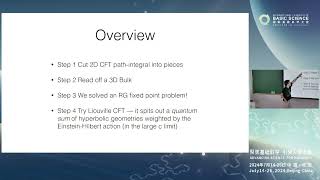
Building Space-time with BCFT Legos - ICBS 2024
Explore quantum gravity duals of CFTs through conformal bootstrap, topological symmetries, and tensor networks. Discover how 2D Liouville theory illustrates building quantum gravitational path integrals using BCFT correlations.
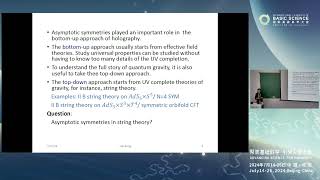
Asymptotic Symmetries from the String Worldsheet - ICBS 2024
Explore asymptotic symmetries in string theory, examining AdS3 with NS-NS flux, flat spacetime, and TsT/TTbar correspondence to understand holographic dualities.
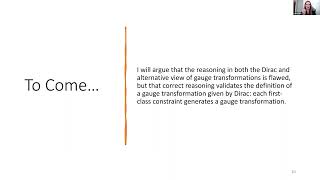
Do First-Class Constraints Generate Gauge Transformations? A Geometric Perspective
Explore the relationship between first-class constraints and gauge transformations in constrained Hamiltonian formalism through a geometric lens, addressing critiques and implications for foundational issues.
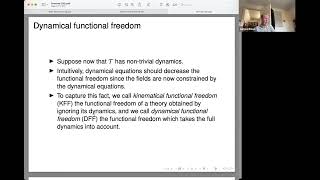
On Functional Freedom and Penrose's Critiques of String Theory
Explore Penrose's conceptual and technical objections to string theory, focusing on the notion of 'functional freedom' in this in-depth analysis by James Read from Oxford University.
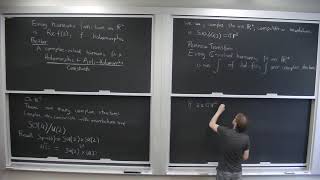
Twistor Theory and Vertex Algebras
Explore the intersection of twistor theory and vertex algebras, delving into advanced mathematical concepts and their applications in geometry and physics.
Rethinking Astrobiology's Biggest Questions About Life Through New Physics
Explore new physics perspectives on astrobiology's fundamental questions about life with Dr. Sara Walker, a leading expert in origin of life and alien life detection research.
Exactly Solvable 2D Conformal Field Theory - Correlation Functions in Loop Models - Lecture 6
Explore correlation functions in loop models, including O(n), Potts, and U(n) models. Learn about combinatorial descriptions and lattice constructions in statistical models.
Exactly Solvable 2D Conformal Field Theory - Lecture 4: Degenerate 4-Point Functions
Explore degenerate 4-point functions and analytic formulas for 2-point and 3-point structure constants in exactly solvable 2D conformal field theories. Gain insights into bootstrap approach and local conformal symmetry.
Reheating and Particle Production in No-Scale Supergravity and Starobinsky-like Models of Inflation
Explore inflationary models in no-scale supergravity, focusing on R+R^2 gravity and Starobinsky-like models. Examine reheating processes and gravitational matter production mechanisms.
Two-Loop N = 1 SYM Amplitudes via SUSY Decomposition and Massive Spinor-Helicity
Explore advanced techniques in supersymmetric Yang-Mills theory, focusing on two-loop amplitudes, SUSY decomposition, and massive spinor-helicity formalism.
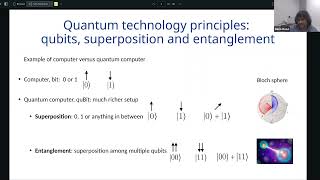
Quantum Technologies: The Case of Quantum Batteries
Explore quantum batteries as energy storage devices, their advantages over classical counterparts, and recent theoretical and experimental progress in quantum charging advantage.
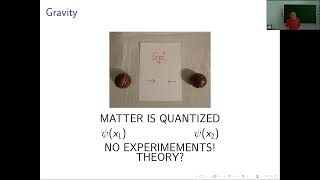
Quantum Control and Semiclassical Quantum Gravity
Explore quantum control and semiclassical quantum gravity, focusing on hybrid quantum-classical coupling and its implications for wave function collapse theory in the Newtonian limit.
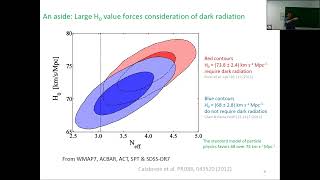
Spatial Curvature, Dark Energy Dynamics, Neither, or Both
Explore dark energy models, their predictions, and observational data constraints. Gain insights into open cosmological questions and the current understanding of the universe's energy composition.
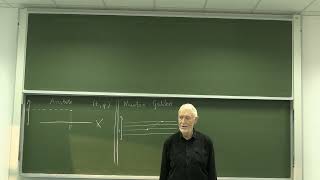
Aristotle versus Galilei-Newton - Different Visions of Space and Time
Explore contrasting perspectives on space and time from Aristotle and Galilei-Newton, delving into fundamental concepts of theoretical physics and relativity.
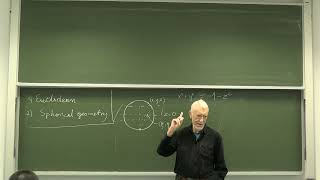
Cartesian, Spherical, and Lobachewskian Geometries - Wave Equation - Lecture 3
Explore Cartesian, spherical, and Lobachewskian geometries, and delve into the wave equation's fundamental role in dynamical theories of physics.
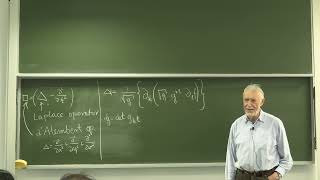
Wave Equation in 4D Spacetime - Introduction to Electrodynamics and Theory of Relativity
Explore wave equations in 4D spacetime, delving into electrodynamics and relativity theory with Professor Jerzy Kijowski's advanced physics lecture.
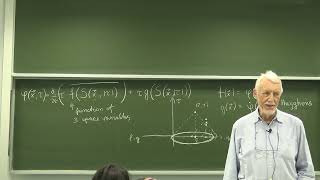
Initial Value Problem, Strong Huygens Principle, and Maxwell Equations in Electrodynamics - Lecture 7
Explore initial value problems, Strong Huygens principle, and Maxwell equations in electrodynamics and relativity theory.
Lorentz Transformation, Initial Value Problem, and Huygens Principle - Lecture 5
Explore Lorentz transformations, initial value problems, and Huygens' principle in electrodynamics and relativity. Deepen understanding of theoretical physics concepts.