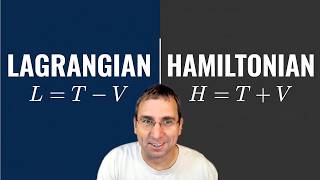
Hamiltonian Systems Introduction - Why Study Them?
Explore Hamiltonian systems and their advantages in mechanics. Learn about generalized momentum, canonical equations, and the transformation from Lagrangian to Hamiltonian formalism.
Geometrical Anatomy of Theoretical Physics
Comprehensive exploration of advanced mathematical concepts in theoretical physics, from set theory to Lie groups, manifolds, and fiber bundles, with applications in quantum mechanics and symmetries.

Understanding the Holographic Universe
Explore cutting-edge theories in physics, from black holes and Hawking radiation to string theory, challenging our understanding of the universe and information.
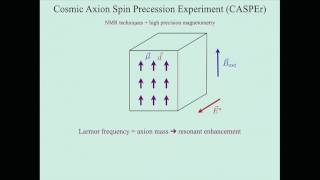
New Experimental Directions for Fundamental Physics II - Peter Graham
Explore cutting-edge experimental approaches in fundamental physics, focusing on innovative techniques and their potential to advance our understanding of particle physics beyond the LHC.
New Physics at the LHC and Beyond I - Liantao Wang
Explore cutting-edge particle physics research at the LHC, including luminosity, hadron colliders, and factorization. Gain insights into new physics prospects and theoretical advancements in the field.
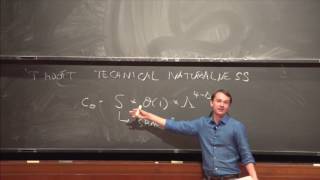
New Approaches to the Hierarchy Problem I - Nathaniel Craig
Explore innovative approaches to the hierarchy problem in particle physics, focusing on technical and direct naturalness, effective field theory, and their implications for the Standard Model.
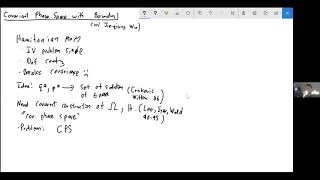
Covariant Phase Space with Boundaries - Daniel Harlow
Explore covariant phase space with boundaries in field theory, covering key concepts like configuration space, prephase space, and Hamiltonian construction.
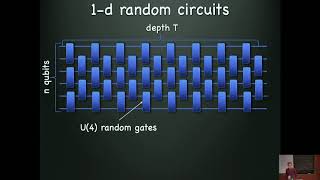
Random Quantum Circuits, Phase Transitions and Complexity - Aram Harrow
Explore quantum complexity, random circuits, and phase transitions in higher dimensions, with applications to tensor networks and simulation algorithms.
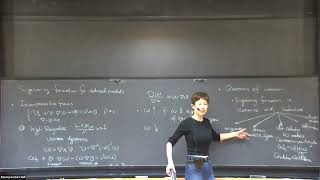
Singularity Formation for Reduced Models of Fluid Equations - Mimi Dai
Explore singularity formation in reduced fluid equation models, focusing on electron magnetohydrodynamics and its connection to Euler equations. Gain insights into nonlinear dynamics and finite-time singularities.
Some Progress on Categorical Local Langlands - Linus Hamann
Exploration of categorical local Langlands correspondence, discussing recent progress, proofs, and implications for number theory and algebraic geometry.
Random Matrix Models, 2D Quantum Gravity, and Holography - Part 1 - Clifford Johnson
Explore random matrix models, focusing on the Gaussian Unitary Ensemble and its applications to gravity, holography, and quantum physics. Discover new insights into discrete spectra and non-perturbative information.
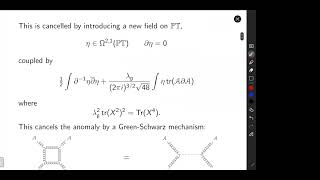
Scattering Amplitudes in Gauge Theory as Chiral Algebra Correlators - Kevin Costello
Explore gauge theory scattering amplitudes as chiral algebra correlators, connecting to celestial holography and deriving expressions for form factors using innovative mathematical approaches.
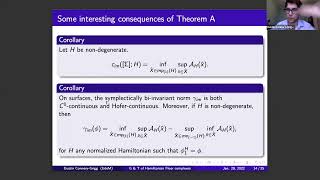
Geometry and Topology of Hamiltonian Floer Complexes in Low-Dimension - Dustin Connery-Grigg
Explore Hamiltonian Floer complexes on surfaces, connecting dynamics to Floer chain structure. Discover a new symplectic norm and geometric interpretations of chain complexes using transverse foliations.
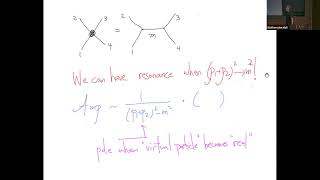
Spacetime and Quantum Mechanics; Particles and Strings; Polytopes, Binary Geometries and Quiver Categories - Nima Arkani-Hamed
Explore connections between particle physics and mathematics, revealing how spacetime and quantum mechanics emerge from fundamental mathematical structures in combinatorics, algebra, and geometry.
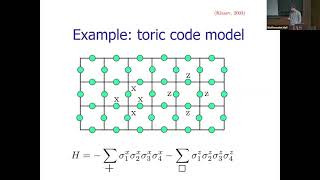
Lattice Edge Theories for Topological Phases of Matter - Michael Levin
Explore lattice edge theories for topological phases, focusing on finite-dimensional edge theories and their unique properties, including ungappable examples with implications for quantum systems.
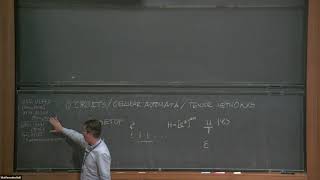
Quantum Circuits, Cellular Automata and Tensor Networks - Ignacio Cirac
Explore quantum circuits, cellular automata, and tensor networks, focusing on their representations, entanglement properties, and generalizations to quantum channels and measurement-assisted dynamics.
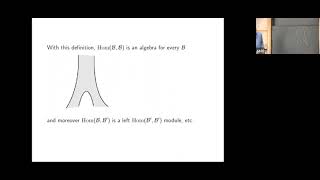
Gauge Theory and the Analytic Approach to Geometric Langlands - Edward Witten
Explore gauge theory's role in geometric Langlands correspondence, comparing categorical and analytic approaches through quantum states, operators, and gauge theory interpretations.
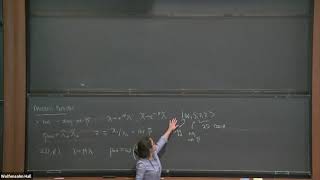
Celestial Operator Product Expansions and W1+Infinity Symmetry for All Spins - Monica Pate
Explore celestial operator product expansions, w1+infinity symmetry, and their implications for massless particles of all spins in gravitational theories and high-energy physics.
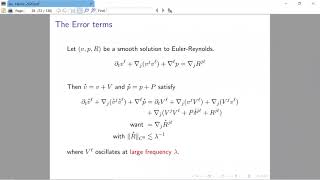
Local Dissipation of Energy for Continuous Incompressible Euler Flows - Phillip Isett
Explore continuous solutions to incompressible Euler equations exhibiting local energy dissipation, addressing Onsager's conjecture and its implications for hydrodynamic turbulence.
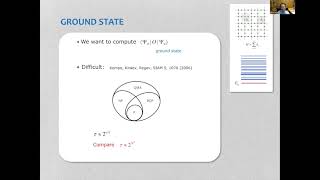
Quantum Computing and the Difficulty of Simulating Quantum Many-Body Systems - Ignacio Cirac
Explore quantum computing's potential in simulating complex many-body systems, discussing algorithms, advantages, and challenges in dynamics, ground states, and finite temperature calculations.
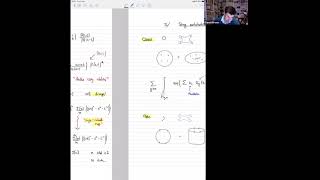
Superstring Amplitudes in Genus 0 and Double Copy - Francis Brown
Explore superstring amplitudes, double copy theory, and related mathematical concepts in this advanced physics seminar by Francis Brown from Oxford University.