Linear Error Correcting Codes - Lecture 11b of CS Theory Toolkit
Explore linear error correcting codes, their properties, and applications in computer science theory. Learn about decoding, notation, and minimum distance in this graduate-level lecture.
Axioms of Quantum Computing - Lecture 9b of CS Theory Toolkit
Explore fundamental axioms of quantum mechanics for quantum computing, covering unitary matrices, qubit gates, and quantum circuits in this graduate-level lecture from Carnegie Mellon University.
The Word RAM Model - Lecture 6c of CS Theory Toolkit
Explore the Word RAM model for algorithms and its impact on integer sorting complexity in this graduate-level lecture on theoretical computer science fundamentals.
Computational Models - Turing Machines - CMU - CS Theory Toolkit
Explore Turing Machines as a computational model, covering historical advantages, multitape variations, and key concepts like memory, time, and space bounds in theoretical computer science.
Hierarchy Theorems - Time, Space, and Nondeterministic: Graduate Complexity Lecture at CMU
Explore hierarchy theorems in computational complexity, covering time, space, and nondeterministic aspects. Gain insights into encoding schemes, Turing machines, and nondeterministic certificates.
Hardness of Approximation - Part 1
Explore hardness of approximation in computational complexity, covering Max Cut, Independent Set, and K-Cover problems. Learn key definitions, algorithms, and current research state.
Great Ideas in Theoretical Computer Science: Time Complexity - Spring 2016
Explore time complexity in theoretical computer science, covering running time, worst-case scenarios, and common runtime scaling, with practical examples and formal definitions.
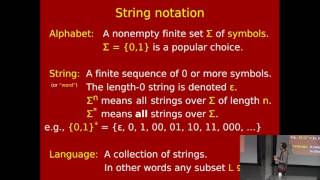
Deterministic Finite Automata
Explore deterministic finite automata, their structure, and applications in computer science. Learn to construct DFAs, understand regular languages, and solve computational problems.
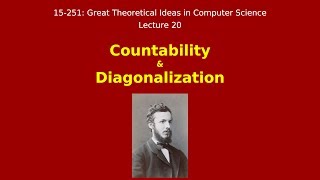
Great Ideas in Theoretical Computer Science: Countability and Diagonalization
Explore fundamental concepts in theoretical computer science, including countability, diagonalization, and set theory, with a focus on infinite sets and cardinality.
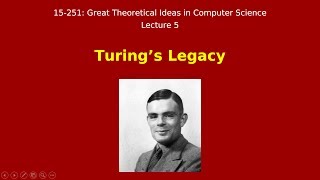
Great Ideas in Theoretical Computer Science - Turing's Legacy
Explore Turing Machines, their definition, and programming techniques in this theoretical computer science lecture, covering interpreters, formal definitions, and practical TM subroutines.
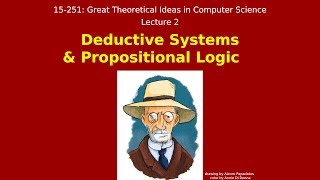
Great Ideas in Theoretical Computer Science: Deductive Systems
Explore deductive systems in theoretical computer science, covering topics like Hilbert's 10th problem, binary trees, propositional logic, and logical equivalence.
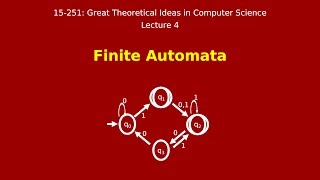
Great Ideas in Theoretical Computer Science: Finite Automata
Explore finite automata and regular languages in theoretical computer science, covering DFAs, computation concepts, and language analysis techniques.
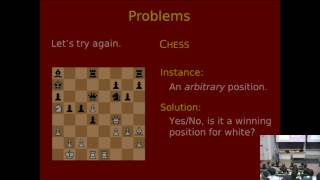
Time Complexity
Learn about time complexity in algorithms, covering input sizes, running time analysis, worst-case scenarios, and efficiency considerations for various computational problems.
Great Ideas in Theoretical Computer Science: Computability
Explore computability theory, Turing machines, and undecidable problems in this theoretical computer science lecture, focusing on fundamental concepts and their implications.
Great Ideas in Theoretical Computer Science - On Proofs
Explore theoretical computer science concepts, focusing on proofs: their history, significance, and modern developments. Learn tips for constructing proofs and avoiding common mistakes in mathematical reasoning.
Great Ideas in Theoretical Computer Science - Approximation Algorithms
Explore approximation algorithms for NP-hard problems, focusing on Vertex Cover, k-Coverage, and Traveling Salesperson. Learn techniques to find near-optimal solutions efficiently.

Analysis of Boolean Functions at CMU - Additive Combinatorics
Explore additive combinatorics in Boolean functions, covering subspaces, cosets, Hamming balls, and the Fryman region conjecture. Gain insights into advanced theoretical concepts.

Analysis of Boolean Functions at CMU - Constraint Satisfaction Problems
Explore constraint satisfaction problems in boolean functions, covering topics like Max3SAT, Max3Coloring, and approximation algorithms for complex computational challenges.

Analysis of Boolean Functions - Restrictions and the Goldreich-Levin Theorem
Explore restrictions and the Goldreich-Levin Theorem in Boolean function analysis, covering key concepts, proofs, and applications in this advanced computer science lecture.
Alan Turing and the Other Theory of Computing and Can a Machine Be Conscious?
Explore neuroscience advances in understanding consciousness, including the Global Workspace Model and its computational implications, with insights on free will and determinism.
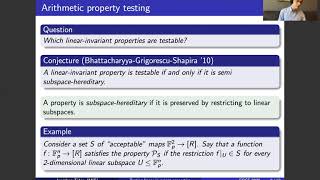
Testing Linear-Invariant Properties
Explore efficient methods for testing linear-invariant properties in mathematical structures, focusing on advanced techniques and their applications in various fields.