Mastering PyTorch Tensors- The Ultimate Guide for Beginners
Comprehensive guide to PyTorch tensors: creation, types, operations, indexing, reshaping, and data handling. Essential for beginners in machine learning and deep learning projects.

Efficient Distributed Deep Learning Using MXNet
Explore distributed deep learning with MXNet, covering practical challenges, deployment strategies, and advanced techniques for efficient large-scale machine learning implementations.

Introduction to PyTorch
Learn to create, visualize, and optimize a neural network using PyTorch in this step-by-step tutorial, covering network creation, output graphing, and parameter optimization through backpropagation.
Everything You Need to Know About Tensors in Deep Learning With PyTorch
Comprehensive guide to PyTorch tensors: creation, operations, data types, and GPU usage. Hands-on examples cover essential concepts for deep learning beginners.
Build a Neural Network for Classification from Scratch with PyTorch
Learn to build a neural network for classification using PyTorch, covering data preparation, network structure, and implementation. Gain hands-on experience in deep learning fundamentals.
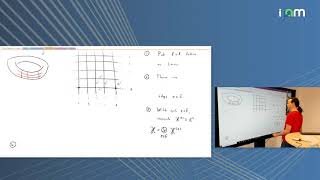
David Gross: Stabilizer Formalism & Quantum Error Correction Through the Lens of Tensors
Explore advanced quantum error correction techniques, focusing on the stabilizer formalism and its applications in quantum fault tolerance, using tensor-based approaches and group theory.
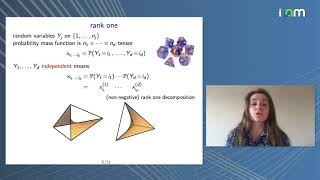
Tensors in Statistics and Data Analysis
Explore tensors in statistics and data analysis, covering probability tensors, biological measurements, and signature tensors for time-series data. Learn about decompositions and algebraic properties in this comprehensive overview.
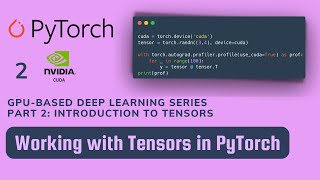
Introduction to Tensors - PyTorch with GPU Series Part 2
Explore tensor initialization, GPU usage, operations, memory sharing, and profiling in PyTorch for efficient deep learning model development.
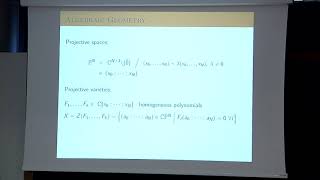
The Geometry of Tensors - Carolina Araujo
Explore tensor decomposition, its applications, and geometric interpretation. Learn about recent developments in determining tensor ranks and their significance in various fields.
Introduction to the Geometry of Tensors
Explore tensor geometry and its applications in physical and data sciences through a gentle introduction, emphasizing how geometric perspectives advance practical implementations.
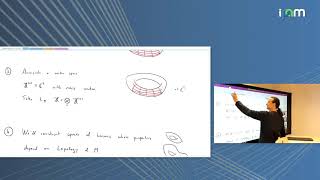
Stabilizer Formalism & Quantum Error Correction Through the Lens of Tensors - Part 1
Explore stabilizer formalism and quantum error correction using tensor methods. Learn about many-body systems, error correction challenges, and connections to finite symplectic geometries.
Introduction to Geometric Complexity Theory by Christian Ikenmeyer
Explore geometric complexity theory, a cutting-edge approach to solving fundamental problems in computational complexity and algebraic geometry.
Machine Learning Tutorial for Beginners
Comprehensive TensorFlow tutorial covering data handling, neural networks, and model building. Learn to clean, analyze, and process data for machine learning applications.

Real-World PyTorch: From Zero to Hero in Deep Learning and LLMs - Tensors, Operations, Model Training
Comprehensive PyTorch tutorial covering tensors, operations, GPU usage, datasets, neural networks, and model training. Hands-on examples for mastering deep learning and LLMs.
Opportunities for Infusing Physics into AI - ML Algorithms
Explore the fusion of physics and AI algorithms, covering neural programming, hierarchies, equations, and applications in autonomous systems and technology.
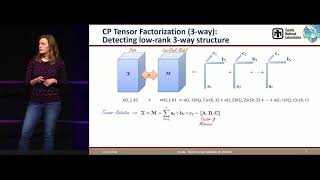
Tensor Decomposition - A Mathematical Tool for Data Analysis
Explore tensor decomposition as a powerful mathematical tool for analyzing complex data structures, with applications in neuroscience, gas detection, and communication patterns.
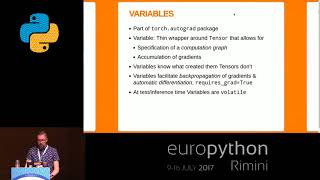
An Introduction to PyTorch & Autograd
Explore PyTorch's dynamic computation graphs and Autograd package for efficient deep learning, with practical examples and insights into GPU processing and algorithmic differentiation.
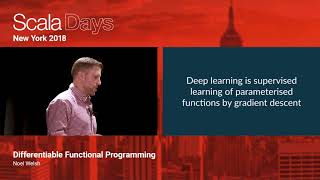
Differentiable Functional Programming
Explore differentiable functional programming, covering supervised learning, gradient descent, and deep learning concepts. Learn about tensor operations, algorithmic differentiation, and Scala's potential in next-gen deep learning systems.
Machine Learning in the Browser
Explore client-side machine learning and neural networks in JavaScript, focusing on implementation techniques and practical applications for browser-based AI.
Deep Learning with CNTK and F#
Explore deep learning with CNTK and F# in .NET, covering neural networks, model training, and practical applications in computer vision and language processing.
Deep Learning with CNTK and F#
Explore deep learning with CNTK and F#, covering neural networks, model training, and practical applications in .NET. Learn core concepts and see live demonstrations using real-world datasets.