Containers Unplugged - Understanding User Namespaces
Explore user namespaces in Linux, their role in container isolation and sandboxing, and their relationship with other namespace types. Includes practical demonstrations and security implications.
AEPIC Leak - Architecturally Leaking Uninitialized Data from the Microarchitecture
Systematic analysis of CPU vulnerabilities, exploring root causes and connections between transient-execution attacks and architectural vulnerabilities. Identifies blank spots in CPU security research.
DirectX - The New Hyper-V Attack Surface
Explore vulnerabilities in Hyper-V's GPU-Paravirtualization feature, examining 4 fixed DirectX component issues and their implications for virtualization security.
Secure System Design on ARM Using PA-RoT
Explore secure system architecture implementation using PA-RoT technology on ARM platforms, focusing on robust hardware-based security measures and trusted computing principles.
Persisting IOMMU Domains Across Kexec - Live Update
Explore techniques for maintaining IOMMU domain persistence during kexec live updates, enhancing system stability and performance in Linux environments.
Fast Trapless Kernel Probes Everywhere - USENIX ATC '24
Efficient trapless kernel probing mechanism for Linux, improving performance 10x over standard Kprobe while covering 96% of kernel code. Enhances debugging, security, and monitoring capabilities.
Bypassing Many Kernel Protections Using Elastic Objects
Explore advanced techniques for bypassing kernel protections through elastic objects, presented by Ph.D. students Yueqi Chen and Zhepeng Lin.
The Goodness is Baked In - Baking Assurance into Software
Learn techniques to integrate security assurance into software development, covering key legislation, essential components, and practical implementation strategies for robust cybersecurity.
Top Secret Cloud Native Security Lessons
Explore cloud-native security essentials for Kubernetes, Docker, and Istio. Learn real-world lessons, audit findings, and best practices to identify and mitigate potential vulnerabilities in your infrastructure.
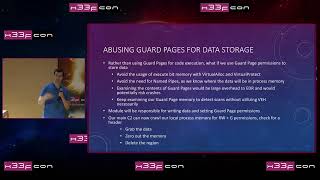
Hiding C2 Communications in Plain Sight Using Windows Memory Page Permissions
Discover advanced techniques for hiding C2 communications by exploiting Windows memory page permissions, with practical approaches to building modular and stealthy command-and-control systems.
Detecting and Triaging Modern Windows Rootkits
Discover modern Windows rootkit detection techniques, memory forensics, and event log analysis methods to combat evolving kernel-level malware threats in Windows 10 and beyond.
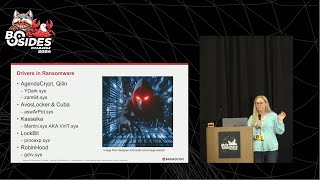
Driver Risk Scores: Threat Detection System for Vulnerable Device Drivers
Discover how Driver Risk Scores (DRS) system evaluates device driver vulnerabilities through seven key traits, enabling informed security decisions for system administrators and security teams.
DriverJack: Turning NTFS and Emulated ROFs into an Infection
Discover advanced exploitation techniques targeting NTFS and emulated filesystem vulnerabilities, exploring novel attack vectors that bypass Windows security measures and maintain system persistence.
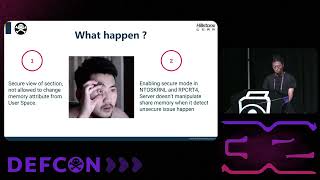
Using ALPC Security Features to Compromise RPC Services
Dive into Windows kernel security through ALPC and RPC services, exploring vulnerability exploitation techniques, security bypass methods, and system privilege escalation strategies.
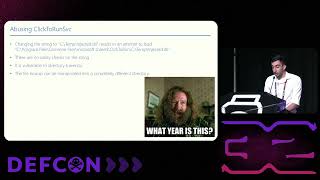
Manipulating Shim and Office Infrastructure for Code Injection and Privilege Escalation
Delve into advanced Windows exploitation techniques, focusing on stealthy shim manipulation and Office infrastructure vulnerabilities for code injection and privilege escalation attacks.

Windows Downdate: Downgrade Attacks Using Windows Updates
Discover how to exploit Windows Update vulnerabilities to craft downgrade attacks, bypass security features, and compromise system integrity - from kernel to virtualization stack.
Security Problems with Symbolic Links in UNIX File Systems
Delve into the security vulnerabilities of UNIX filesystem's symbolic links, exploring their design flaws, historical impact on system security, and modern Linux-based solutions for safer implementations.
Improving eBPF Complexity with a Hardware-backed Isolation Environment
Explore hardware-backed isolation for eBPF, enhancing complexity management and security in Linux kernel development.
How Hacking Works - Web Edition
Explore web exploitation techniques and tools to enhance your software security skills through gamified environments, empowering you to write safer code and better protect your systems.
Windows Server 2025 - New Ways to Gain Cloud Agility and Security - Session 238
Discover groundbreaking features in Windows Server 2025, from enhanced security and Azure Arc integration to GPU partitioning for AI/ML workloads, helping organizations scale efficiently and optimize operations.
Writing Memory with eBPF - Implementing W3C Trace Context Propagation
Explore advanced eBPF memory writing techniques for W3C trace context propagation, examining available APIs, security implications, and practical solutions for protocol stack implementation.