Neural Nets for NLP 2020 - Generating Trees Incrementally
Explore transition-based parsing, shift-reduce parsing with neural networks, stack LSTMs, and semantic parsing for natural language processing applications.
Supervised Learning Projects Tutorial - Machine Learning Tutorial
Hands-on tutorial exploring supervised learning projects, including COVID-19 prediction, Pokémon analysis, and credit card fraud detection. Covers data gathering, visualization, and practical implementation of machine learning algorithms.

Deep Learning Revolution: Turing Award Lecture by Geoffrey Hinton and Yann LeCun
Pioneers of deep learning discuss breakthroughs, applications, and future prospects of neural networks in AI, from handwriting recognition to medical imaging and autonomous vehicles.
PAC Learning
Explore PAC learning framework in machine learning, covering supervised classification, learnability criteria, and VC dimension. Understand theoretical foundations and practical implications.
Grammatical Inference and Language Frameworks for LANGSEC
Explore grammatical inference and language frameworks for enhancing security protocols and parsers. Learn about pattern languages, formal systems, and their applications in HTTP session analysis.

Wikipedia Vector Search Demo with Weaviate
Explore semantic search through Wikipedia using Weaviate, featuring demos of vector search, question answering, and applications in various domains like protein folding and natural language processing.
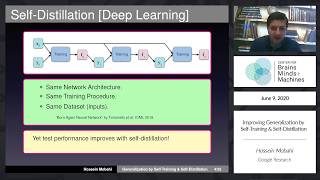
Improving Generalization by Self-Training & Self Distillation
Explore self-training and self-distillation techniques to improve model generalization, with insights on regularization effects and applications in deep learning.

Connections Between Physics and Deep Learning
Explore the fascinating intersections of physics and deep learning, from neural networks to scale-invariant behavior, with insights from MIT's Max Tegmark.
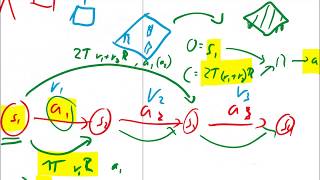
Reinforcement Learning Upside Down - Don't Predict Rewards, Just Map Them to Actions
Innovative approach to reinforcement learning that maps desired rewards to actions, transforming it into supervised learning. Shows promising performance compared to traditional RL algorithms.
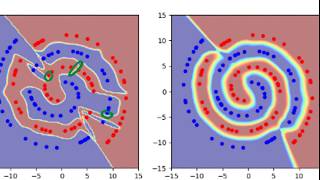
Manifold Mixup: Better Representations by Interpolating Hidden States
Explore Manifold Mixup, a regularization technique that improves neural network performance by interpolating hidden representations, leading to smoother decision boundaries and more robust predictions.

Gradient Descent and the Backpropagation Algorithm
Explore gradient descent and backpropagation algorithms, covering supervised learning, parametrized models, loss functions, and neural network architectures with PyTorch implementation.

Low Resource Machine Translation
Explore machine translation techniques for low-resource languages, covering evaluation methods, supervised and unsupervised learning approaches, and domain adaptation. Gain insights into Nepali-English translation case study.
Supervised and Self-Supervised Transfer Learning With PyTorch Lightning
Explore supervised and self-supervised transfer learning techniques using PyTorch Lightning, comparing their implementation, training, and generalization capabilities in deep learning applications.

History, Motivation, and Evolution of Deep Learning
Explore the history, motivation, and evolution of deep learning, covering key concepts like gradient descent, backpropagation, CNNs, and feature extraction in neural networks.
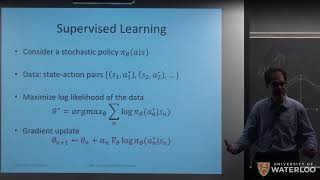
Policy Gradient
Learn about policy gradient methods in reinforcement learning, covering stochastic policies, supervised learning, and the stochastic gradient policy theorem with applications to AlphaGo.
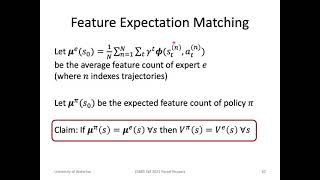
Inverse RL
Explore inverse reinforcement learning, its applications, and key concepts like feature matching and maximizing margins. Learn implementation techniques and policy induction.

Off-Policy Policy Optimization
Explore advanced reinforcement learning techniques, focusing on off-policy optimization, batch methods, and sequential decision-making in deep learning contexts.
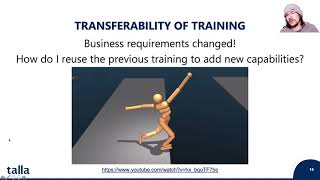
Alternatives to Reinforcement Learning for Real-World Problems
Explore alternatives to Reinforcement Learning for real-world problems, focusing on Contextual Bandits and Imitation Learning. Learn their applications, limitations, and how they differ from full RL.
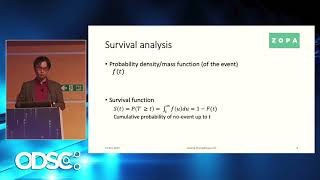
Deep Learning Survival Analysis for Consumer Credit Risk Modelling
Explore deep learning survival analysis for precise credit risk prediction in consumer lending, combining traditional methods with advanced techniques for improved time-to-event forecasting.
Why Machine Learning Is Important - Learn Machine Learning - Machine Learning Algorithm
Explore machine learning fundamentals, algorithms, and applications. Gain insights into supervised and unsupervised learning, and practice with Microsoft Azure experiments.
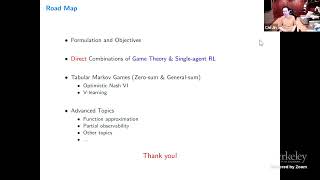
Multi-Agent Reinforcement Learning - Part II
Explore advanced concepts in multi-agent reinforcement learning, including equilibrium, rewards, and techniques like Q-value and no-regret learning. Gain insights into challenges and applications in AI and game theory.