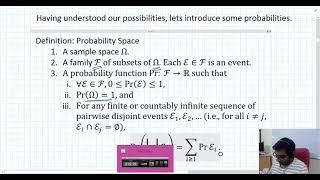
Basic Definitions in Probability Theory - Introduction and Experiment
Learn fundamental probability concepts through clear definitions and practical experiments, enhancing your understanding of statistical principles.
The Central Limit Theorem and its Applications - Part 1
Explore the Central Limit Theorem, its applications, and the concept of standard error of the mean in statistical analysis.
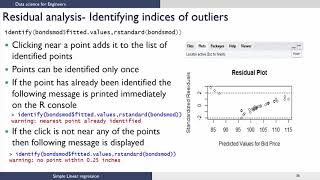
Simple Linear Regression Model Assessment - Continued
Assess simple linear regression models through continued exploration of key concepts and techniques for evaluating model performance and validity.
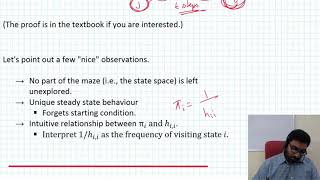
Stationary Distribution of a Markov Chain
Explore the concept of stationary distribution in Markov chains, understanding its properties and applications in probability theory and stochastic processes.
Time Sampled M/M/1 Queue and Burke's Theorem - Lecture 66
Explore Burke's Theorem and M/M/1 Queue concepts, including reversibility and time sampling, to enhance understanding of queueing theory.
Issues in Hypothesis Testing - Part 1
Explore key issues in hypothesis testing, including error types, biases, and experimental design strategies for more robust scientific research.
The Birth-Death Continuous Time Markov Chains - Lecture 74
Explore continuous time birth-death Markov chains, analyzing expected waiting times and queue lengths in various queueing systems.
Elements of Scientific Measurement - Part 2: Analyzing Sampled Data and Experimental Errors
Explore issues in measurement, data analysis, distribution, sampling, and experimental errors for enhanced scientific understanding.
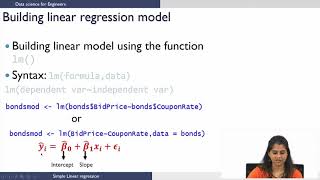
Simple Linear Regression Model Building
Build a simple linear regression model by loading data, exploring its structure, and fitting a regression line, with a comprehensive model summary.
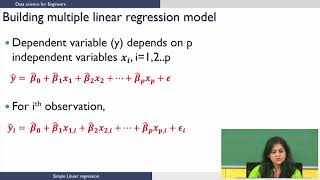
Multiple Linear Regression: Model Building and Selection
Build and select multiple linear regression models through data loading, visualization, and iterative model refinement using R.
Matrix Representation of a Discrete-Time Markov Chain (DTMC) - Lecture 46
Explore matrix notation of DTMCs, including egodicity, ergodic chains, and global balance equations. Learn about n-step transition probabilities in this concise lecture.
Fast Probabilistic Inference for ODEs with ProbNumDiffEq.jl
Explore probabilistic ODE solvers with ProbNumDiffEq.jl. Learn Bayesian inference for numerical problems, implementation details, and future prospects in the Julia ecosystem.

New Performance Guarantees for Tukey's Median - Lecture
Explore Tukey's depth concept, its applications in robust statistics and social choice, and recent advancements in performance guarantees for Tukey's median in high-dimensional data analysis.
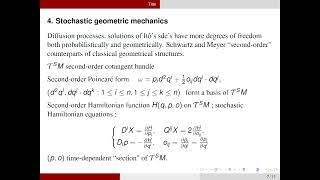
Gauge Transformations in Stochastic Geometric Mechanics
Explore gauge transformations in stochastic geometric mechanics, delving into advanced mathematical concepts and their applications in physics.
Skewness - Bowley's Method in Probability and Statistics - Numerical Examples
Learn to calculate skewness using Bowley's Method, with practical numerical examples for probability and statistics in advanced mathematics.
Error Bars and Confidence Intervals - Part 2
Explore error bars, confidence intervals, and z-statistics for data analysis. Learn techniques for small datasets and estimating confidence intervals.
Regression and Differentiation: Practical Issues
Explore practical issues in regression and differentiation, focusing on key concepts and real-world applications in data analysis and mathematical modeling.
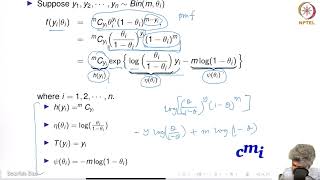
Generalised Linear Models: Introduction to Natural Exponential Family and Binomial Distributions
Explore Generalised Linear Models and Natural Exponential Family, focusing on Binomial Distributions and their applications in statistical modeling.
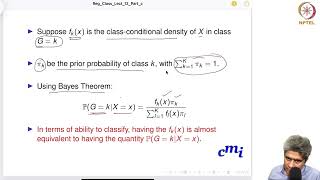
Multi-Class Classification with Discriminant Analysis
Learn discriminant analysis techniques for multi-class classification, covering data collection, distributions, decision boundaries, and linear approaches to effectively categorize new data points.
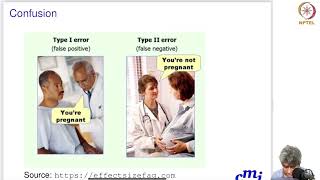
Statistical Inference of Logistic Regression: Confusion Matrix, Errors, and Model Selection
Explore statistical inference in logistic regression, covering confusion matrices, error types, and model selection techniques for improved predictive accuracy.
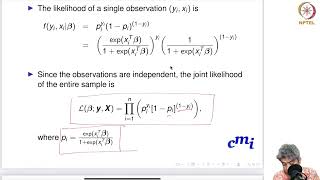
Maximum Likelihood Estimate for Logistic Regression
Explore maximum likelihood estimation for logistic regression, covering likelihood functions and gradient descent techniques.