Periodic Operators on Trees - Non-Commutative Floquet Theory?
Explore non-commutative Floquet theory and periodic operators on trees with Jorge Garza Vargas in this advanced mathematics talk from the Fields Institute workshop on Operator Algebras.
The Zero Bias
Explore the concept of Free Zero Bias in operator algebras with Todd Kemp, delving into its applications and implications in free probability theory.
Strong 1-Boundedness and Graph Products
Explore strong 1-boundedness and graph products in operator algebras with Brent Nelson, delving into advanced mathematical concepts and their applications in free probability theory.
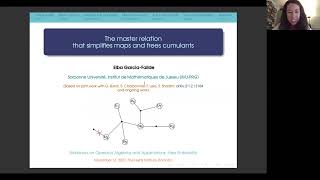
The Master Relation That Simplifies Maps and Frees Cumulants
Explore the master relation's role in simplifying maps and freeing cumulants, presented by Elba Garcia-Failde at the Fields Institute's Workshop on Operator Algebras and Applications.
Causal Data Integration
Techniques for integrating datasets with unobserved confounding variables and summarizing causal DAGs to address data management challenges in causal inference.

The Perfect Bet - Mathematics of Gambling
Mathematician Adam Kucharski explores the mathematics, economics, and physics behind gambling, challenging the notion that the house always wins in this insightful Ri Science podcast.
Credal Models for Uncertainty and Logic Treatment
Explore credal models as a generalization of probability theory for handling uncertainty and logic in AI, enhancing reliability and trustworthiness in decision-making processes.
How to Find the Median of a Function
Learn to calculate the median of a function, exploring mathematical concepts and problem-solving techniques for this unique statistical measure.
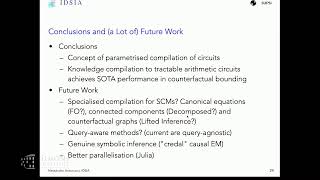
Tractable Bounding of Counterfactual Queries by Knowledge Compilation
Explores bounding partially identifiable queries in causal models using knowledge compilation, offering computational advantages for inference in Bayesian networks with shared structures.
Variational Bayesian Approximation of Inverse Problems Using Sparse Precision Matrices
Explore Variational Bayes as an efficient alternative to MCMC for solving inverse problems in PDEs, using sparse precision matrices and stochastic optimization for improved computational tractability.
Uncertainty Quantification with Physics-Informed Machine Learning
Exploring uncertainty quantification in physics-informed machine learning, focusing on architecture and learning approaches for scientific applications and complex real-world phenomena.
The Sign Rule and Continuous Probability Distributions - Probability and Statistics
Explore sign rule, continuous probability distributions, uniform and normal distributions, and key concepts like mean and variance for continuous random variables in probability and statistics.
Random Variables, Means, Variance, and Standard Deviations in Probability and Statistics
Explore key concepts in probability and statistics: random variables, probability distributions, mean, variance, and standard deviation. Learn through examples and practical applications.
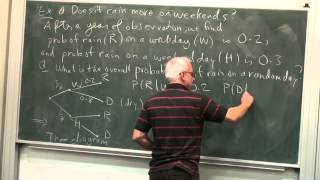
Total Probability, Bayes' Rule and Tree Diagrams - Probability and Statistics
Explore total probability, Bayes' rule, and tree diagrams in probability and statistics. Learn about mutually independent events and apply these concepts to real-world scenarios, including medical statistics.
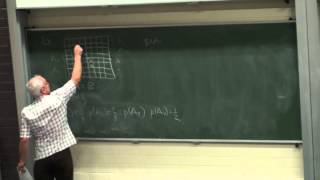
Probability Spaces, Events, and Conditional Probabilities
Explore probability spaces, events, and conditional probabilities. Learn about sample spaces, visualizations, independence, and practical applications using chess board examples.
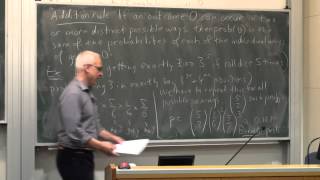
Basic Counting and Probability - Introduction to Probability and Statistics
Explore fundamental counting techniques, probability concepts, and their applications in dice rolls, card games, and birthday scenarios. Learn to calculate odds for informed decision-making in various contexts.
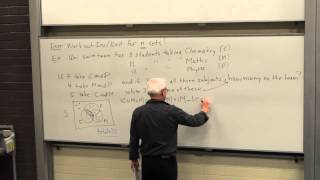
Review of Sets and Functions - Probability and Statistics Introduction
Comprehensive review of set theory and functions, covering key concepts like Venn diagrams, distributive laws, partitions, and disjoint sets. Essential foundation for probability and statistics.
Causal Inference in Single-cell Genomics - Machine Learning in Computational Biology
Explore causal inference in single-cell genomics, focusing on differential expression analysis and integrating bulk data for high-resolution insights into complex disease mechanisms.
A Generalized Central Limit Conjecture for Convex Bodies
Explore a generalized central limit theorem for convex bodies, its connection to the KLS conjecture, and implications for asymptotic convex geometry in this advanced mathematics lecture.
Large Deviations Principle for Sub-Riemannian Random Walks
Explore large deviations in sub-Riemannian random walks on Carnot groups, focusing on rate functions, hypoelliptic Brownian motions, and comparisons between standard and Heisenberg group Brownian motions.
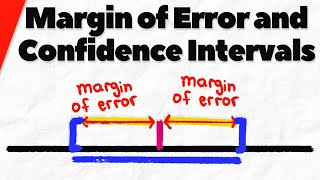
Margin of Error in Confidence Intervals - Statistics Guide
Comprehensive guide to calculating and interpreting margin of error in confidence intervals for various statistical scenarios, with practical examples and tips for adjusting sample size.