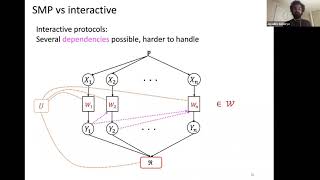
Cookbook Lower Bounds for Statistical Inference in Distributed and Constrained Settings - Part 2
Explore advanced statistical inference techniques for distributed and constrained environments, focusing on lower bounds and their applications in complex data analysis scenarios.
Inverse Problems on Graphs with Geometric Deep Learning
Explores geometric deep learning for graph inverse problems, focusing on non-Euclidean geometries, physics-based approaches, and applications in particle physics and community detection.

Pokémon Catch Rate Formula Explained
Explore the mathematics behind Pokémon's catch rate formula with Oxford mathematician Dr Tom Crawford. Learn how variables like HP, status effects, and ball types influence capture probability.
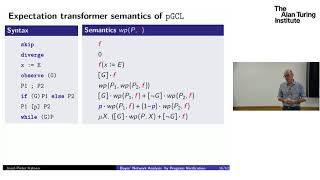
Bayesian Inference by Program Verification - Joost-Pieter Katoen, RWTH Aachen University
Explore Bayesian inference through program verification, learning how weakest precondition reasoning can be applied to exact inference and analyzing expected sampling times in Bayesian networks.
Concentration of Tempered Posteriors and of Their Variational Approximations – Pierre Alquier
Explores concentration of tempered posteriors and variational approximations in high-dimensional function reconstruction, addressing challenges in approximation theory and non-parametric regression.
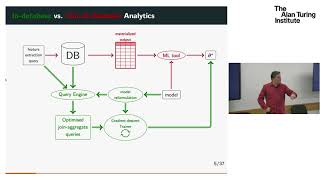
In-Database Factorised Learning - Professor Dan Olteanu
Explore in-database factorised learning techniques for efficient data analysis and machine learning, covering integration approaches, advantages, and practical applications in relational databases.
Understanding the Impact of the Pandemic: Challenges, Opportunities and Politics
Explore the statistical challenges and political implications of measuring COVID-19's global impact, including methodologies for calculating excess mortality and their consequences for international statistics.
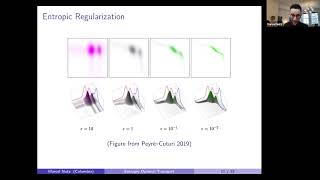
Entropic Optimal Transport
Explore entropic optimal transport with Prof. Marcel Nutz, delving into advanced mathematical concepts and their applications in economics and probability theory.
John M. Keynes and Treatise on Probability - Prof. Simon Blackburn
Explore Keynes's Treatise on Probability, its scholarly depth, Russell's influence, and skepticism about mathematical applications. Examine Ramsey's critique and Keynes's response.
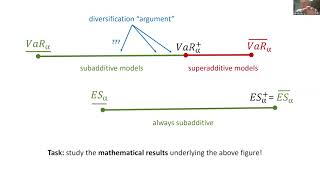
Dependence, Uncertainty, and Risk - Prof. Paul Embrechts
Explore quantitative risk management through extremal bounds for risk measures, focusing on uncertainty in interdependence between risk factors and its impact on portfolio analysis.
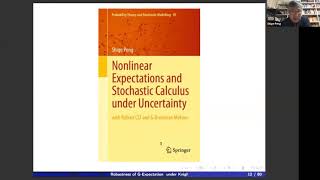
Robustness of G-Expectation under Knightian Uncertainty - Prof. Shige Peng
Explore G-Expectation's robustness in Knightian uncertainty, examining its applications in economics and probability theory. Gain insights into handling unpredictable outcomes in complex systems.

The Changing Role of National Statistics Offices in a Data-Driven Future - Professor Sir Ian Diamond
Exploring how national statistics offices innovate to meet modern data demands, utilizing new methods and sources for timely, accurate information to inform critical societal decisions.

Efficient and Effective Calibration of Spatio-Temporal Models - Dan Williamson & James Salter, Exeter
Explore efficient calibration techniques for spatio-temporal models, focusing on uncertainty quantification and Gaussian Process emulation in complex physical systems like climate and natural disasters.
Deep and Multi-Fidelity Learning with Gaussian Processes
Explore uncertainty quantification using Gaussian Process emulators for complex systems, focusing on deep learning and multi-fidelity approaches in climate, tsunami, and earthquake modeling.
High-Dimensional Hierarchical Models for Large-Scale Geophysical Applications
Explore high-dimensional hierarchical models for geophysical applications, focusing on uncertainty quantification and Gaussian Process emulation in complex physical systems.
Structured Dynamic Graphical Models & Scaling Multivariate Time Series
Explore advanced Bayesian methods for multivariate time series forecasting, focusing on scalability and model complexity. Learn about dynamic dependency networks and graphical dynamic linear models with real-world applications.
New Challenges in Computational Statistics
Explore cutting-edge computational statistics challenges and innovations in this lecture by Professor Gareth Roberts, focusing on complex data analysis and algorithm advancements in statistical science.
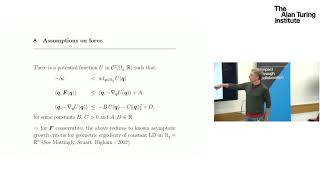
Stability and Inference for Position-Dependent Langevin Diffusions
Explore stability and inference in position-dependent Langevin diffusions, combining statistical inference, computation, and physical laws for complex systems modeling across various scientific domains.
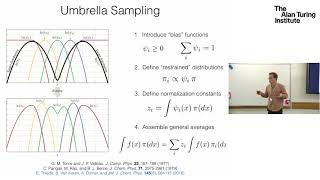
Stratification for Markov Chain Monte Carlo
Explore advanced Markov Chain Monte Carlo techniques, focusing on stratification methods for complex systems modeling and statistical inference in various scientific domains.
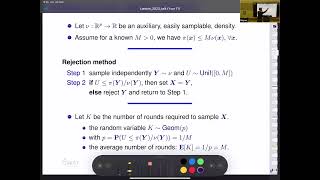
Langevin Monte Carlo: Randomized Midpoint Method Revisited
Explore advanced Langevin Monte Carlo techniques, focusing on the Randomized Midpoint method's superior sampling error guarantees and recent improvements for high-dimensional target distributions.
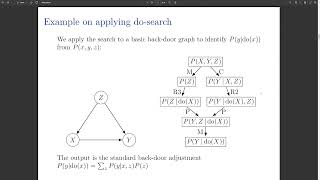
Causal Effect Identification from Multiple Incomplete Data Sources
Explore causal effect identification using do-calculus search algorithms, addressing complex data scenarios like missing data and context-specific independence in causal inference.