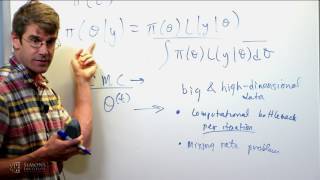
Scaling Up Bayesian Inference for Big and Complex Data
Explore advanced Bayesian inference techniques for large-scale datasets, focusing on computational challenges and innovative solutions in machine learning and deep learning applications.

Perceptual Organization From a Bayesian Point of View
Explore Bayesian approach to perceptual organization, examining how the visual system groups images into distinct units through inverse inference and mixture estimation techniques.
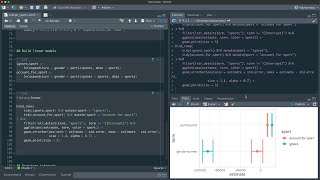
Handling Coefficients for Modeling Collegiate Sports Expenditures
Explore collegiate sports expenditures using linear modeling and tidymodels, focusing on handling coefficients and intervals for insightful analysis of financial patterns.
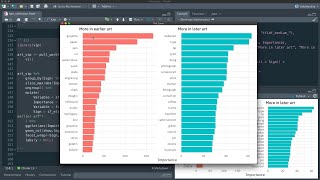
Explore Changes in Art Over Time With Tidymodels
Analyze art trends in the Tate collection using tidymodels for regression modeling, text feature engineering, and model diagnostics to uncover insights on changing art media usage over time.

Linear Mixed Model in R with lme
Learn to implement Linear Mixed Models in R using lme(). Understand statistical modeling concepts, fixed and random effects, and interpret results for complex data relationships.
Kernel Methods for Causal Inference
Explore kernel ridge regression for causal inference, covering dose responses, treatment effects, and extensions to various settings. Learn about consistency, efficiency, and robustness in estimation.
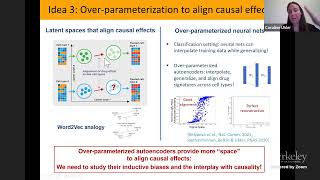
Causality and Autoencoders in Light of Drug Repurposing for COVID-19
Explore causal inference and autoencoders in drug repurposing for COVID-19, covering observational data, causality hierarchy, and predicting interventions with Caroline Uhler from MIT.
Recent Development in Selective Inference II
Explore advanced selective inference techniques, including randomized approaches, computational challenges, and approximate methods for statistical analysis in adaptive data settings.
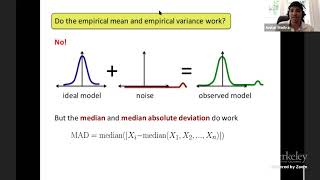
Recent Progress in High-Dimensional Learning
Explore recent advancements in high-dimensional learning, covering robust estimation, maximum likelihood, and algorithmic approaches for handling noise and adversarial scenarios.
Remarks on the Discrete Cube
Explore probability theory on the discrete cube, covering Fourier analysis, Poisson inequality, and random walks, with applications in high-dimensional geometry and computation.
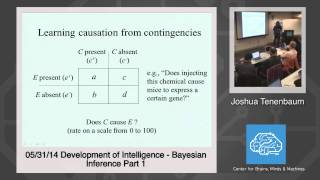
Development of Intelligence - Josh Tenenbaum: Bayesian Inference
Explore Bayesian inference and cognitive neuroscience with Josh Tenenbaum, delving into AI challenges, scene understanding, and advanced mathematical concepts for intelligence development.
Bayesian Inference in Generative Models
Explore approximate Bayesian inference methods, including sampling-based techniques and variational inference, with hands-on exercises in implementing algorithms and using probabilistic programming languages.
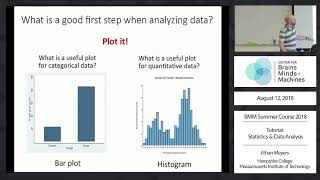
Statistics and Data Analysis
Learn essential statistics and data analysis concepts, including distributions, visualization techniques, correlation, regression, and hypothesis testing, to enhance your data interpretation skills.
Probability Tutorial
Explore probability concepts, from uncertainty to Bayesian reasoning, with practical applications in graphical models and hidden Markov models.
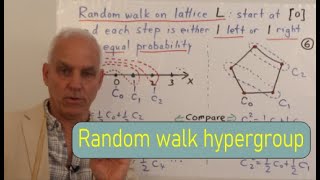
The One Dimensional Random Walk Hypergroup - Diffusion Symmetry
Explore affine transformations, representation theory, and random walks on a 1D lattice. Learn about hypergroups and calculate probabilities in this advanced mathematics lecture.
The Normal Distribution - Probability and Statistics
Explore the normal distribution, its importance in statistics, and the Central Limit Theorem. Learn about probability density, standard and general normal distributions, and cumulative distribution functions.
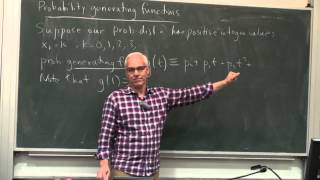
Binomial and Geometric Distributions - Probability and Statistics
Explore binomial and geometric distributions, probability generating functions, and calculating means and variances in this comprehensive overview of key probability concepts.
Problems With the Calculus - Math History - NJ Wildberger
Exploring historical controversies in calculus, including debates on derivatives, integrals, and curves, highlighting critiques from notable figures and ongoing mathematical challenges.
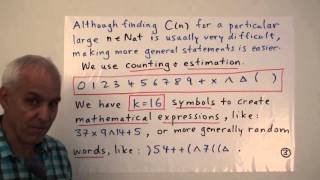
The Sporadic Nature of Big Numbers - Data Structures in Mathematics
Explores how arithmetic breaks down with large numbers, revealing most "numbers" are invisible to us. Challenges conventional number theory and questions the nature of natural numbers.
Newcomb's Paradox - Famous Math Problems
Explore Newcomb's paradox, a mathematical-philosophical puzzle involving free will, determinism, and rationality. Learn about expected value and strategies for decision-making in uncertain scenarios.
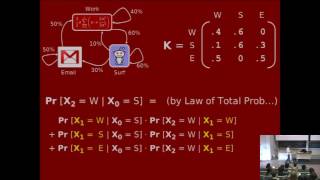
Random Walks
Explore random walks and Markov chains, covering key concepts, theorems, and real-world applications like PageRank. Gain insights into probability theory and graph algorithms.