
Measurement Uncertainty in Physics
Explore measurement uncertainty in physics, focusing on experimental techniques, error analysis, and data interpretation to enhance research skills and scientific accuracy.
The Grapheme-Valued Wright-Fisher Diffusion With Mutation by Anita Winter
Explore grapheme-valued Wright-Fisher diffusion with mutation in population genetics. Gain insights into mathematical models for genetic variation and evolutionary processes.

Role of AI in Tackling Climate Change - How Uncertain is Future Sea Level Rise
Explore AI's potential in addressing climate change, focusing on predicting sea level rise uncertainties, with insights from a leading expert in the field.
Inhomogeneous Multispecies t-PushTASEP and Macdonald Polynomials
Explore connections between inhomogeneous multispecies t-PushTASEP's stationary distribution and Macdonald polynomials at q=1 in this advanced mathematics lecture by Harvard's Lauren Williams.

The Inhomogeneous Multispecies PushTASEP
Explore multispecies PushTASEP variants, stationary distributions, and symmetry properties. Discover explicit formulas for correlations using Schur functions in this advanced mathematical presentation.
Compact Formula for Symmetric Macdonald Polynomials via ASEP and TAZRP
Explore connections between particle models and Macdonald polynomials, unveiling a new compact tableau formula with applications in probability and integrable systems.
Is It Dark Matter, or Is Spacetime Undergoing a Random Walk?
Explore a theory combining classical and quantum systems, applying it to general relativity to explain galactic rotation curves without dark matter through stochastic spacetime processes.
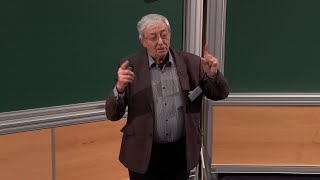
Geometry and Physics of Covalent Network Glasses
Explore the mathematical modeling of glass transition in covalent network glasses, focusing on molecular agglomeration and stochastic processes to predict glass transition temperatures.
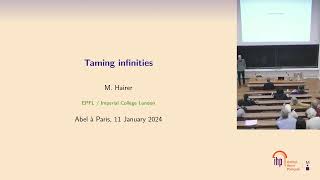
Taming Infinities: Renormalisation Techniques in Physics and Mathematics
Explorez les techniques de renormalisation pour maîtriser les infinis en physique et mathématiques, avec des applications récentes en théorie des probabilités.
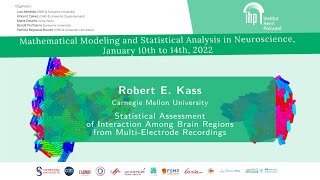
Statistical Assessment of Interaction Among Brain Regions from Multi-Electrode Recordings
Explore statistical methods for assessing brain region interactions using multi-electrode recordings, enhancing understanding of neural connectivity and communication.
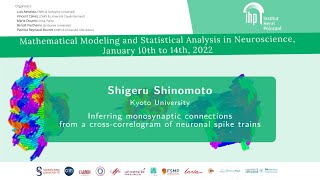
Inferring Monosynaptic Connections from Cross-Correlograms of Neuronal Spike Trains
Explore techniques for inferring monosynaptic connections from neuronal spike train cross-correlograms, enhancing understanding of neural network structures.

Transition from Fractional Diffusion to Normal Diffusion in Kinetic Models
Explore the transition between fractional and normal diffusion in kinetic models, examining mathematical principles and applications in complex systems.
Range Dynamics for a Spatially Structured Asexual Population
Explore range dynamics of spatially structured populations, considering spatial propagation and evolutionary dynamics in heterogeneous environments.
Ancestors' Genetic Weights in Biparental Populations
Explore genetic composition in biparental populations using a Moran model. Analyze ancestral genome proportions and their convergence as population size increases.
Filling the Gap Between Individual-Based Evolutionary Models and Hamilton-Jacobi Equations
Explore Hamilton-Jacobi equations in quantitative genetics, bridging stochastic individual-based models and phenotypic density analysis through asymptotic derivations and population dynamics.
A Multiple Time Renewal Equation for Neural Assemblies with Elapsed Time Model
Explore neural assemblies through a multiple time renewal equation, focusing on the elapsed time model and its implications for understanding brain dynamics.
Fokker-Planck Equations of Neuron Networks: Understanding Time Periodic Solutions
Explore Fokker-Planck equations in neuron networks, focusing on time periodic solutions and their implications for neural dynamics.
Noise-Driven Bifurcations in Neural Field Systems Modeling Grid Cell Networks
Explore noise-driven bifurcations in neural field systems, focusing on grid cell network modeling and their implications for spatial navigation.
Propagation of Chaos and Poisson Hypothesis for Replica Mean-Field Models
Explore propagation of chaos and Poisson hypothesis in replica mean-field models, delving into advanced statistical physics concepts.
Time Averages of a Metastable System of Spiking Neurons
Explore metastable systems of spiking neurons and their time averages in this concise neuroscience lecture by Morgan André.
Spontaneous Oscillations in Pure Excitatory Mean Field Networks of Neurons
Explore spontaneous oscillations in excitatory neural networks through mean field analysis, uncovering insights into complex neuronal dynamics.