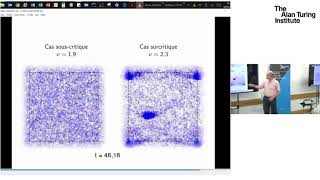
From Micro to Macro in Collective Dynamics
Explore methods for modeling collective dynamics, from microscopic to macroscopic scales. Learn techniques for analyzing complex systems in various scientific fields.
Statistical Physics and Learning - Florent Krzakala, Sorbonne Université
Explore the intersection of statistical physics and machine learning, examining algorithmic paradigms, high-dimensional models, and cross-fertilization between statistics and computer science in the era of Big Data.
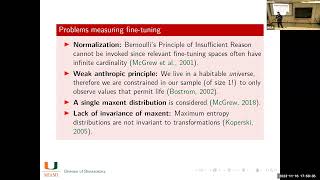
On Some Aspects of Cosmological Fine-Tuning
Explore fine-tuning in cosmology through Bayesian and maximum entropy frameworks. Examine probabilistic measurements, distribution families, and the learnability of fine-tuning concepts.
Learning Battery Physics from Images
Explore advanced techniques for extracting battery physics from synchrotron imaging data, combining electrochemical models with PDE-constrained optimization and Bayesian inference to uncover hidden information.
Genomic Medicine XV: Population Screening - Welcome and Keynotes - Session 1
Explore the current state, barriers, and opportunities of population genomic screening in the U.S., discussing its impact on clinical practice, technologies, costs, and future research directions.
Using Historical Information to Improve Seismic Data Processing Methods I
Explore innovative seismic data processing techniques, including Bayesian methods, machine learning, and waveform cross-correlation, to enhance earthquake monitoring and location accuracy.
Nonlinear and Scaling Processes in the Atmosphere and Ocean at All Scales
Explore cutting-edge research on nonlinear and scaling processes in atmospheric and oceanic systems, covering climate reconstructions, sensitivity, long-range memory, megadroughts, turbulence, and micro-scale phenomena.
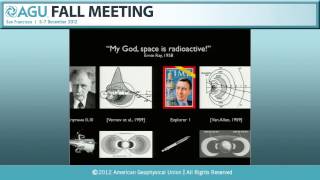
Dynamic Regimes of Space Plasmas - Deterministic or Stochastic? - Lecture 1
Explore statistical and physical aspects of self-organized criticality in solar flares and astrophysical phenomena, and the complexity of radiation belt electron transport at Earth.
Quantum and Classical Probability Distributions - Computational Quantum Mechanics Lecture 10
Explore the transition from quantum to classical mechanics through probability distributions, using computer animations to visualize quantum behaviors in VPython.
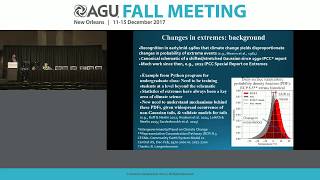
Bolin Lecture: Climate Extremes and Global Change - 2017 Fall Meeting
Explore climate change impacts on extreme weather events, focusing on precipitation patterns and El Niño dynamics. Gain insights into real-time attribution and global warming implications.
Lung Disease and AI Applications - From Cough Sounds to CT Scan by Anurag Agrawal
Explore AI applications in lung disease diagnosis, from analyzing cough sounds to interpreting CT scans. Learn how machine learning enhances detection and treatment of respiratory conditions.
Cause of Obesity, Diabetes & CVD Epidemic by Ponnusamy Saravanan
Explores the role of Gestational Diabetes Mellitus in obesity, diabetes, and cardiovascular disease epidemics, discussing its causes, impacts, and potential interventions.
The Healthy Life Trajectories Initiative - Implementation, Challenges and Future
Exploring the Healthy Life Trajectories Initiative's implementation, challenges, and future prospects, focusing on improving health outcomes through data-driven approaches and collaborative research.
Martin Hairer - Stochastic Quantisation of Yang-Mills
Explores recent progress in constructing a stochastic process with Yang-Mills measure as its invariant measure, focusing on gauge-covariance preservation despite UV regularization breaking.
Nanoscale Quantum Sensing by Jörg Wrachtrup
Explore nanoscale quantum sensing techniques and applications, focusing on precision measurements and quantum metrology advancements for cutting-edge research and technological innovations.
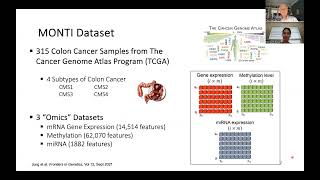
TUSCA: A Method for Tucker3 Modeling with ASCA+ - Webinar
Explore TUSCA, a novel method combining Tucker3 and ASCA+ for analyzing multi-way datasets from designed experiments, enhancing interpretation and visualization of complex data structures.
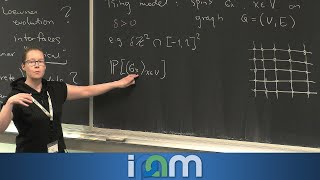
Gaussian Free Field and Schramm-Loewner Evolution - Part 2
Explore Gaussian free field and Schramm-Loewner Evolution in random geometry. Discover connections between these canonical objects and their applications in statistical physics and conformal field theory.
Gaussian Free Field and Schramm-Loewner Evolution - Part 1
Explore the Gaussian free field and Schramm-Loewner Evolution, two key concepts in random geometry. Learn their applications in statistical physics and connections to critical phenomena.
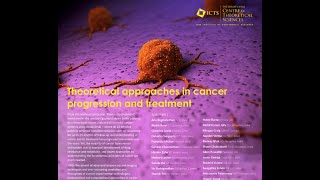
Chance and Necessity: Decision Making in Single Cancer Cells - Lecture 2
Explore decision-making processes in individual cancer cells, examining the interplay between randomness and determinism in cellular behavior and its implications for cancer progression.
Sums of GUE Matrices and Concentration of Hives from Correlation Decay of Eigengaps
Explore the concentration of augmented hives in sums of random Hermitian matrices, using GUE ensemble eigenvalues and analyzing asymptotic behavior as eigenvalue count increases.
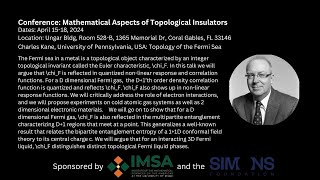
Topology of the Fermi Sea
Explore the Fermi sea's topology, its quantized responses, and correlation functions. Discover how topological invariants manifest in entanglement and distinguish Fermi liquid phases.