Literate Statistical Programming for Reproducible Data Science
Learn a reproducible, auditable workflow for data science projects using Literate Statistical Programming principles, tools, and techniques for improved experimentation and iteration.

Detecting Power Laws in Real-world Data with Python Code
Learn to detect power laws in real-world data using Python, covering log-log and maximum likelihood approaches with practical examples using artificial and social media datasets.
Verifiable Data Science via Interactive Proofs
Explore interactive proofs for verifiable data science, enhancing trust and reliability in scientific computations and analyses.

Excel Tips and Tricks - 10 Time-Saving Tutorials for Beginners and Intermediate Users
Learn 10 time-saving Excel techniques, from inserting hyperlinks to creating gauge charts. Enhance productivity with step-by-step tutorials suitable for beginners and intermediate users alike.

Microsoft Excel 365 Intermediate Training - 4-Hour Tutorial
Enhance spreadsheet skills with advanced functions, data validation, lookups, sorting, and formatting. Master logical operations, statistical analysis, and efficient data organization techniques.

Exploring Datasets with Python and Pandas
Explore datasets using Python and pandas. Learn essential data analysis techniques for scientists, engineers, and analysts working with diverse datasets.
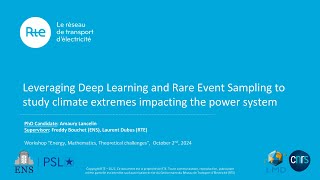
Leveraging Deep Learning and Rare Event Sampling to Study Climate Extremes Impacting the Power System
Explore deep learning and rare event sampling techniques for analyzing climate extremes' impact on power systems.
Descriptive Statistics Concept and With R
Learn descriptive statistics techniques and their implementation in R, covering data summarization, visualization, and basic measures to effectively analyze and present research findings.
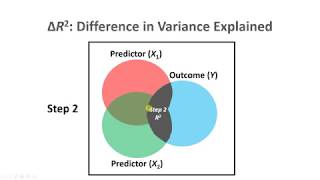
Conceptual Overviews of Statistical and Data-Analytic Tools and Techniques
Explore key statistical and data analysis methods, from hierarchical regression to survival analysis, with conceptual overviews of advanced techniques and tools.
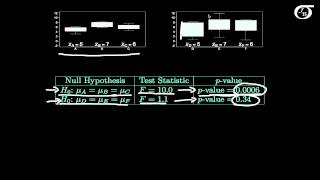
One-Way ANOVA - Analysis of Variance
Learn to perform and interpret one-way ANOVA, including formulas, examples, confidence intervals, and p-value calculations for comparing multiple group means.
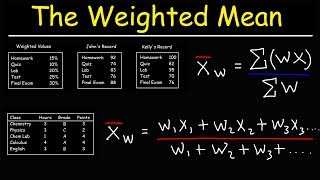
How to Find the Weighted Mean and Weighted Average in Statistics
Learn to calculate weighted means and averages in various scenarios, from test scores to GPAs and mixture concentrations, with clear explanations and practical examples.
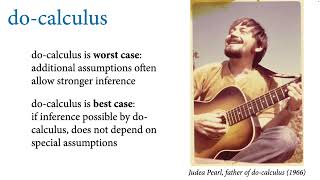
Statistical Rethinking 2023 - Good & Bad Controls
Explore causal inference, do-calculus, and the backdoor criterion. Learn to distinguish good and bad controls in statistical analysis, with insights on the Table 2 Fallacy.
Statistical Rethinking 2022 - Missing Data
Explore Bayesian imputation techniques for handling missing data, including DAG analysis, conceptual understanding, and practical implementation using Stan.

Statistical Rethinking 2022 - Multi-Multilevel Models
Explore advanced statistical concepts including multiple cluster types, multilevel predictions, and non-centered priors in this comprehensive lecture on multi-multilevel models.
Statistical Rethinking 2022 - Counts & Confounds
Explore statistical rethinking with focus on counts and confounds. Learn about confounded admissions, sensitivity analysis, proxies, factors, and Poisson GLMs in this comprehensive lecture.
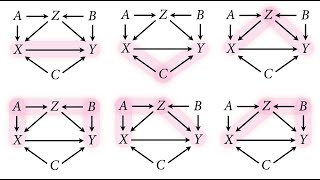
Statistical Rethinking 2022 - Good & Bad Controls
Explore causal inference through DAGs, backdoor criterion, and control variables. Learn to identify good and bad controls for accurate statistical analysis and avoid common pitfalls.

Statistical Rethinking 2022 - Elemental Confounds
Explore key concepts in statistical analysis: forks, pipes, colliders, and unobserved confounds. Learn to identify and address elemental confounds for more robust research designs.
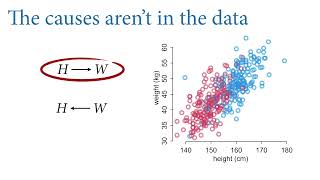
Statistical Rethinking 2022 - Categories, Curves & Splines
Explore statistical concepts like categorical variables, contrasts, and splines. Learn Bayesian causal inference and polynomial models for advanced data analysis and modeling techniques.
Mathematical and Statistical Modelling in the Fight to Control Tuberculosis by Emma McBryde
Exploring mathematical models to combat tuberculosis, from basic concepts to advanced simulations. Insights on disease dynamics, latency, mortality, and regional applications in the Asia Pacific.
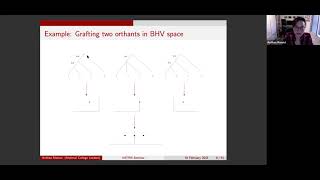
Tropical Geometry of Phylogenetic Tree Spaces
Explore tropical geometry's application to phylogenetic tree spaces, examining BHV space, tropical Grassmannians, and their implications for computational biology and statistics.
Order and Patterns in Randomness by Abhishek Dhar
Explore hidden patterns in seemingly random events through examples of Random Walk, Brownian Motion, Statistical Physics, and a card trick. Gain insights into physicists' and mathematicians' approaches.