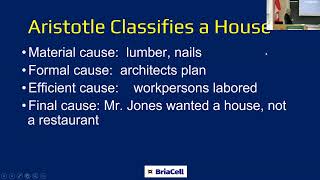
Determining Causation in Immunotherapy
Explore methods for determining causation in immunotherapy, focusing on analytical techniques and challenges in evaluating treatment effectiveness.
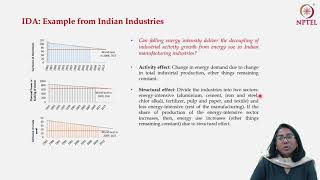
Energy Demand - Part I: Decomposition Analysis and Parametric Approach
Explore decomposition analysis and parametric approaches for understanding energy demand, gaining insights into key factors influencing consumption patterns and forecasting methods.
Dynamic Panel Data Model: Lag Sensitivity and STATA Application - Part 16
Explore lag sensitivity in Dynamic Panel Data models and apply DPD techniques using STATA for advanced econometric analysis.
Multinomial Regression Model: Logit and Conditional Logit Models - Part 4
Explore multinomial regression models, including logit and conditional logit, to analyze choice-specific data and interpret relative probabilities in econometric contexts.
Multinomial Regression Model - Part III: Empirical Estimation and STATA Application
Explore empirical estimation of bi-variate logit and its STATA application in multinomial regression models, enhancing statistical analysis skills.
Qualitative Response Models: Introduction to Logit Model - Part I
Explore qualitative response models, focusing on logit models and their applications in analyzing car ownership patterns.
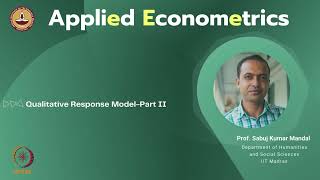
Qualitative Response Models: Logit and Types - Part II
Explore types of qualitative response models, focusing on logit models and their applications in statistical analysis.
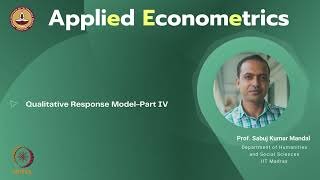
Qualitative Response Models: Logit and Probit - Part IV
Explore logit and probit models as examples of qualitative response models, gaining insights into their applications and interpretations.
Panel Data Model Estimation - Part VII
Explore panel data estimation techniques, focusing on fixed effects and random effects models for comprehensive econometric analysis.
Qualitative Response Models: Logit and Probit - Part III
Explore logit, probit, and qualitative response models for analyzing categorical data and predicting discrete outcomes.
Pooled Data and Panel Data Model Estimation - Part II
Explore pooled data characteristics, OLS models, and STATA implementation for advanced statistical analysis and econometric modeling.
Generating Synthetic Tabular Data that is Differentially Private
Explore approaches to applying differential privacy in generating synthetic tabular data, including measuring low-dimensional distributions and learning graphical model representations for enhanced data privacy.

Predicting Events Using Large Language Models - A Practical Guide to AI Forecasting
Explore practical techniques for event prediction using large language models, from basic forecasting methods to advanced strategies, with hands-on demonstrations and research insights.
Business Intelligence Solutions: How to Use Data to Deliver Business Insights
Discover essential strategies for becoming a successful Business Intelligence Engineer, from mastering technical skills to delivering impactful data insights that drive organizational decision-making.
How to Run A-B Tests as a Data Scientist
Explore Bayesian A/B testing for data scientists, comparing it with frequentist methods using real data and code. Learn to define experiments, process data, and interpret results effectively.
Data Science and Data System - Dr. Amy Braveman, NASA Jet Propulsion Laboratory
Explore NASA's Earth observation data systems, statistical challenges in climate science, and innovative approaches to analyzing complex environmental datasets.
Black Scientists - Past, Present and Future
Panel discussion exploring diversity in science, focusing on Black scientists' contributions, challenges, and the impact of representation on research and society.
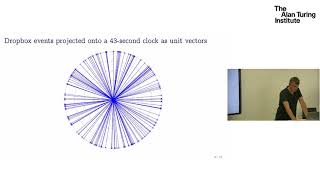
Statistics in Cyber-Security - Dr Nick Heard, Imperial College London
Explore statistical approaches for cyber-security, from micro-level models to full network graph representations, to identify illegitimate network activity using enterprise data sources.
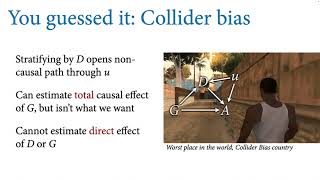
Statistical Rethinking 2023 - Counts & Hidden Confounds
Explore hidden confounds in statistical analysis, sensitivity analysis, and poison counts. Learn about Simpson's paradox and its implications for data interpretation.

Statistical Rethinking - Social Networks
Explore statistical approaches to analyzing social networks, including reciprocal ties, generalized giving, and household features. Learn techniques for modeling complex social structures.
Advanced SQL for Data Scientists
Master essential SQL skills for data science: statistics, data prep, advanced filtering, window functions, and analytics tool integration.