Flambda 2 Types: An Abstract Domain for Static Analysis of Functional Programs
Explore Flambda 2 Types, an abstract domain for static analysis of OCaml programs, focusing on its role in optimizing functional code.

Getting into the Flow: Towards Better Type Error Messages for Constraint-Based Type Inference
Explore innovative approaches to improve type error messages in constraint-based type inference systems, focusing on data flow and subtyping constraints to enhance programmer understanding.
Lifting On-Demand Analysis to Higher-Order Languages
Explore an innovative approach to on-demand analysis for higher-order languages, focusing on precise call graph construction and scalable bug detection in complex code bases.
Relational Solver for Java Generics Type System
Explore a relational solver for Java Generics Type System, enhancing understanding of advanced programming concepts and type theory.

CodeProber: Live Compiler Exploration - LIVE23
Explore interactive compiler debugging with CodeProber. Learn to identify and fix bugs in language tooling using source code-based exploration of AST properties.

Degrees of Separation: A Flexible Type System for Data Race Prevention
Explore a flexible type system for data race prevention in parallel programming, allowing aliasing while controlling it to prevent data races. Implemented as a Scala 3 compiler extension.

Is Peter Correct or Incorrect? - O'HearnFest Lecture
Explore Patrick Cousot's analysis of Peter O'Hearn's work in program verification and reasoning, examining correctness and potential inaccuracies in his theories.

Bi-abductive Adversarial Program Synthesis
Explore bi-abductive adversarial program synthesis techniques in this advanced computer science talk by Julien Vanegue.

Working with Peter O'Hearn in Academia and Industry
Explore Mark Harman's experiences collaborating with Peter O'Hearn across academic and industrial settings, gaining insights into their influential work.
Monotonicity and the Precision of Program Analysis
Explore the connection between program monotonicity and analysis precision. Learn how monotone behavior enables complete abstract interpretation for numeric invariant inference.
Automatic Parallelism Management - POPL 2024
Explore techniques for automatic parallelism management in high-level languages, combining static and runtime approaches to optimize performance without manual tuning.
Control-Flow Tracking and Misuse Detection for Non-local Jumps in C
Explore an approach for analyzing setjmp/longjmp in C, enhancing static analyzers to detect misuse and support non-local control flow through side-effecting transfer functions.
Misconceptions About Loops in C - Challenges in Loop Analysis for Static Analysis Tools
Explore rare edge cases and challenges in loop analysis for C programming, enhancing understanding of static analysis tools and improving software verification techniques.
Interleaving Static Analysis and LLM Prompting for Error-Specification Inference
Explore a novel approach combining static program analysis with LLM queries to enhance error-specification inference in C systems code, improving recall and F1-score while maintaining precision.

Typing with Pixie Dust - Enhancing Legacy Code with Automated Type Specs
Discover tools for enhancing legacy code with automatic type specifications, improving code reliability and maintainability through a Rebar3 plugin and TypEr enhancements.
Refactoring Made Easy - Tools and Techniques for Erlang Code
Discover tools and techniques for efficient Erlang code refactoring, combining codemods with diagnostics and quick fixes to improve maintainability at scale.
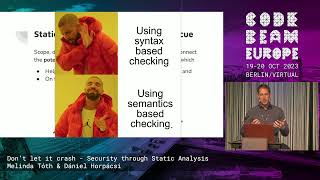
Security Through Static Analysis - Don't Let It Crash
Explore static analysis techniques for detecting and mitigating security vulnerabilities in Erlang/Elixir projects, focusing on data-flow analysis and real-world examples from open-source codebases.

Bridging the Security Tool Gap for Go
Explore automated security fixing for Go, focusing on ICR's precision tools that address vulnerabilities efficiently and save development time.
Deadcode - A Tool to Find and Fix Unused Python Code
Discover a powerful tool for identifying and eliminating unused Python code, enhancing codebase efficiency, reducing technical debt, and improving security.
Syntax Tree: A Toolkit for Interacting with Ruby Parse Trees
Explore Syntax Tree, a powerful toolkit for analyzing and manipulating Ruby code, and discover its potential applications and future possibilities.
Writing Allocation-Free Julia Code with AllocCheck.jl - JuliaCon 2024
Optimize Julia code performance with AllocCheck.jl. Learn to identify and eliminate allocations, write efficient code for embedded systems, and leverage static analysis for safer, faster Julia applications.