Introductory Astronomy - Star Formation and the Lifetimes of Stars
Explore the fascinating process of star formation and discover how long stars live in their main hydrogen-fusing phase in this concise astronomy lecture.
Prediction and Assignment of Spectra from Strongly Magnetized
Explore spectral prediction and assignment techniques for strongly magnetized systems, focusing on white dwarf stars and their astrophysical implications in galactic population studies.
Surviving Runaway Stellar Remnants from Thermonuclear Supernovae - Roberto Raddi
Explore surviving stellar remnants from thermonuclear supernovae with Roberto Raddi. Discover astrometric, photometric, and spectroscopic insights into white dwarfs and their role in understanding galactic evolution.
A Road-Map to White Dwarf Pollution - Marc Brouwers
Explore white dwarf pollution through astrometric, photometric, and spectroscopic data. Gain insights into stellar remnants and their role in probing various astrophysical phenomena.
Moment of Birth - How Infant-Phase Signals from SN2018aoz Inform
Explore how infant-phase signals from supernova SN2018aoz provide insights into white dwarf physics and stellar evolution, presented by Yuan Qi Ni from the University of Toronto.
Observations of Thermonuclear Supernovae - Kate Maguire
Explore thermonuclear supernovae observations with Kate Maguire, covering astrometric, photometric, and spectroscopic data from all-sky surveys to gain insights into white dwarf populations and their astrophysical implications.
Type Ia Supernova Progenitors - Ruediger Pakmor
Explore Type Ia supernova progenitors with Ruediger Pakmor, focusing on white dwarf physics, stellar evolution, and their role in galactic populations and gravitational wave sources.
Towards a Volume-Limited All-Sky Sample of Extremely Low-Mass White Dwarfs - Ingrid Pelisoli
Explore the latest research on extremely low-mass white dwarfs using all-sky surveys, focusing on their significance in astrophysics and potential for new scientific discoveries.
A Unified Model for the Evolution of Cataclysmic Variables - Arnab Sarkar
Explores a unified model for cataclysmic variable evolution, discussing recent observational data and theoretical developments in white dwarf physics to advance our understanding of these stellar remnants.
Magnetic Braking in Binaries Containing White Dwarfs - Kareem El-Badry
Explore magnetic braking in white dwarf binary systems with insights from astrometric, photometric, and spectroscopic surveys, revealing implications for stellar evolution and gravitational wave sources.
Stellar Autopsies from White Dwarf Pulsations - JJ Hermes
Explore white dwarf pulsations as a tool for stellar autopsies, uncovering insights into stellar evolution, Galactic history, and fundamental physics through cutting-edge observational and theoretical approaches.

White Dwarf Sedimentation and Phase Separation - Status
Explore white dwarf sedimentation and phase separation with expert Evan Bauer, discussing current research status and implications for stellar evolution and galactic history.
Fractionation Processes in Crystallizing White Dwarfs - Simon Blouin
Explore fractionation processes in crystallizing white dwarfs, examining their impact on stellar evolution and composition. Gain insights into cutting-edge research in astrophysics and stellar remnants.
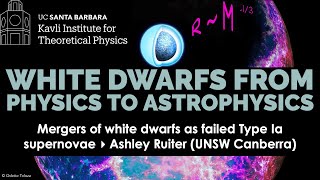
Mergers of White Dwarfs as Failed Type Ia Supernovae - Ashley Ruiter
Explore white dwarf mergers as potential failed Type Ia supernovae, examining their characteristics and implications for stellar evolution and galactic populations.

Massive Stars and Supernovae – With Thomas Haworth
Explore the formation, life, and explosive death of massive stars, their impact on galaxies, and recent discoveries in planetary science through engaging demonstrations and simulations.
Revealing the Cosmos - A Startling New View from the James Webb Space Telescope
Explore the latest findings from the James Webb Space Telescope with Nobel Laureate John Mather and leading astronomers, discussing new clues about star and galaxy formation, and emerging cosmic mysteries.
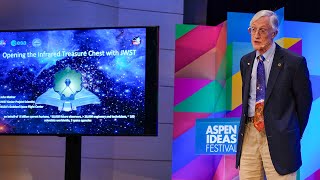
Opening the Infrared Treasure Chest - Images from the James Webb Space Telescope
Explore groundbreaking discoveries from the James Webb Space Telescope, revealing cosmic history from the Big Bang to present-day star formation, with unexpected findings that challenge NASA's predictions.
Secrets Revealed by the Webb Telescope - Looking at Ourselves from the Beginning of Time
Explore the universe's origins with the James Webb Space Telescope. Dr. Bullock discusses its groundbreaking capabilities to observe early stars, galaxies, and nearby planet formation, offering unique insights into our cosmic history.
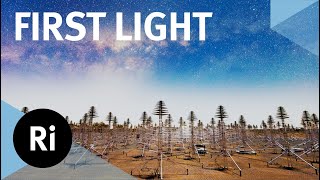
The First Billion Years of the Universe
Explore the early Universe's mysteries, from the Big Bang to the first stars. Learn about unusual cosmic phenomena and their impact on our understanding of the Universe today.
Munching Black Holes as Beacons to Our Place in the Cosmos
Explore the mysteries of black holes and their role in understanding our cosmic place with astrophysicist Prajval Shastri, who simplifies complex space concepts and inspires curiosity about the universe.
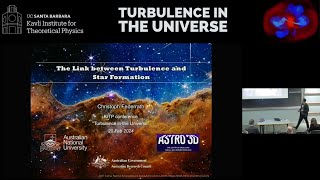
The Link Between Turbulence and Star Formation - Christoph Federrath
Explores the crucial relationship between turbulence and star formation in astrophysical environments, discussing recent advances in observational and theoretical studies across various cosmic scales.