Prompt Engineering - Steps Towards AI Native Tooling
Explore the evolving landscape of AI-native tooling through prompt engineering, from code generation to creative applications, while understanding its impact on the future of technology and development.
QLoRA - How to Fine-tune an LLM on a Single GPU with Python Code
Learn to fine-tune large language models on a single GPU using QLoRA. Explore quantization techniques, LoRA, and practical implementation with Python code for custom YouTube comment responses.
Generative AI for Product Builders
Explore generative AI's potential to enhance products, accelerate workflows, and unlock creativity. Learn about technical challenges and solutions in building AI-powered products.
Fine-Tuning LLMs: Best Practices and When to Go Small - Lecture 124
Explore best practices for fine-tuning LLMs, including strategies for improving performance, overcoming challenges, and determining when to use smaller models for specific tasks.
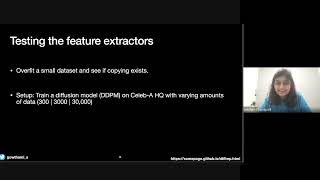
Understanding and Mitigating Copying in Diffusion Models
Explore frameworks for detecting replication in diffusion models, identify memorization factors, and learn techniques to reduce data replication during training and inference.
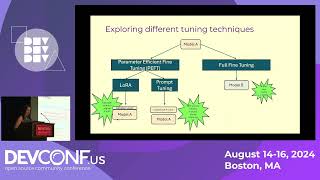
Creating Your Own LLM Tuning Platform with Open Source Technologies
Explore open-source LLM tuning techniques using FMS HF Tuning. Learn architectural integration, various tuning methods, and deployment on Open Data Hub for enhanced AI solutions.
Fine-tuning LLMs Without Maxing Out Your GPU - LoRA for Parameter-Efficient Training
Discover parameter-efficient fine-tuning of large language models using LoRA. Learn to classify consumer finance complaints with RoBERTa on Google Colab's V100 GPU.
Fine-tuning Optimizations - DoRA, NEFT, LoRA+, and Unsloth
Explore advanced fine-tuning techniques like DoRA, NEFT, LoRA+, and Unsloth to optimize language models. Learn implementation, comparisons, and practical applications through code examples and demonstrations.
Full Fine-Tuning vs LoRA and QLoRA - Comparison and Best Practices
Explore full fine-tuning vs (Q)LoRA techniques, comparing VRAM usage, training time, and quality. Learn parameter selection, tips for QLoRA, and step-by-step guidance for TinyLlama and Mistral 7B fine-tuning.
Very Few Parameter Fine-Tuning with ReFT and LoRA
Explore advanced fine-tuning techniques ReFT and LoRA for efficient parameter optimization in transformer models. Learn implementation, comparison, and practical tips for improved model performance.
Fine-tuning Llama 3 on Wikipedia Datasets for Low-Resource Languages
Learn to fine-tune Llama 3 on Wikipedia datasets for low-resource languages. Master dataset creation, LoRA setup, blending techniques, and parameter optimization for improved language model performance.
Fine-Tuning a Diffusion Model with Your Photos
Learn to fine-tune a diffusion model using your own photos. Explore Flux Schnell, set up GPU environments, create datasets, and understand the intricacies of diffusion models and their architectures.
Understanding the Landscape of Latest Large ML Models
Explore the evolving landscape of large ML models, from ChatGPT to open-source projects. Learn how teams use W&B to accelerate development and stay ahead in the rapidly advancing field of AI.
Training LoRA with SimpleTuner and AI-Toolkit for FLUX.1 - Art Style and Concept Development
Comprehensive guide on training LoRA models for FLUX.1 [dev], covering techniques, experiments, and analysis for art style and concept generation in Stable Diffusion.
Create GUI App with Stable Diffusion, Docker, and Flask - Beginner Friendly
Learn to build a text-to-image AI app using Stable Diffusion, Docker, and Flask. Create high-res images from text prompts, explore Docker Init, CUDA, FreeU, and more in this beginner-friendly Python tutorial.
Fine-Tuning Large Language Models with Limited Resources - NeurIPS Hacker Cup AI
Strategies for fine-tuning large language models with limited resources: memory optimization, gradient accumulation, activation checkpointing, LoRa, and dataset quality. Practical advice for 40 GB VRAM GPU constraints.
Stable Diffusion 3 2B Medium Training with Kohya and SimpleTuner - Full Finetune and LoRA
Comprehensive guide on training Stable Diffusion 3 for art styles using kohya and SimpleTuner, covering setup, parameters, experiments, and result analysis for both full finetune and LoRA approaches.
Full Fine-tuning LLMs with Lower VRAM: Optimizers, GaLore, and Advanced Techniques
Explore advanced techniques for full fine-tuning LLMs with limited GPU resources, including optimizer tricks, Galore, and Adafactor. Enhance model performance and efficiency.
Custom RAG Pipelines and LLM Fine-Tuning - A Gradient Tutorial
Explore custom RAG pipelines and LLM fine-tuning using Gradient. Learn to deploy fine-tuned models, mimic Yoda's speech style, and efficiently fine-tune 13B parameter open-source models for unique applications.
LoRA Fine-tuning Explained - Choosing Parameters and Optimizations
Explore LoRA fine-tuning techniques, from parameter selection to optimization strategies, enhancing your ability to customize language models effectively.
Multi-GPU Fine-tuning with DDP and FSDP
Master multi-GPU fine-tuning techniques using DDP and FSDP. Explore VRAM optimization, distributed training strategies, and practical implementation with code examples and demos.