
Bubble Sort - Theory and Optimised Code - Best-Worst Case Complexity
Comprehensive guide to Bubble Sort algorithm: theory, implementation, optimization, and complexity analysis. Includes code examples and practical use cases.

Time and Space Complexity - How to Avoid Time Limit Exceeded
Learn time and space complexity concepts to optimize code performance and avoid time limit exceeded errors. Includes practical examples and problem-solving techniques.

Linked List Questions - Reverse in K Group and Check if Circular
Learn to reverse linked lists in K groups and check for circular lists. Gain practical coding skills with step-by-step explanations, algorithms, and complexity analysis for these important data structure operations.

Time and Space Complexity of Recursive Algorithms - C++ Placement Course
Comprehensive guide to analyzing time and space complexities of recursive algorithms in C++, with practical examples and homework assignments for reinforced learning.

Quick Sort Using Recursion - Day-6 - 10 Day Recursion Challenge
Learn QuickSort algorithm implementation using recursion, including partition logic, code walkthrough, dry run, and time/space complexity analysis.
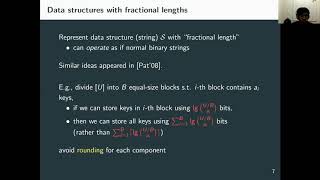
Nearly Optimal Static Las Vegas Succinct Dictionary
Explore advanced data structures for efficient dictionary operations, focusing on succinct representations and optimizing space usage for various input types.
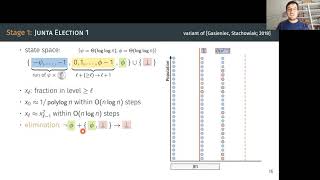
Optimal Time and Space Leader Election in Population Protocols
Explores optimal time and space complexity for leader election in population protocols, presenting a novel algorithm achieving O(n log n) interactions with Θ(log log n) states per agent.
Undergrad Complexity at CMU - Savitch's Theorem and NL
Explore Savitch's Theorem and NL in computational complexity theory, focusing on space complexity, recursion, and pseudocode implementation for advanced undergraduate-level understanding.

Hierarchy Theorems - Time, Space, and Nondeterministic: Graduate Complexity Lecture at CMU
Explore hierarchy theorems in computational complexity, covering time, space, and nondeterministic aspects. Gain insights into encoding schemes, Turing machines, and nondeterministic certificates.
Error Correction for Streaming Messages
Explores error-resilient encoding for streaming data, enabling accurate sketch computation despite message corruption while maintaining efficiency in communication and space complexity.
Streaming Lower Bounds for the Needle Problems
Exploring tight lower bounds for frequency estimation in random order data streams, focusing on the needle problem and its implications for streaming algorithm design.
Pseudorandom Hashing for Space-Bounded Computation with Applications in Streaming
Explores a new pseudorandom generator for space-bounded computation, improving update time in streaming algorithms without sacrificing space. Applications in Fp estimation and CountSketch are discussed.
Sketching Algorithms for Max-DICUT and Other CSPs
Explore algorithms for Maximum Directed Cut problem in graph theory, focusing on sketching techniques, space complexity, and applications to Constraint Satisfaction Problems.
An Overview of Data Streams Algorithms
Explore efficient algorithms for processing massive data streams, focusing on space-saving techniques and approximation methods for real-time analysis and decision-making.
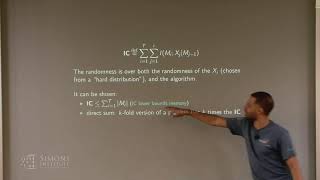
New Upper and Lower Bounds on Approximate Counting
Explores new upper and lower bounds for approximate counting, addressing amortized space complexity and memory optimization in maintaining arrays of approximate counters.
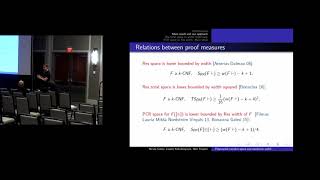
Polynomial Calculus Space and Resolution Width
Explore proof complexity, resolution systems, and space complexity in polynomial calculus, featuring combinatorial characterizations and discussions on total spaces and tight bounds.

Declarative APIs in an Imperative World
Explore integrating imperative APIs with declarative UI frameworks, addressing challenges and solutions in modern web development while considering historical software trends.
Computer Science You Might Not Want to Know
Explore the relevance of Computer Science topics for Rails developers, examining their practical applications and potential limitations in day-to-day work.

Coarser Equivalences for Causal Concurrency
Explore relaxations of trace equivalence in concurrent programs, focusing on grain equivalence for efficient causal concurrency analysis while maintaining algorithmic advantages.
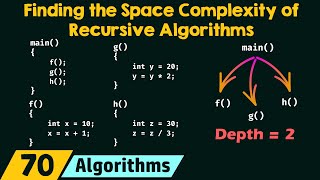
Finding the Space Complexity of Recursive Algorithms
Learn to analyze space complexity of recursive algorithms, focusing on function calls, activation records, and practical applications in algorithm design.
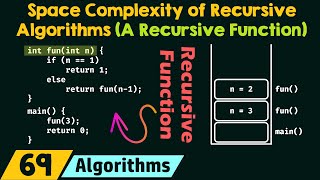
Space Complexity of Recursive Algorithms - A Recursive Function
Explore space complexity in recursive algorithms, focusing on direct and indirect recursion, and the role of call stacks in recursive functions.