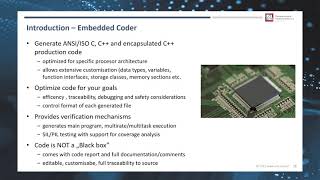
Automating Code Generation for Embedded Systems
Explore automated code generation for embedded systems, transforming high-level algorithms into optimized C/C++ code. Learn about enhancing efficiency, ensuring traceability, and meeting safety standards in software development.
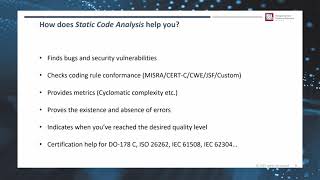
Implementing Innovations in a Safe and Secure Way
Explore automated static code analysis for software safety and security. Learn to prove absence of runtime errors using formal methods and tools like Polyspace for exhaustive testing.

Static Code Analysis in Software Development Process
Explore static code analysis integration in DevOps workflows, code reviews, and verification pipelines to enhance software quality and streamline development processes.

Stop Writing Test Doubles You Are Using
Discover strategies to eliminate unnecessary test doubles, improving code quality and maintainability. Learn practical techniques for more effective and efficient unit testing.
How We Switched to C++11 at SolidFire and How It Worked Out
Explore SolidFire's transition from C++03 to C++11, including team motivation, testing strategies, and new coding possibilities. Gain insights on overcoming challenges and leveraging modern C++ features.
Production Use of Boost.Test
Explore advanced Boost.Test usage in production, including execution monitoring, floating point exception handling, in-place unit testing, and integrating test tools into components.
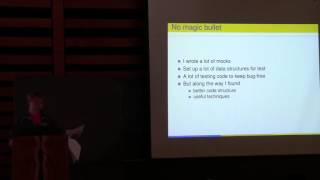
Testing Battle.net - Before Deploying to Millions of Players
Explore designing testable components in distributed systems, focusing on Battle.net's development. Learn practical strategies for structuring classes, ensuring correctness, and evaluating performance without full-scale deployment.
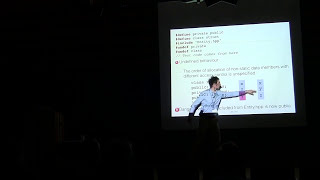
Friendship in Service of Testing
Explores challenges in unit testing object-oriented code, discussing dependency injection, access to private dependencies, and potential solutions to make testing less intrusive in C++ development.
Exceptional Performance
Explore the impact of exceptions on C++ performance, examining hardware architecture, memory hierarchy, and optimization techniques to understand when exceptions might enhance performance.
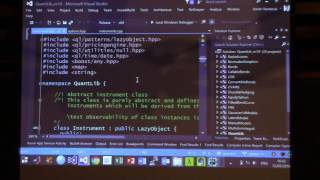
C++ Tool Support - Where We Are and Where We Are Heading
Exploring the evolution and benefits of C++ development tools, from basic editors to advanced IDEs, highlighting features that enhance productivity and code quality.
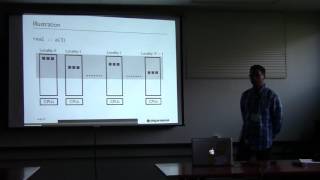
Extending C++ with Co-Array Semantics
Extending C++ with co-array semantics for efficient distributed computing in HPX, enabling SPMD schemes and simplified data transfer between localities in scientific applications.
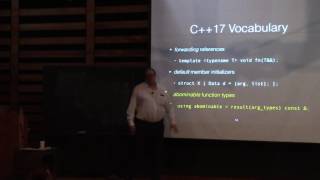
Implementing Tuple in C++17
Explore C++17's impact on std::tuple implementation, including new language features, library changes, and design considerations. Dive into testing and benchmarking scenarios for tuple implementations.
The Design of a New C++ Build Toolchain
Exploring challenges and solutions in cross-platform C++ building, including cross-compilation, in/out-of-source builds, and package management. Discusses design decisions and features of the build2 toolchain and cppget.org repository.
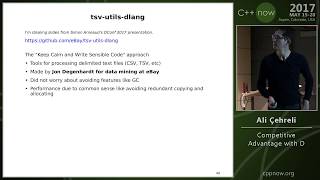
Competitive Advantage with D
Explore D programming language's competitive advantages, focusing on compile-time features, safety, and productivity. Learn how D simplifies systems programming and enhances software engineering.

Effective CMake
Comprehensive guide to CMake, CTest, and CPack, covering best practices for building, testing, and packaging C++ projects, including dependency management and cross-platform development.

Mocking C++
Explore mocking in C++ for efficient unit testing without dependencies. Learn techniques to create mock objects, overcome limitations, and improve test reliability and speed.

Building Useful Tools with LLVM and Clang for Fun and Profit
Explore LLVM and clang libraries for custom C++ tools. Learn AST representation, static analysis, and source-to-source transformations to enhance workflow and productivity.

C++17's std::pmr Comes With a Cost
Explore C++17's std::pmr, its benefits and costs in large codebases. Learn about polymorphic allocators, their impact on move semantics, testing, performance, and when to use them effectively.
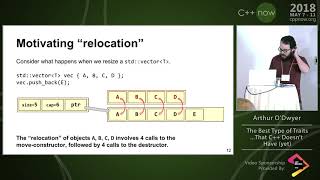
The Best Type Traits that C++ Doesn't Have
Explore advanced C++ type traits for efficient memory operations, comparisons, and optimizations. Gain insights into relocatable objects, equality comparisons, and tombstone traits for improved performance.
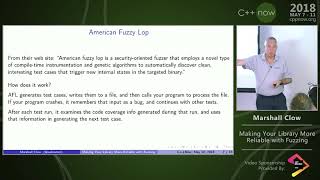
Making Your Library More Reliable with Fuzzing
Explore advanced fuzzing techniques to enhance library reliability, with insights on tools, guided fuzzing, and real-world examples from libc++ and Boost.Algorithm.
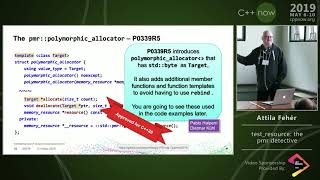
Test Resource - The PMR Detective
Explore pmr::test_resource for detecting memory allocation bugs in C++. Learn to diagnose and fix issues like leaks, overruns, and exception-safety failures using real-world examples.