AI Deployment: Mastering LLMs with KFServing in Kubernetes
Unlock LLM deployment in Kubernetes with KFServing. Learn integration, best practices, and optimization for efficient AI model serving in cloud-native environments.

Revolutionizing Scientific Simulations with Argo Workflows
Explore how Argo Workflows revolutionizes scientific simulations, enhancing productivity and scalability. Learn best practices for managing complex workflows, optimizing performance, and integrating with HPC systems.
Effortless Scalability: Orchestrating Large Language Model Inference with Kubernetes
Explore automated deployment of large language models on Kubernetes, leveraging CRDs for seamless management and optimizing GPU utilization through preset configurations and auto-provisioning.

XRegistry - Looking Beyond CloudEvents
Explore xRegistry's role in enhancing CloudEvents for distributed systems, enabling efficient resource discovery, metadata querying, and automation in event-driven architectures.
Leveraging Wasm for Portable AI Inference Across GPUs, CPUs, OS and Cloud-Native Environments
Explore WebAssembly's advantages for AI inference in cloud-native ecosystems, enabling uniform performance across diverse hardware and seamless integration into frameworks for enhanced deployment and scalability.
Harnessing Angular's Momentum - Strategies for Effective Refactoring
Explore strategies for effective Angular refactoring, integrating new features safely while considering their impact and relevance to your codebase. Learn practical techniques for revolutionizing your approach.
Workflow for Developing Multiple Interdependent Packages - JuliaCon 2024
Explore efficient workflows for developing interconnected Julia packages, covering version management, testing, and deployment strategies for large-scale projects and team collaboration.

How to Avoid Designing a Big Ball of Mud - YAGNI Principles
Dave Farley explores evolutionary software design, balancing complexity management with adaptability, and avoiding over-engineering while keeping systems flexible for future changes.
The Ultimate Cloud Platform Team Topology - Scaling Cloud Teams with CDK
Explore effective cloud platform team structures, leveraging Team Topologies and CDK to enhance collaboration, implement guardrails, and streamline serverless development for improved feature delivery.
Improve Your ML Projects - Embrace Reproducibility and Production Readiness with Kedro
Discover how Kedro framework enhances ML project management, focusing on reproducibility, flexibility, and production readiness. Learn to integrate Kedro for improved efficiency in Python-based projects.

Coding with AI: The Beginning of the Personalized Software Era
Explore AI-assisted coding to create personalized software, from setup to advanced features, in this hands-on tutorial for building a customizable study app.

Building Permissions into Data Modeling
Explore a design pattern for integrating complex permissions into data models, enhancing reliability and performance in large-scale applications like social networks.
DRust - Language-Guided Distributed Shared Memory with Fine Granularity and Full Transparency
Explores DRust, a Rust-based distributed shared memory system that leverages language ownership semantics for improved efficiency and scalability in distributed computing environments.

Inductive Invariants for Streamlining Distributed Protocol Proofs
Streamlining distributed protocol proofs using invariant taxonomies. Simplifies finding inductive invariants by categorizing them into Regular and Protocol Invariants, reducing developer effort in proving correctness.

IronSpec - Increasing the Reliability of Formal Specifications
Innovative framework for enhancing formal specification reliability through automated testing, SpecTesting Proofs, and mutation testing. Discovers bugs in real-world verified systems, strengthening software verification.
Using Dynamically Layered Definite Releases for Verifying the RefFS File System
Explore RefFS, a groundbreaking concurrent file system with proven liveness and safety. Learn about dynamically layered definite releases and the MoLi framework for verifying concurrent systems.
Fast and Scalable In-network Lock Management Using Lock Fission
Innovative distributed lock service using programmable switches for improved latency and throughput, supporting millions of locks through lock fission and on-demand migration techniques.
Anvil: Verifying Liveness of Cluster Management Controllers
Innovative framework for verifying liveness in cluster management controllers, ensuring continuous reconciliation to desired states despite failures and asynchrony in cloud environments.
CyberStar - Simple, Elastic and Cost-Effective Network Functions Management in Cloud Networks
Innovative cloud-scale network function service leveraging elastic compute for massive traffic and diverse requests. Achieves 100Gbps bandwidth and scales to millions of connections within seconds.
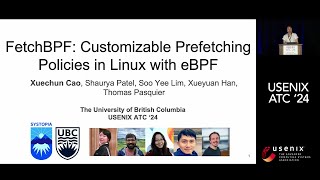
FetchBPF - Customizable Prefetching Policies in Linux with eBPF
Explore FetchBPF, a framework for customizing Linux memory prefetching policies using eBPF, enabling performance optimization without kernel modifications.
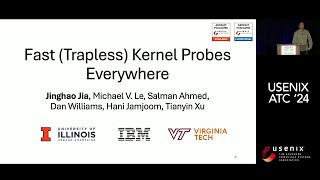
Fast Trapless Kernel Probes Everywhere - USENIX ATC '24
Efficient trapless kernel probing mechanism for Linux, improving performance 10x over standard Kprobe while covering 96% of kernel code. Enhances debugging, security, and monitoring capabilities.